CGD’s research in this area focuses on how rich-country trade policies could be more supportive of poverty reduction and economic growth in developing economies. This work strives to rebuild a foundation for broad support of open trade policies in key developed and emerging markets.
Trade provides important opportunities for developing countries to attract investment, create jobs, and reduce poverty. Rich-country policies that are open to trade are critical in creating these development prospects. Unfortunately, support for open trade policies has eroded in recent years, particularly in the United States.
In addition, CGD’s education, outreach, and coalition-building activities strive to rebuild a foundation for broad support of open trade policies in key developed and emerging markets. Senior Fellow Kimberly Elliott leads this work.
Key areas of research include global trade negotiations at the World Trade Organization, especially on agriculture, the implications of proliferating regional trade agreements for developing countries, the role of labor standards in trade agreements and development, and the need for greater coherence between trade and aid policies, especially in the areas of trade facilitation and capacity-building.
CGD publications on trade include Elliott's Delivering on Doha: Farm Trade and the Poor and her essay “U.S. Trade Policy and Development” (access the brief or download the full chapter) in The White House and the World: A Global Development Agenda for the Next U.S. President.
Reforming Trade Preferences Initiative
One important way that rich countries affect the trade opportunities available to developing countries is through trade preference programs. While many rich countries provide special access for exports from the least-developed countries (LDCs), these trade preferences often do not extend to the products that matter most to LDCs, such as agriculture and clothing. Encouraging preference-giving countries to improve and expand their policies would significantly help developing countries. To effectively contribute to development, trade preferences need to be easy to use, permanent, coordinated with funding for capacity building, and available for products that developing countries commonly export.
To identify effective and feasible reforms, CGD launched theReforming Trade Preference Initiative and organized the Global Trade Preferences Working Group to devise practical policy recommendations for high-income and emerging-market countries to improve and coordinate their trade preference programs to better serve development objectives.
Newest
Popular
Publications
Experts
Initiatives
Multimedia
-
With the Doha Round dead if not buried, the United States has no excuse for not acting on its rhetoric and providing improved market access for all of the world’s least developed countries.
-
Until recently, the World Trade Organization (WTO) has been an effective framework for cooperation because it has continually adapted to changing economic realities. The current Doha Agenda is an aberration because it does not reflect one of the biggest shifts in the international economic and...
-
This paper analyses the case of the International Labour Organization’s Better Factories Cambodia (BFC) project as a transnational instrument to create the institutional space for industrial relations in Cambodia. Based on the principle of social dialogue among the social partners as well as with...
-
The Commitment to Development Index (CDI) ranks 22 of the world’s richest countries on their dedication to policies that benefit the five billion people living in poorer nations. Moving beyond standard comparisons of foreign aid volumes, the CDI quantifies a range of rich country policies that...
-
In this note, CGD fellow Kimberly Ann Elliott discusses how flexible rules of origin can improve trade for the least developed countries.
-
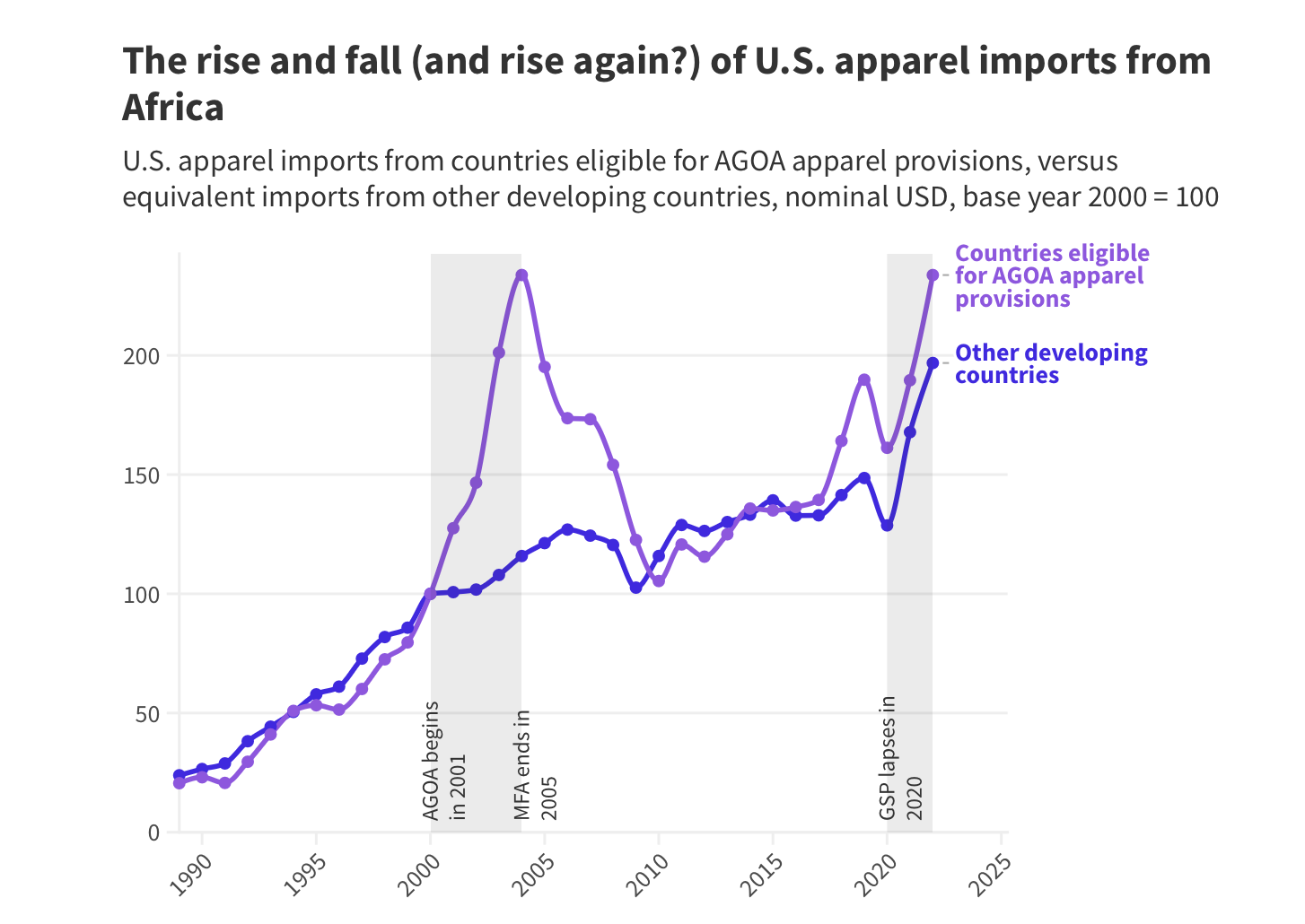
In this brief Kimberly Ann Elliott discusses the two main priorities the Obama administration should focus on in order to revive the AGOA program and expand its benefits.
-
There are 49 countries in the world that the United Nations classifies as Least Developed Countries (LDCs). How does a country wind up on the list, and how is the international community working to help these countries develop? My guest this week is Debapriya Bhattacharya, currently a Special...
-
The United States ranked 17th in the 2009 Commitment to Development Index with strengths in trade and security but weaknesses in aid and environment. This CGD Note describes how the United States could boost its score.
-
Leaders of the world’s largest and richest countries met over the weekend in Ontario, Canada. What did they accomplish? This week on the Wonkcast, I’m joined by two guests: CGD Senior Fellow Liliana Rojas-Suarez and Director of Policy Outreach Sarah Jane Staats. We examine the statements...
-
Cutting tariffs across the board on Pakistani exports would expand economic opportunities and increase stability in Pakistan with vanishingly small effects on U.S. producers.
-
With the Doha Round dead if not buried, the United States has no excuse for not acting on its rhetoric and providing improved market access for all of the world’s least developed countries.
-
Until recently, the World Trade Organization (WTO) has been an effective framework for cooperation because it has continually adapted to changing economic realities. The current Doha Agenda is an aberration because it does not reflect one of the biggest shifts in the international economic and...
-
Director of the Center for Public Leadership at the John F. Kennedy School of Government at Harvard University, editor-at-large at U.S. News & World Report, and a senior political analyst for CNN, David Gergen joined CGD president Nancy Birdsall, and CGD senior fellows who authored essays in our...
-
A Better Globalization: Legitimacy, Governance, and Reform by Kemal Dervis is a reformist manifesto that argues that gradual institutional change can produce beneficial results if it is driven by an ambitious long-term vision and by a determination to continually widen the limits of the possible.
-
The White House and the World: A Global Development Agenda for the Next U.S. President shows how modest changes in U.S. policies could greatly improve the lives of poor people in developing countries, thus fostering greater stability, security, and prosperity globally and at home. Center for Global...
-
Development refers to improvements in the conditions of people’s lives, such as health, education, and income. It occurs at different rates in different countries. The U.S. underwent its own version of development since the time it became an independent nation in 1776.
Learn more about Rich...
-
The CGD Working Group on Global Trade Preference Reform shows how changes to trade preference programs could greatly benefit those living in the poorest countires at very little cost to preference-giving countries.
-
Agricultural market liberalization is the linchpin for a successful conclusion to the Doha Round of World Trade Organization (WTO) negotiations because these are the most protected markets remaining in most rich countries. But the implications for developing countries, especially the poorest, are...
-
The Commitment to Development Index (CDI) ranks 22 of the world’s richest countries on their dedication to policies that benefit the five billion people living in poorer nations. Moving beyond standard comparisons of foreign aid volumes, the CDI quantifies a range of rich country policies that...
-
The loss of rice production in Myanmar is worsening the crisis in world rice markets, where prices have trebled this year. Meanwhile, Japan has 1.5 million tons of surplus rice, most of it imported from the U.S. Releasing this rice to global markets would prick a speculative bubble and bring rice...
-
Edward Bbaale, Former Visiting Fellow Edward Bbaale was a Visiting Fellow at CGD from September 2010 – September 2011, coming from the Faculty of Economics and Management, Makerere University in Kampala-Uganda. His research focused on child and maternal health issues including ante-natal care, child immunization, nutrition, and...
-
Thomas Bollyky, Former Research Fellow Thomas J. Bollyky was a research fellow at the Center for Global Development, where his research focused on legal and regulatory issues in global health, technological innovation and delivery, and international trade.
-
William R. Cline, Senior Fellow Emeritus William R. Cline is a senior fellow emeritus at the Center for Global Development and a senior fellow at the Peter G. Peterson Institute for International Economics. His research focused on finance, capital flows, trade and development; currently he is investigating the differential impact of...
-
Kimberly Ann Elliott, Senior Fellow Kimberly Ann Elliott is an expert on economic sanctions, trade policy, and globalization, including the role of trade in development policy. She is the author or co-author of numerous books, articles, and reports, including most recently Open Markets for the Poorest Countries: Trade Preferences...
-
Ricardo Hausmann, Non-Resident Fellow Ricardo Hausmann is Professor of the Practice of Economic Development at Harvard University's Kennedy School of Government. Previously, he served as the first Chief Economist of the Inter-American Development Bank (1994-2000), where he created the Research Department.
-
Ethan Kapstein, Visiting Fellow Ethan Kapstein is a visiting fellow at CGD and Paul Dubrule Professor of Sustainable Development at INSEAD. Prior to this, Kapstein was Stassen Professor of International Peace at the Humphrey Institute of Public Affairs and Dept. of Political Science at the University of Minnesota (1996-2003). He...
-
Steve Radelet, Former Senior Fellow Steve Radelet works on issues related to foreign aid, developing country debt, economic growth, and trade between rich and poor countries. He also leads CGD's Modernizing U.S. Foreign Assistance and MCA Monitor initiatives.
-
Raymond Robertson, Non-Resident Fellow Raymond Robertson is professor of economics and director of the Latin American Studies program at Macalester College. His research focuses on the effects of globalization on labor markets, particularly in developing countries. Following graduation from Trinity, he spent a year on a Fulbright grant...
-
-
A China Round of Multilateral Trade Negotiations - Working Paper 277
- Dec 10, 2011
Until recently, the World Trade Organization (WTO) has been an effective framework for cooperation because it has continually adapted to changing economic realities. The current Doha Agenda is an aberration because it does not reflect one of the biggest shifts in the international economic and...
-
-
Commitment to Development Index 2010
- Nov 4, 2010
The Commitment to Development Index (CDI) ranks 22 of the world’s richest countries on their dedication to policies that benefit the five billion people living in poorer nations. Moving beyond standard comparisons of foreign aid volumes, the CDI quantifies a range of rich country policies that...
-
-
Reviving AGOA
- Sep 29, 2010
In this brief Kimberly Ann Elliott discusses the two main priorities the Obama administration should focus on in order to revive the AGOA program and expand its benefits.
-
-
-
-
-
-
-
-
-
Opening Markets for Poor Countries: Are We There Yet? - Working Paper 184
- Oct 7, 2009
Despite six decades of trade liberalization, trade policies in rich countries still discriminate against the exports of the world’s poorest countries. Much remains to be done to achieve the goal of meaningful market access for the poorest countries, including reformed rules of origin that...
-
-
-
-
Biofuels and the Food Price Crisis: A Survey of the Issues - Working Paper 151
- Aug 11, 2008
While the precise contribution of biofuels to surging food prices is difficult to know, policies promoting production of the current generation of biofuels are not achieving their stated objectives of increased energy independence or reduced greenhouse gas emissions. Reaching the congressionally...
-
-
Integration in the Americas: One Idea for Plan B (Essay)
- Jun 16, 2008
In this CGD Essay, visiting fellow Nancy Lee provides the full details and policy recommendations for a strategy of regional investment integration in the Americas. The essay, excerpted from her chapter in the forthcoming White House and the World: A Global Development Agenda for the Next U.S....
-
-
Unwanted Rice in Japan Can Solve the Rice Crisis--If Washington and Tokyo Act
- May 9, 2008
The loss of rice production in Myanmar is worsening the crisis in world rice markets, where prices have trebled this year. Meanwhile, Japan has 1.5 million tons of surplus rice, most of it imported from the U.S. Releasing this rice to global markets would prick a speculative bubble and bring rice...
-
The Commitment to Development Index 2007 Report
- Oct 25, 2007
Each year since 2003, the Commitment to Development Index (CDI) has ranked 21 rich countries on their dedication (or not!) to policies that benefit the five billion people living in poor countries. The CDI moves beyond simple comparisons of aid funding and in so doing embodies the mission of CGD,...
-
The 2007 Commitment to Development Index: Components and Results
- Oct 10, 2007
This CGD brief summarizes the results of the 2007 Commitment to Development Index (CDI), which ranks 21 of the world's richest countries on their dedication to policies that benefit the five billion people living in poorer nations. The Netherlands comes in first on the 2007 CDI on the strength of...
-
Trade Policy for Development: Reforming U.S. Trade Preferences
- Sep 4, 2007
By any measure, the United States is one of the most open economies in the world—importing more than $1 trillion worth of goods duty-free in 2006 alone. Yet poor nations still pay much higher U.S. tariffs than rich countries—an average of 15 percent on a quarter of their imports,...
-
A Better Way Forward on Trade and Labor Standards
- Mar 29, 2007
Core labor standards--an end to forced and child labor, nondiscrimination, and respect for workers' right to organize--are important for sharing the benefits of globalization. But how to enforce them remains contentious. In this CGD Note, senior fellow Kimberly Elliott says that U.S. policy should...
-
Saving the Doha Round Requires Further Cuts in U.S. Agricultural Support
- Jan 22, 2007
Although many countries must share responsibility for the negotiating stalemate in the Doha Round of trade negotiations, the proximate cause of the talks' collapse last summer was the U.S. refusal to offer additional reductions in agricultural subsidies. In this CGD Note, senior fellow Kimberly...
-
Agriculture and the Doha Round
- Jan 22, 2007
In this CGD/ Peterson Institute Brief, CGD senior fellow Kimberly Elliott argues that agriculture liberalization is crucial to the successful completion of the Doha Round of multilateral trade negotiations, since it is the sector with the highest remaining barriers in rich countries and the...
-
Delivering on Doha: Farm Trade and the Poor
- Dec 5, 2006
Agricultural market liberalization is the linchpin for a successful conclusion to the Doha Round of World Trade Organization (WTO) negotiations because these are the most protected markets remaining in most rich countries. But the implications for developing countries, especially the poorest, are...
-
Global Trade, the United States, and Developing Countries
- Jun 15, 2006
The collapse of the Doha trade talks puts at risk one of the rich world's most important commitments to developing countries: to reform policies that make it harder for poor countries to participate in global commerce. Trade has the potential to be a significant force for reducing global poverty by...
-
Why Global Development Matters for the U.S.
- Jun 15, 2006
Development refers to improvements in the conditions of people’s lives, such as health, education, and income. It occurs at different rates in different countries. The U.S. underwent its own version of development since the time it became an independent nation in 1776.
Learn more about Rich...
-
Global Trade, Jobs and Labor Standards
- Jun 15, 2006
Trade has the potential to raise incomes worldwide. But trade creates losers as well as winners. This Rich World, Poor World brief provides an accessible introduction to the impact of global trade on U.S. jobs and suggests policies that the U.S. can pursue to maximize the gains and minimize the...
-
The U.S. External Deficit and the Developing Countries--Working Paper 86
- Mar 20, 2006
With foreign investment in the U.S. increasingly in the spotlight, this working paper by William Cline explores the U.S. external deficit and the fact that the U.S. relies on foreign lending to finance its trade deficit. Cline emphasizes the dangers of a hard landing for the U.S., and why this...
-
-
-
Rich Country Tariffs and Subsidies: Let's Do the Numbers
- Dec 13, 2005
The ninth negotiating round, named the "Doha" Round for the city in Qatar where it was launched, has proven to be unique, because many developing countries are flexing their political muscle as never before. As a result, the Doha Round seems destined to fail unless rich countries cut the trade...
-
Looking For the Devil in the Doha Agricultural Negotiations
- Dec 13, 2005
With the prospects for an ambitious outcome in the Doha Round of trade negotiations seemingly fading, many are lamenting the welfare gains that would be lost from a superficial agreement while others are asking whether it matters for the world's poorest and, if so, how.
-
Achieving a Grand Bargain in the Doha Round
- Dec 12, 2005
Senior Fellow William R. Cline outlines a "grand bargain" that negotiators can strike at the upcoming "Doha Development Round" that would ahieve increased trade liberalization.
-
Delivering on Doha
- Nov 14, 2005
All eyes are on Geneva in the next few weeks as negotiators try to salvage the Doha Round of trade talks before the Hong Kong WTO meetings in mid-December. A new brief by CGD and IIE Research Fellow Kimberly Elliott. Learn more
-
The United States as a Debtor Nation
- Sep 19, 2005
How is America's debt of 22% of GDP and its $670 billion trade deficit sustainable? What are the challenges to the rest of the world as the US’ fiscal accounts and exchange rates adjust to correct this imbalance? In this important new book, CGD/IIE Senior Fellow William R. Cline argues that...
-
-
The Dollar and Development - Working Paper 64
- Aug 10, 2005
In this posthumously published working paper, Dick Sabot argues that the U.S. external deficit is putting at risk the welfare of poor people in developing countries. This accessible paper draws on a forthcoming book, The U.S. as a Debtor Nation, by William Cline, and has been updated to include...
-
Agriculture and Pro-Poor Growth: An Asian Perspective - Working Paper 63
- Jul 21, 2005
After two decades of neglect, interest in agriculture is on the rise. This new working paper by one of the leading thinkers in rural development argues that the reach and efficiency of rural infrastructure, coupled with effective investment in agricultural research and extension, hold the key to...
-
-
Adjusting to the MFA Phase-Out: Policy Priorities
- Apr 28, 2005
In this brief we focus on potential disruptions in poor countries and the policy priorities for coping with them. In particular, we recommend that the United States, which is the only rich country that does not grant tariff-free access for imports from all least-developed countries, provide this...
-
Big Sugar and the Political Economy of US Agricultural Policy
- Apr 1, 2005
Sugar is a prototypical case of a policy that favors the few at the expense of the many. Thanks to a government policy that supports prices by sharply restricting imports, a small number of American sugar cane and beet growers are enriched at the expense of US consumers and of more efficient...
-
A Better Globalization: Legitimacy, Governance, and Reform
- Mar 1, 2005
A Better Globalization: Legitimacy, Governance, and Reform by Kemal Dervis is a reformist manifesto that argues that gradual institutional change can produce beneficial results if it is driven by an ambitious long-term vision and by a determination to continually widen the limits of the possible.
-
A Better Globalization: Legitimacy, Governance, and Reform (Brief)
- Feb 1, 2005
This brief summarizes five key recommendations from the CGD book A Better Globalization: Legitimacy, Governance, and Reform by Kemal Dervis. It presses for reform on a broad front with a renewed, more legitimate, and more effective United Nations as the overarching framework for global governance...
-
-
Trade Policy and Global Poverty
- Jun 1, 2004
Trade Policy and Global Poverty by William Cline examines how changes in trade policies in the United States and other industrial countries could help reduce poverty in developing countries. Cline first reviews the extent of global poverty and its relationship to trade and growth. He then examines...
-
Trading Up: Labor Standards, Development, and CAFTA
- May 28, 2004
This brief examines the potential positive synergies between globalization, development, and labor standards. It argues that certain core labor standards can be applied globally without undermining comparative advantage, and that doing so would be good for development. The issues are also examined...
-
-
-
-
-
-
-
-
Beyond TRIPS: A New Global Patent Regime
- Aug 1, 2002
I present here a proposal for constructing a global patent regime, which could be a reasonable compromise to the current bitter dispute fueled by TRIPS. It allows the right line to be drawn between prices and incentives because different lines can be drawn for different products.
-
-
-
-
Reforming Trade Preferences
Rich countries and some emerging powers offer poorer developing countries preferential market access, but the programs are often flawed and lack coordination. The initiative aims to reform trade preference programs to expand market access for the poorest countries.
-
From the World Policy Journal
By Todd Moss and Alicia Bannon
-
From the Democrat and Chronicle (Rochester, NY)
|
|