


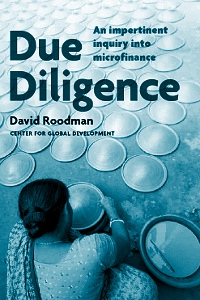
Due Diligence: An Impertinent Inquiry into Microfinance
David Roodman
January 2012
 Download (PDF,294 KB)
Microfinance: Few development ideas have been so buoyed by high expectations in recent decades, and few have been so buffeted by difficulties in recent years. Images of microfinance lifting people out of poverty now compete with ones of the poor driven by debt to suicide. Where does the truth lie? David Roodman investigates in Due Diligence. He finds no evidence that small loans lift people out of poverty en masse but argues that financial services, like clean water and electricity, are essential to a modern life. The practical question is not whether microfinance should continue, but how it can play to its strengths, which lie in providing useful services to millions of poor people in a businesslike way. Due Diligence is the most complete investigation ever into the sources and consequences of microfinance. Roodman explores the financial needs of poor people, the history of efforts to meet those needs, the business realities of doing so, and the arguments and evidence about how well modern microfinance is succeeding. Drawing on this comprehensive survey, he offers practical recommendations to those involved in providing microfinance services, including donors, social investors, and microfinance leaders:
- Eschew any drive to extend credit to the poorest.
- In general, invest less in microcredit for fear of bubbles.
- Favor the development of safer services such as savings, insurance, and money transfers.
- Look to new technologies to revolutionize financial services for the poor.
The Financial Needs of the Poor
Imagine your life without financial services: no insurance, no bank account, no credit cards—all business done with cash. Clearly they are a necessary part of a modern, relatively affluent life. But in fact, the global poor need financial services more than the rich precisely because they are poor. As the seminal book Portfolios of the Poor has shown, the incomes of the poor are more volatile and unpredictable than for the world's salaried minority. Meanwhile, the livelihoods of the poor depend more on their physical health, which tends to be more fragile and is rarely insured.
The intense uncertainty of poverty leaves an intense need for ways to set aside money in good times for use in bad times (and to discipline oneself into doing so). Loans, savings accounts, insurance, even money transfers can all meet that need, however imperfectly, so poor people devise and use such services as they can. The services available are often far from ideal—for lack of insurance, people may borrow or deplete savings to pay a hospital bill—but that is part of being poor. In the financial lives of the poor, microfinance is one more option, typically characterized by high reliability, if also rigidity, and useful in the spirit of diversification.
The Long History of Efforts to Meet the Needs of the Poor
Organized efforts to meet the financial needs of the poor began centuries ago. In 15th-century Italy, some towns instituted pawn shops, monti di pieta, to undermine Jewish bankers seen as usurious. The monti were themselves accused of usury, but the pope ruled in their favor in 1515. Around the same time, bequests for charitable loan funds began appearing of well-to-do Englishman. In the 1720s, famed author Jonathan Swift began lending £5–10 at a time to “industrious tradesman” in Dublin. Rather like microcredit clients today who must take loans through groups, shouldering responsibility for each other's loans, each of Swift's borrowers needed to two cosigners, who would be liable in the event of default. By the mid-19th century loan funds on Swift's model reached a fifth of Irish households. Today's microfinance traces to Germany's credit cooperative movement, which began in response to famine in the 1850s. In 1903, for instance, the British introduced cooperative credit groups into colonial India, including what is today Bangladesh.
History demonstrates the abiding demand among poor people for additional financial tools; yet it provides no evidence that meeting the demand systematically lifts people out of poverty. And today's microfinance echoes the past in many ways. As in previous eras, the movement has developed as do-gooders and profit-seekers discovered, invented, borrowed, and tinkered with ideas. The rarest of these figures are those who found ways to scale up, reaching thousands or millions. Muhammad Yunus and his students did not invent microcredit, but they were the first in the modern wave to go to scale in founding what is now the Grameen Bank.
Microfinance as Business
Microfinance is supplied by macro-organizations. As of 2009, the “average microcredit client” was served by an institution with 2.2 million borrowers, 9,000 employees, $730 million in assets, and operating profits equal to 16 percent of revenue. The big institutions got that way by solving a tough business problem: how to mass-produce financial services for the poor without losing lots of money. If things do not run smoothly, collecting on a $100 loan can easily cost $100 in staff time. That creates intense pressure to control costs.
It pays to observe microfinance institutions the way Darwin did finches, looking for links between how they operate and whether they survive and thrive. The most famous traits of microfinance—the emphases on loans, groups, and women—do admit Darwinian explanations. For example, making groups of people responsible for each other's loans shifts traditional bankers’ tasks onto borrowers. Out of self-interest, the jointly liable peers must judge who is a prudent risk; and after loans are made they must pressure their peers to repay. This reduces the quality of the financial product—who wants to be on the hook for the debts of others?—but this is a largely necessary trade-off in order to serve the poor.
The good news is that competition and innovation have steadily lowered interest rates while raising the diversity and flexibility of microfinance services. Though it began life with lending, the Grameen Bank now holds more deposits than loans. New technologies may throw back the frontier of the possible, vitiating old trade-offs between affordability and quality and creating radical new possibilities. The potential has been demonstrated by M-PESA, the wildly popular mobile phone–based money transfer system in Kenya.
Does Microfinance “Work”?
The heart of Due Diligence is an analysis of whether microfinance “works,” according to three definitions of that word. Each definition corresponds to a different conception of “development.” Each has validity. And each tends to lead to different kinds of evidence, all of which the book reviews. The three are:
- Development as Escape from Poverty. Among the microfinance industry and the public, it was widely held that microcredit reduces poverty. But academics understood how limited the statistical evidence was and their skepticism gained the upper hand after the release in 2009 of the first two randomized tests microcredit, which took place in Hyderabad, capital of the Indian state of Andhra Pradesh, and Manila, capital of the Philippines. [1] Neither found impacts on poverty over the first 12–18 months of availability. But a separate paper showed a microsavings account reduced poverty (raised household spending) when offered to female vendors in a market in rural Kenya. [2]
-
Development as Freedom. Economist and philosopher Amartya Sen argues that the essence of development is expanding freedom, meaning greater control over one's
circumstances. Freedoms, in Sen's view, are both ends and means—means because they support each other. For example, greater income allows people to
invest in education, which can lead to greater income. As suggested above, poor people use financial services precisely in order to gain more
control over their financial lives. And microcredit is often said to empower women by giving them more say over family finances. On the other hand,
debt can entrap, reducing freedom. On balance, financial services are inherently, if not automatically, freedom-enhancing.
Most of the evidence on whether microfinance gives people, especially women, more control over their lives is qualitative: narrative analysis from researchers who spent weeks or months studying a village or slum. It is quite mixed. Some women have found liberation by doing financial business in public spaces. Others have been made to sit in meetings until all dues are paid. [3] Some have had their cows or chicks or trees taken by peers in order to pay off their debts. [4] Appraisals have been more favorable when lending is subsidized or when it is given individually rather than through groups (to somewhat better-off people). -
Development as Industry Building. The most powerful force against poverty history has been industrialization, the process of churning that continually introduces new products and
new ways of making old ones, along the way generating jobs and profits. [5]
Within economics, this conception of development is associated with Joseph Schumpeter, who popularized the term “creative destruction.” From the
point of development as industry building, support for microfinance has succeeded, not in turning clients into Schumpeterian entrepreneurial
heroes, but in building microfinance institutions and industries that cater to poor people, create jobs, that enrich the national economic fabric.
But here too, critique is warranted. The development of the microfinance industry has often been unhealthy. Microcredit, like all credit, is susceptible to bubbles. Overindebtedness is a real possibility. [6] Implosions have recently occurred in Bosnia and Herzegovina, Morocco, Nicaragua, Pakistan, and India’s Andhra Pradesh state. [7] To make sense of these troubles, Due Diligence draws parallels with ecology. It highlights two aspects of microfinance’s development that have sometimes made it less healthy, more like that of an invasive species. First is the absence of negative feedback mechanisms such as credit bureaus, which can check the growth of credit. Second is the lack of diversity of linkages to other economic actors. Microfinance institutions that get the majority of their finance from a handful of foreign investors and devote it all to one product—microcredit—are historically less stable than those that diversify their services and funding sources. Notably, diversification on both counts occurs when a credit-only institution moves into deposit-taking.
Conclusions and Recommendations
Microfinance has promoted the impression that it is good at some things—reducing poverty and empowering women—while actually being good at another: building dynamic industries that deliver inherently useful services to millions of poor people. That duplicity, however unwitting, came home to roost in the last few years. New studies challenged the claim that microcredit reduces poverty. Finance excited by the assumption that microcredit could do no harm inflated bubbles that popped.
On current evidence, the best estimate of the average impact of microcredit on poverty is zero. So microcredit as a whole appears neither to live up to the hype nor justify the harshest attacks against it as modern usury. Microcredit does not appear to be the financial equivalent of cigarettes. The commonsense idea that credit is a useful tool that sometimes helps and sometimes hurts appears close to the truth.
Thus, just as the contribution of mortgages and sovereign borrowing to the global financial crisis does not argue for ending those forms of credit, neither should microfinance be abolished for its faults.
Going forward, social investors public and private should be honest that the true strengths of microfinance lie in development-as-industry-building. Recognizing that, they should take the following steps to help microfinance play to its strengths:
- Discourage efforts to lend to the poorest, which, far from automatically improving their lot, will add risk to their already risky lives;
- Support moves into deposit-taking, insurance, and money transfers, which will entail involvement with management training, regulation, policy,and politics;
- Support the search for ways to exploit communications technologies to deliver safer and more flexible services than are possible with the low-tech microfinance methods developed circa 1980;
- Stand ready to reduce support for microfinance—microcredit in particular—since ample finance for credit can inflate bubbles, undermine the drive to take savings as an alternative source of money for lending, and thus corrode the true strength of microfinance in enriching the local economic fabric.
The microfinance movement got into trouble by allowing its rhetoric to get ahead of the evidence. Only by critically confronting the evidence and the theories used to interpret it can the movement realize its full potential for helping the poor manage their wealth.
Due Diligence: An Impertinent Inquiry into Microfinance is available for purchase at www.cgdev.org/DueDiligence and through Hopkins Fulfillment Service, P.O. Box 50370, Baltimore, MD 21211-4370. Tel: 1-800-537-5487.
For review or exam copies, please send a note to [email protected] with details about the potential review or the course you are teaching.
6 X 9, 365 pp. paper, 978-1-933286-48-8, $24.95
[1] On the weak evidence, see Beatriz Armendáriz and Jonathan Morduch, The Economics of Microfinance (MIT Press: 2005), chapter 8. Studies are Abhijit V. Banerjee and others; “The Miracle of Microfinance? Evidence from a Randomized Evaluation.” Massachusetts Institute of Technology, Department of Economics, 2009; and Dean Karlan and Jonathan Zinman, “Microcredit in Theory and Practice: Using Randomized Credit Scoring for Impact Evaluation,” Science 332 (6035): 1278–84.
[2] Pascaline Dupas and Jonathan Robinson, “Savings Constraints and Microenterprise Development: Evidence from a Field Experiment in Kenya," Working Paper 14693, National Bureau of Economic Research, 2009.
[3] Stuart Rutherford, Grameen II at the End of 2003: A ‘Grounded View’ of How Grameen’s New Initiative Is Progressing in the Villages (MicroSave: 2004).
[4] Lamia Karim, “Demystifying Micro-Credit: The Grameen Bank, NGOs, and Neoliberalism in Bangladesh,” Cultural Dynamics 20 (5): 5–29 [2008].
[5] Not to suggest that government has no role to play in ameliorating the costs of industrial transformation and sharing the benefits.
[6] Jessica Schicks and Richard Rosenberg, Too Much Microcredit? A Survey of the Evidence on Over-Indebtedness, Occasional Paper 19 (CGAP: 2011).
[7] Greg Chen, Stephen Rasmussen, and Xavier Reille. Growth and Vulnerabilities in Microfinance, Focus Note 61 (CGAP: 2010).


