

Nicaragua was among the first round of countries deemed eligible for the MCA in 2004. The country signed a five-year, $175 million compact with the MCC in July of 2005 and the compact "entered into force" (EIF) in May 2006. The MCA Nicaragua (MCAN)[2] is housed in an independent foundation established by the Government of Nicaragua and approved by the National Assembly. The MCAN compact draws on the economic growth and job creation focus of Nicaragua’s National Development Plan, as well as on priorities of department-level development plans for the MCAN target area. Nicaragua’s initial MCA proposal included four sectors: property regularization, road construction, rural business development, and energy. Through the due diligence process, the MCC determined that the regulatory environment and overall structure of the energy sector were not strong enough to justify investment in energy at the time and thus the final compact covers the three remaining sectors.
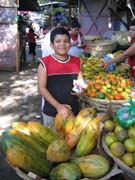
The MCAN compact covers two former breadbasket "departments" (like provinces or states) in the northwest of the country, León and Chinandega, and has the following program activities:
- Property regularization ($26.5 million): This project aims to strengthen property rights and land use management by conducting cadastral mapping, strengthening capacity in government land administration institutions, formalizing land tenure documents, and legally demarcating the boundaries of four protected areas.
- Rural business development ($33.7 million): This project offers technical and financial assistance to small and medium producers to transition to higher-value products and make profitable links to markets, works to attract significant investment to the region, and improves water supply for farming and forestry. This component will also promote sustainable agriculture and forestry practices by prioritizing watershed interventions and offering grants to improve water supply for irrigation.
- Transportation project ($93.8 million): This project will improve both primary and secondary roads to help link producers to markets and offer technical assistance to the national Ministry of Transportation and Infrastructure (MTI) and the national fund for road maintenance (FOMAV by its initials in Spanish).
(For much more information on the Nicaragua compact, see the Nicaragua page on the MCC’s website.)
Let’s take a look at the current status of each of these components:
Property regularization project: The MCAN is working with the World Bank’s existing property project, Proyecto de Ordenamiento de la Propiedad (PRODEP), a project unit in the Ministry of Finance that coordinates all relevant ministries and government offices in the process of property regularization across Nicaragua, to strengthen institutional capacity, develop a systematic and digital property titling process, and clean approximately 43,000 land parcels in León. The MCAN is also supporting land tenure offices in León in developing technical teams to manage the increased work load of issuing new titles. The MCAN is in the process of contracting a firm to conduct a "cadastral sweep" in León, while the World Bank is supporting the same in Chinandega. (This sweep entails a topographical survey to measure property lines, ascertain the legal history of each plot, and create a basis for future titling.) The MCAN has overseen the formalization of the first 26 new land titles (of the approximate 43,000 total to be administered in León throughout the life of the compact).
Rural business development project: The MCAN is working with small and medium agricultural producers to help them improve quality standards, connect with stable buyers, and increase the price of their products. These activities are taking place under the roughly 250 business plans that the MCAN has developed with producers’ groups or individuals to date (thousands more are expected over the life of the compact). Through its partnership with ProNicaragua, a Government of Nicaragua (GON) agency dedicated to attracting investment to Nicaragua, the MCAN held the first annual investment summit focused on the Northwest region that resulted in a $6 million investment commitment by a Honduran apparel production plant that will create 1,500 jobs this year (with an anticipated 80 percent going to women). The MCAN has bids out for two land management plans for protected areas (out of four planned in the compact) and is working on a third. The MCAN is also on track to plant one million trees (fruit trees, fuel wood and precious woods) this year.
Transportation project: The MCAN is in the process of selecting firms to conduct the feasibility studies, environmental impact assessments and designs for 14 primary and secondary roads totaling 364 km. The studies will take nine months to conduct and will serve as the basis for selecting which of the secondary roads to build/upgrade. (The primary roads are already chosen due to their higher rates of return.) Selected road projects must have an internal rate of return of 8 percent and 20-years’ viability. The whole package of roads is not to exceed the $93 million dedicated to this component, and construction will be prioritized based on a ranking derived from a participatory process with local authorities and producers and criteria in the compact. (Though, if the studies reveal that all proposed projects meet the performance criteria but exceed the project total, the MCAN may try and seek supplemental compact funds from the MCC, though it is not clear if they can.) Construction is expected to begin in 2008.
Cross-cutting principles: The MCAN approach incorporates three cross-cutting principles: gender focus, environmental conservation, and strategic communications. The MCAN has hired a gender specialist who developed a gender strategy. Since interviews were conducted for this report, the strategy has been formally approved by MCC and launched. The MCAN team has a full-time person dedicated to social and environmental issues as well as one for the forestry and protected area projects. Finally, the MCAN takes strategic communications very seriously and has a full-time communications expert who disseminates information about the MCAN’s approach and programs via printed media, radio programs, and monthly newsletters. She also encourages regular outreach by the MCAN General Director and other senior staff.
Disbursement: The MCAN has received four disbursements from the MCC which will total $7.4 million by the end of the fourth quarter (against a first year target of $20 million). The MCAN has started bids worth $25 million and is on track to have a total of $30 million in the pipeline by the end of the fourth quarter of 2007. Disbursements of these newly committed funds will be spread over the life of the compact and made on a quarterly basis. They do not necessarily indicate an imminent ramp-up of expenditure.
Next Section: Three Headline Stories
2. The MCA program is known in Nicaragua by its Spanish name--La Cuenta Reto del Milenio, or CRM. In the interest of consistency with other MCA Monitor field reports, this report refers to the MCA Nicaragua as MCAN.