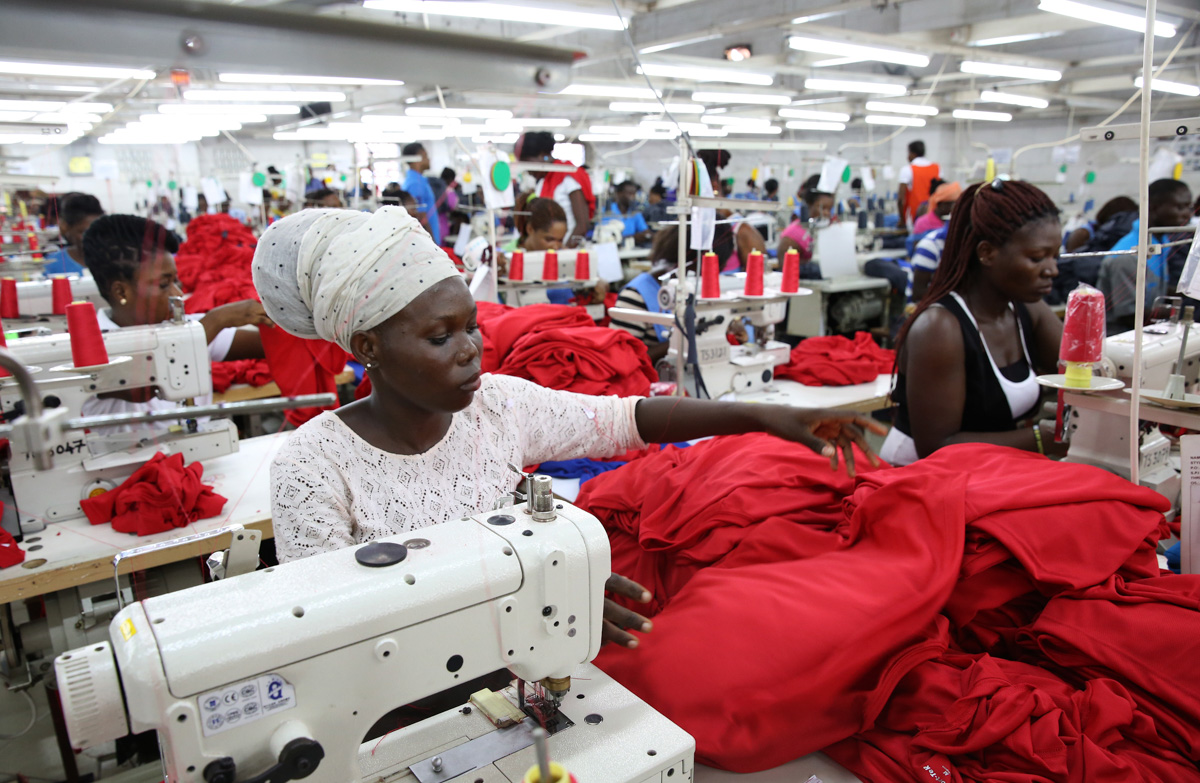
Financial services—savings, credit, insurance, money transfers—are vital yet intangible economic infrastructure. CGD’s work on financial services analyzes how to strengthen, deepen, and broaden financial systems in poor countries to maximize the benefits for poor households and improve development prospects.
Financial services help people manage some of life’s great challenges: investing in education, softening the financial trauma of illness and death, attaining ownership of a safe home. On a macroeconomic scale, they channel investment and diversify risk. Building a strong and inclusive financial sector is an essential part of the development process.
Financial services—savings, credit, insurance, money transfers—are vital yet intangible economic infrastructure. CGD’s work on financial services analyzes how to strengthen, deepen, and broaden financial systems in poor countries to maximize the benefits for poor households and improve development prospects.
Financial services help people manage some of life’s great challenges: investing in education, softening the financial trauma of illness and death, attaining ownership of a safe home. On a macroeconomic scale, they channel investment and diversify risk. Building a strong and inclusive financial sector is an essential part of the development process.
Examples of CGD’s work in this area:
- CGD senior fellow Liliana Rojas-Suarez led a Task Force on Access to Financial Services that identified ten principles for financial-sector policymakers (national authorities, donors, private-sector participants, international financial institutions, and others) involved in the facilitation, regulation, and direct provision of financial services.
- The Provision of Banking Services in Latin America: Obstacles and Recommendations by Rojas-Suarez.
- David Roodman and Uzma Qureshi’s Microfinance as Business report asks how some microfinance institutions succeed in controlling costs, raising capital, and scaling up.
- David Roodman and Jonathan Morduch’s working paper, The Impact of Microcredit on the Poor in Bangladesh: Revisiting the Evidence, replicates and challenges the leading nonexperimental studies of the impacts of microcredit.
David Roodman's Open Book Blog
The Open Book Blog is an experiment in sharing the process of writing of a book about the history and impacts of microfinance. Roodman, a CGD research fellow, asks bottom-line questions about the benefits of microfinance and encourages readers to comment on draft chapters for a forthcoming book. He also shares useful sources that he and his readers uncover.
Newest
Popular
Publications
Experts
Initiatives
Multimedia
-
Readers of David Roodman's Microfinance Open Book Blog will immediately recognize his thorough, straightforward, and trenchant analysis of whether microfinance is the boon many think it is.
-
Ben Leo testified before the House Subcommittee on International Monetary Policy and Trade on July 27, 2011 about the importance of multilateral development banks to the United States and the greater world.
-
This paper examines the efficacy of loan programs in the development of domestic enterprises in the immediate aftermath of conflicts. The author explores whether the strategies employed by such programs are effective and if there are opportunities for improving the outcomes of similar projects in...
-
This paper provides a review of the rationale for and against SME initiatives and an overview of existing targeted USG and IFI programs. The authors offer several new incremental options for private foundations to establish focused partnerships with donor agencies in their efforts to assist SMEs in...
-
Mohammed Yunus has been forced by a Bangladesh court to step down as the head of the Grameen Bank, leaving the world to wonder what will become of the institution that helped inspire the microfinance revolution. On this week’s Wonkcast, we consider the rise and uncertain future of...
-
In this working paper, the authors examine four categories of existing resource-mobilization options and recommend which might best be used to finance global public goods.
-
Looking for an investor with billions? Want to know where the money is? If you’re a country with a sound financial and political record seeking money for infrastructure, you can find it in the hands of “global public investors” (GPI’s), a growing group of little-known foreign investment...
-
Regulators at the Bank for International Settlements in Basel, Switzerland, are hard at work designing regulatory standards to avoid future financial meltdowns like the global financial crisis of 2008. Joining them for two months is Liliana Rojas Suarez, a CGD senior fellow and the founding...
-
Nuhu Ribadu, former head of Nigeria's Economic and Financial Crimes Commissions, shows how he and his team used international money-laundering laws to fight corruption in Nigeria.
-
A crisis is unfolding in India's microcredit sector that-- beyond its immediate effects on borrowers and lenders-- will greatly affect the future of financial services for the poor. I'm joined by David Roodman, senior fellow here at the Center for Global Development and author of the forthcoming...
-
Readers of David Roodman's Microfinance Open Book Blog will immediately recognize his thorough, straightforward, and trenchant analysis of whether microfinance is the boon many think it is.
-
CGD fellow David Roodman and Jonathan Morduch a landmark evaluation of the impact of microcredit on poor households in Bangladesh. They replicate the study's statistical analysis and put an end to the controversy surrounding it by showing that it fails to rule out reverse causation. A positive...
-
Public policy on financial crises in emerging markets has implicitly been grounded in economic theory calling for lender-of-last-resort intervention when the country is solvent, and on theory recognizing that reputational damage is the quasi-collateral enabling lending to sovereigns with no...
-
In this working paper, the authors examine four categories of existing resource-mobilization options and recommend which might best be used to finance global public goods.
-
Microfinance is a widely celebrated strategy for helping poor people in the developing world. Leading microfinance institutions, including the Nobel Peace Prize-winning Grameen Bank, reach millions of clients. CGD research fellow David Roodman and Uzma Qureshi analyze why some microfinance...
-
This course explores the role of microfinance in economic development. It will discuss how poor people in poor countries use financial services such as credit and savings; the history and practice of delivering such services; what is known about their contribution to development; and how stories...
-
Ben Leo testified before the House Subcommittee on International Monetary Policy and Trade on July 27, 2011 about the importance of multilateral development banks to the United States and the greater world.
-
The CGD Task Force on Access to Financial Services proposes 10 principles for financial-sector policymakers—including national authorities, donors, private-sector participants, international financial institutions, and others—on the facilitation, regulation, and direct provision of...
-
Nuhu Ribadu, former head of Nigeria's Economic and Financial Crimes Commissions, shows how he and his team used international money-laundering laws to fight corruption in Nigeria.
-
This paper provides a review of the rationale for and against SME initiatives and an overview of existing targeted USG and IFI programs. The authors offer several new incremental options for private foundations to establish focused partnerships with donor agencies in their efforts to assist SMEs in...
-
William R. Cline, Senior Fellow Emeritus William R. Cline is a senior fellow emeritus at the Center for Global Development and a senior fellow at the Peter G. Peterson Institute for International Economics. His research focused on finance, capital flows, trade and development; currently he is investigating the differential impact of...
-
Ricardo Hausmann, Non-Resident Fellow Ricardo Hausmann is Professor of the Practice of Economic Development at Harvard University's Kennedy School of Government. Previously, he served as the first Chief Economist of the Inter-American Development Bank (1994-2000), where he created the Research Department.
-
Dean Karlan, Non-Resident Fellow Dean Karlan is an Assistant Professor of Economics at Yale University. Karlan is President of Innovations for Poverty Action and a research fellow of the M.I.T. Jameel Poverty Action Lab. His research focuses on microeconomic issues of poverty, specifically employing experimental methodologies to...
-
Guillermo Perry, Non-Resident Fellow Guillermo Perry is the former chief economist of the Latin America and Caribbean region of the World Bank. He has been the director of two of Colombia’s leading economic think-tanks, Fedesarrollo and the Center for Economic Development Studies. He is currently the Robert F. Kennedy Visiting...
-
Liliana Rojas-Suarez, Senior Fellow Liliana Rojas-Suarez is an expert on Latin America, financial services, and the effects of global financial regulation. She leads CGD’s extensive package of analysis on the development impact of the U.S. financial crisis and has been the chair of the Latin American Shadow Financial Regulatory...
-
David Roodman, Senior Fellow David Roodman's research focuses on microfinance, debt relief, and climate change. His book Due Diligence: An Impertinent Inquiry into Microfinance is available now.
-
-
-
-
-
-
-
-
-
-
Introduction to Microfinance for Development, Georgetown University (Syllabus)
- Dec 7, 2009
This course explores the role of microfinance in economic development. It will discuss how poor people in poor countries use financial services such as credit and savings; the history and practice of delivering such services; what is known about their contribution to development; and how stories...
-
Policy Principles for Expanding Financial Access
- Sep 30, 2009
The CGD Task Force on Access to Financial Services proposes 10 principles for financial-sector policymakers—including national authorities, donors, private-sector participants, international financial institutions, and others—on the facilitation, regulation, and direct provision of...
-
-
-
-
-
-
-
-
-
Microfinance as Business - Working Paper 101 (Revised November 2006)
- Oct 13, 2006
Microfinance is a widely celebrated strategy for helping poor people in the developing world. Leading microfinance institutions, including the Nobel Peace Prize-winning Grameen Bank, reach millions of clients. CGD research fellow David Roodman and Uzma Qureshi analyze why some microfinance...
-
The U.S. External Deficit and the Developing Countries--Working Paper 86
- Mar 20, 2006
With foreign investment in the U.S. increasingly in the spotlight, this working paper by William Cline explores the U.S. external deficit and the fact that the U.S. relies on foreign lending to finance its trade deficit. Cline emphasizes the dangers of a hard landing for the U.S., and why this...
-
-
-
Financial Crises and Poverty in Emerging Market Economies - Working Paper 8
- Jun 1, 2002
This study examines the impact of the principal financial crises in emerging markets in recent years on the incidence of poverty in the countries in question. The growth impact is first identified by comparing average per capita growth in the two years prior to the crisis to that in the crisis year...
There are no initiatives related to this topic.
There are no opinions related to this topic.
|
|