Recent Research
Non-Resident Fellow
Economic reform processes; effects of technological change; globalization; state capacity; international financial institutions.
Email:
Education: B.Tech., Banaras, India; M.S., University of Minnesota; Ph.D., Princeton University
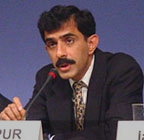
Devesh Kapur is a non-resident fellow at the Center for Global Development. He is the Director of the Centre for Advanced Study of India, he holds the Madan Lal Sobti Professorship for the Study of Contemporary India, and he is an associate professor of political science at the University of Pennsylvania. Prior to arriving at the University of Pennsylvania, Dr. Kapur was an associate professor of government at the University of Texas at Austin, and before that the Frederick Danziger Associate Professor of Government at Harvard.
He received a B.Tech. in chemical engineering from Banaras, India; a M.S. in chemical engineering from the University of Minnesota; and a Ph.D. from the Woodrow Wilson School at Princeton University. Subsequently he was a program associate at the Brookings Institution in Washington D.C..
His research focuses on human capital, national and international public institutions, and the ways in which local-global linkages affect political and economic change in developing countries. Dr. Kapur has focused in particular on India, and the impact of international institutions (especially the Bretton Woods Institutions) and diasporas. He is the coauthor of The World Bank: Its First Half Century (Brookings) and author of The Reverse Midas Touch? The Indian State and Economic Development: Lessons from the Indian Petrochemical Industry (forthcoming, Oxford University Press). He is currently working on public institutions in India, the impact of international human capital flows on developing countries and the political and economic impact of the Indian diaspora on India.
New
Popular
Working Papers Books Other CGD Pubs Events Selected Works
-
In this working paper, the authors find that remittances are often greatly underestimated in surveys. They suggest ways to improve the collection of such data.
-
In developing countries where elections are costly and accountability mechanisms weak, politicians often turn to illicit means of financing campaigns. This paper examines one such channel of illicit campaign finance: India’s real estate sector. Politicians and builders allegedly engage in a quid...
-
Although higher education is crucial to development remarkably little is known about what happens within developing country universities. Moreover, while enrollment and budgets are rising, the impact of this growth is unclear. A new CGD working paper by non-resident fellow Devesh Kapur and...
-
Efforts to reform the IMF should be complemented by alternative approaches to doing what the Fund does, according to this new paper. The authors argue that competition would give developing countries more bargaining power and spur the IMF to improve. The paper focuses on the IMF's insurance role...
-
Critics allege that the World Bank is deeply flawed. Yet the world needs a strong World Bank to help manage development and the related global challenges of the 21st century. Do the Bank's shortcomings put its future at risk? If so, can the Bank be rescued? Rescuing the World Bank, a new book that...
-
Human capital flows from poor countries to rich countries are large and growing. A leading cause is the increasing skill-focus of immigration policy in a number of leading industrialized countries—a trend that is likely to intensify as rich countries age and competitive pressures build in...
-
A CGD best-seller, Give Us Your Best and Brightest has been praised in Foreign Affairs as "a judicious combination of facts, theory, and informed conjecture on a growing but complex phenomenon about which too little is known." Best and Brightest addresses the migration of well-educated workers from...
-
This report was prepared by a Working Group convened by the Center for Global Development to identify key priorities the Paul Wolfowitz at the start of his tenure at the World Bank on June 1, 2005. It argues that Wolfowitz's biggest challenge will not be managing the Bank, with its 10,000 staff,...
-
The paper addresses three key issues raised by the G-7 in its proposals to reform the multilateral banks, in 2001. One, the restructuring of IDA with a part of its lending in the form of grants rather than loans. Two, the harmonization of procedures, policies and overlapping mandates among MDBs....
-
In this working paper, the authors find that remittances are often greatly underestimated in surveys. They suggest ways to improve the collection of such data.
-
A CGD best-seller, Give Us Your Best and Brightest has been praised in Foreign Affairs as "a judicious combination of facts, theory, and informed conjecture on a growing but complex phenomenon about which too little is known." Best and Brightest addresses the migration of well-educated workers from...
-
Critics allege that the World Bank is deeply flawed. Yet the world needs a strong World Bank to help manage development and the related global challenges of the 21st century. Do the Bank's shortcomings put its future at risk? If so, can the Bank be rescued? Rescuing the World Bank, a new book that...
-
Human capital flows from poor countries to rich countries are large and growing. A leading cause is the increasing skill-focus of immigration policy in a number of leading industrialized countries—a trend that is likely to intensify as rich countries age and competitive pressures build in...
-
This report was prepared by a Working Group convened by the Center for Global Development to identify key priorities the Paul Wolfowitz at the start of his tenure at the World Bank on June 1, 2005. It argues that Wolfowitz's biggest challenge will not be managing the Bank, with its 10,000 staff,...
-
Although higher education is crucial to development remarkably little is known about what happens within developing country universities. Moreover, while enrollment and budgets are rising, the impact of this growth is unclear. A new CGD working paper by non-resident fellow Devesh Kapur and...
-
In developing countries where elections are costly and accountability mechanisms weak, politicians often turn to illicit means of financing campaigns. This paper examines one such channel of illicit campaign finance: India’s real estate sector. Politicians and builders allegedly engage in a quid...
-
The paper addresses three key issues raised by the G-7 in its proposals to reform the multilateral banks, in 2001. One, the restructuring of IDA with a part of its lending in the form of grants rather than loans. Two, the harmonization of procedures, policies and overlapping mandates among MDBs....
-
Efforts to reform the IMF should be complemented by alternative approaches to doing what the Fund does, according to this new paper. The authors argue that competition would give developing countries more bargaining power and spur the IMF to improve. The paper focuses on the IMF's insurance role...
-
-
-
-
Beyond the IMF - Working Paper 99
- Sep 15, 2006
Efforts to reform the IMF should be complemented by alternative approaches to doing what the Fund does, according to this new paper. The authors argue that competition would give developing countries more bargaining power and spur the IMF to improve. The paper focuses on the IMF's insurance role...
-
-
Rescuing the World Bank
- Sep 5, 2006
Critics allege that the World Bank is deeply flawed. Yet the world needs a strong World Bank to help manage development and the related global challenges of the 21st century. Do the Bank's shortcomings put its future at risk? If so, can the Bank be rescued? Rescuing the World Bank, a new book that...
-
-
Rescuing the World Bank
- Sep 5, 2006
Critics allege that the World Bank is deeply flawed. Yet the world needs a strong World Bank to help manage development and the related global challenges of the 21st century. Do the Bank's shortcomings put its future at risk? If so, can the Bank be rescued? Rescuing the World Bank, a new book that...
-
The Global Migration of Talent: What Does it Mean for Developing Countries?
- Oct 13, 2005
Human capital flows from poor countries to rich countries are large and growing. A leading cause is the increasing skill-focus of immigration policy in a number of leading industrialized countries—a trend that is likely to intensify as rich countries age and competitive pressures build in...
-
-
|
|