Recommended



Andy Burnham, the UK’s latest prime minister, has suggested reducing the amount the UK provides as climate finance grants and providing some of its climate finance through loans instead, in a move that the government anticipates will save £400 million. The government plans to use the savings to fund a cap on bus fares in the UK, triggering accusations from the development sector that Burnham’s proposal “throws global south countries under the bus.”
One likely destination for these new loans is the Tropical Forest Forever Facility (TFFF). The TFFF is a new initiative designed to provide payments to countries that protect their forests by raising money from governments and private investors, investing that money in riskier and therefore higher return assets, and using the returns it earns to fund forest protection.
But there is a catch. The UK has committed to provide around £6 billion in climate finance funded through aid (or official development assistance (ODA)). In this blog, we show that switching from grants to a loan to the TFFF may reduce government spending, but it could also reduce how much of the UK’s climate finance counts as ODA. In other words, the government can make the £400 million saving, or meet its £6 billion aid budget-funded climate finance commitment, but it probably cannot do both. The UK cannot have its cake and eat it.
Would a loan to the TFFF make savings? Possibly.
The terms for any loan that the UK might make to the TFFF are yet to be agreed, and therefore we cannot be certain about how it will be treated either as ODA, or in the UK public accounts. But in implying that this loan will lead to savings which can be used elsewhere, the government has signalled that they are not expecting it to count towards the public deficit. Using money on a loan (rather than a grant) creates an asset, the value of which gets netted off against fiscal measures such as Public Sector Net Financial Liabilities (main measure of debt) or Public Sector Net Borrowing (main measure of the deficit).
But this only works if the loan is expected to be repaid, and that is not certain. According to the concept note for TFFF, loans from sponsors such as the UK would be a junior, loss-absorbing tranche. And the investments made by the TFFF are in risky bonds by design: that is how it is able to generate returns above its cost of capital. Repayments to the UK would depend on TFFF making sufficient investment income, and some have called into question whether the returns targeted by TFFF are plausible. (In a previous parliamentary debate, a question by Baroness Sheehan hinted that the Treasury had already made a preliminary decision “not count investment in the TFFF as an asset on its public balance sheet” although this is clearly not set in stone). The concept note itself models up to a 10 percent risk of donors losing interest payments, and 1 percent chance of losing capital, and this is based on assumptions about investment returns that some analysts think are optimistic. So it is not clear that a loan to the TFFF would avoid hitting the deficit; the Office for National Statistics will have the final say.
Would TFFF loans count towards ODA? Probably not.
If the risk of the loan is deemed low enough, then the TFFF loan will not count towards the deficit, and the UK can save money by switching to it from grants. However, it is unlikely that the UK will be able to count the loan as ODA. To do so, the loan must meet the DAC’s rule for concessionality. For a multilateral organisation such as the TFFF—global in nature with pooled capital from different contributors, hosted at the World Bank—only the “grant element” of the loan would count, calculated with a 5 percent discount rate. (The difference between the face value of the loan and the flow of discounted repayments, expressed as a percentage of the face value). Any loan with an interest rate above 5 percent would have no grant element, and so would not count as ODA at all.
The terms on TFFF loans are not set in stone, but the most recent concept note suggests that loans will have a term of 40 years and pay a similar return to US treasury bonds. That implies an interest rate of around 5.2 percent (the yield on 30-year US treasury bonds, the longest tenor), which is above the discount rate for multilaterals. The UK could choose to charge a lower interest rate on the loan, in order to count it against the ODA budget. But ODA classification is not binary: reducing the interest rate to just below 5 percent will only score a small amount of ODA (figure 1). The lower the interest rate on the loan, the higher the ODA, but the weaker the case for making the loan on the basis that it makes savings, as the UK will be making a return well below its cost of borrowing.
Figure 1: Grant element of TFFF loan by interest rate
<---- higher ODA, higher deficit…lower ODA, lower deficit ---->
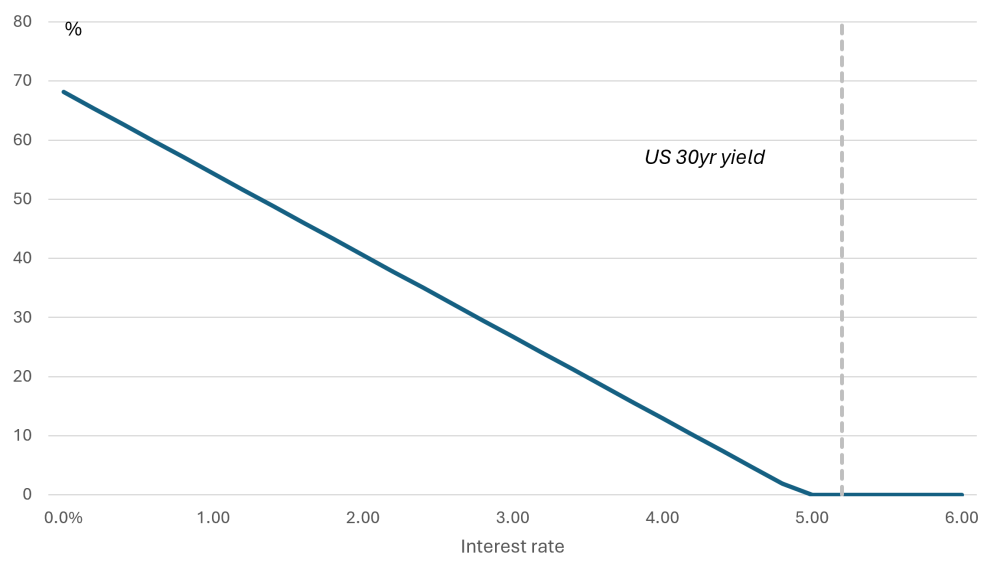
The greater the ODA, the bigger the deficit
If the UK charges a rate below its borrowing cost (currently 5.7 percent for 30-year gilt), then this would also have an impact on the deficit in future years (albeit a small one): the difference between UK borrowing costs and the interest charged is added to the deficit in each year of the loan (see for example paragraph 2 here)
If the UK were to charge no interest, then around £23 million would be added to the deficit in the first year, with that amount declining as the loan principal is repaid. Under the loan structured proposed in the concept note, this would add up over the course of the loan to roughly £581 million—that would be the interest earned on the same loan but charging 5.7 percent, the UK’s borrowing cost—or roughly £368 million in real terms (using 3.5 percent discount rate), which would undermine the case for making “savings” by reducing grants and funding this instead. That is before taking into account the risk of the loan. Factor this risk in, and the deficit impact could almost cancel out the £400 million in savings.
That is one extreme, and the government could choose an intermediate point. But the principle remains that the more ODA it scores, the more the loan will hit the deficit, even if that impact is gradual. The less ODA it scores, the more ODA the government will have to spend in the next two years if it still plans on meeting its £6 billion target.
This fiscal treatment is governed by numerous international accounting standards, most notably the UN System of National Accounts, or Eurostat’s Manual on Government Debt and Deficit. A key purpose of these frameworks (and the reason why statistical agencies have independence) is to prevent politically motivated obfuscation of how government is spending its money. If it costs money, there should be an impact on the deficit even if it is a loan. And if it doesn’t cost money, then it is right that it does not count as aid.
Base funding on strategy and need, not accounting
None of the above points are reasons not to fund the TFFF. If the government believes in the finance model, and wants to provide funding to protect forests, then it should. But our reading of the statistical rules suggest that if the government intends to switch from grants to a TFFF loan to save money, then it can only do so at the expense of its ODA climate finance target.
The government cannot expect to reduce the real value of climate finance to partner countries by giving less in grant money, without this having an impact on commitments to spend that money.
Topics
DISCLAIMER & PERMISSIONS
CGD's publications reflect the views of the authors, drawing on prior research and experience in their areas of expertise. CGD is a nonpartisan, independent organization and does not take institutional positions. You may use and disseminate CGD's publications under these conditions.
Thumbnail image by: Sergii Figurnyi/ Adobe Stock