Recommended
Blog Post
Update on Lives Lost from USAID Cuts
In December, UN Relief Coordinator Tom Fletcher launched an appeal for 2026 humanitarian funding, reporting that in 2025 “hunger surged… millions went without essential food, healthcare and protection.” He suggested that in 2026, by focusing on those in greatest need, the global humanitarian system could save 87 million lives with just $23 billion. But that is still about twice the funding that was available in 2025, after a global financing collapse led by the US and EU. The US administration is supporting Fletcher’s efforts to focus spending, but unless it provides considerably more resources, many more people will still be at risk in 2026.
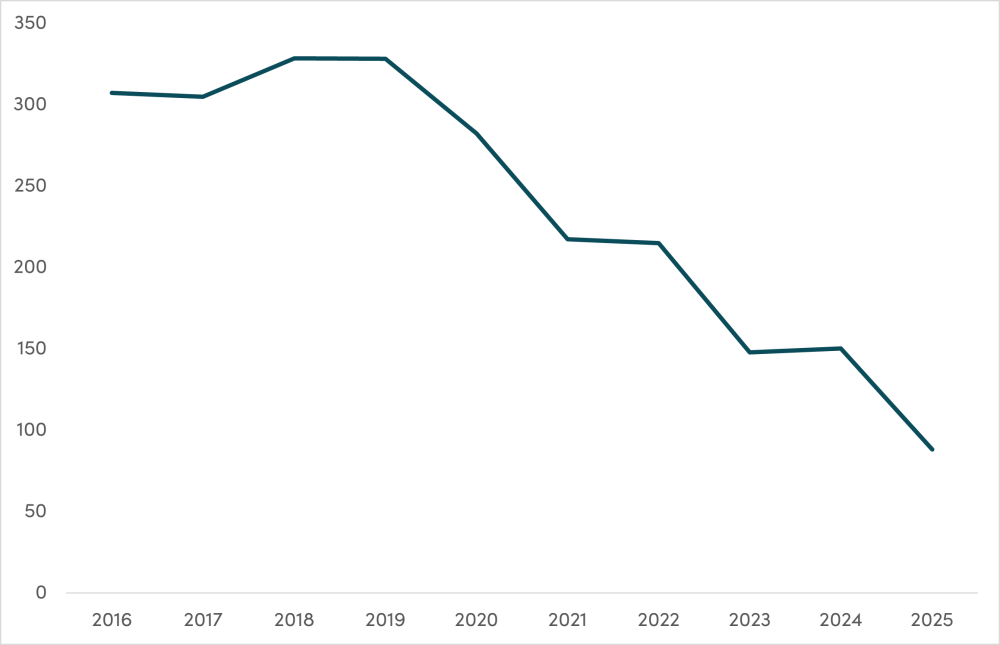
Between 2016 and 2019, available humanitarian funding per person in need worldwide was around $300. This started to decline as the number of people in need rapidly climbed between 2019 and 2023, and then as global humanitarian spending rapidly declined from its 2022 peak.
Figure 1. Global humanitarian funding per person in need ($)
Source: Market Impact
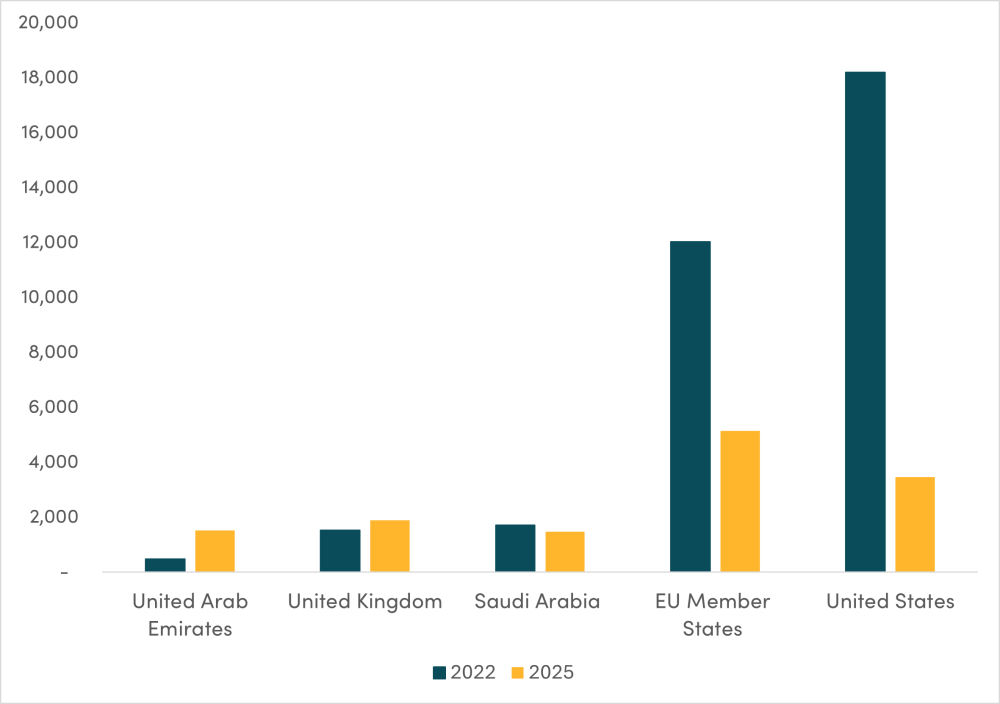
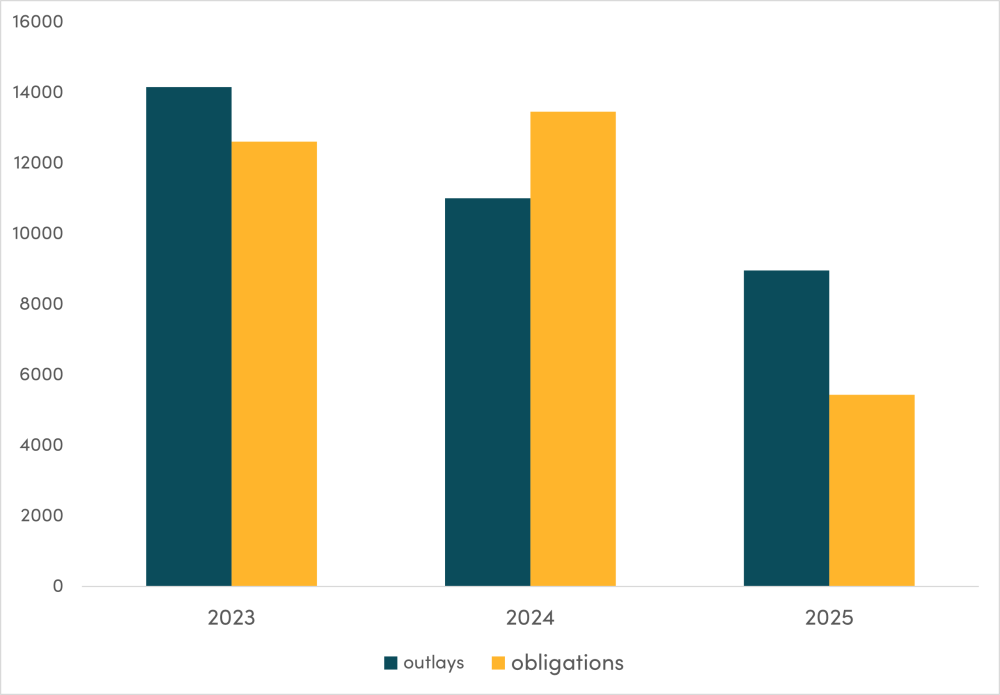
The collapse in humanitarian funding was driven primarily by the United States and the European Union, which together accounted for considerably more than half of global funding. And the collapse in the US considerably accelerated this past fiscal year, with obligations in the two main humanitarian accounts falling 60 percent between FY2024 and FY2025. As obligations are a leading indicator of outlays—actual payments for humanitarian response—this suggests 2026 may look worse than 2025, which already involved US financing cuts potentially associated with more than 400,000 deaths worldwide over the medium term.
Figure 2. Five largest donors (2025): Humanitarian funding 2022 and 2025 ($ million)
Source: Market Impact
Figure 3. US humanitarian accounts fiscal year outlays and obligations ($ million)
Source: USAspending.gov, data for International Disaster Assistance and Migration and Refugees Accounts
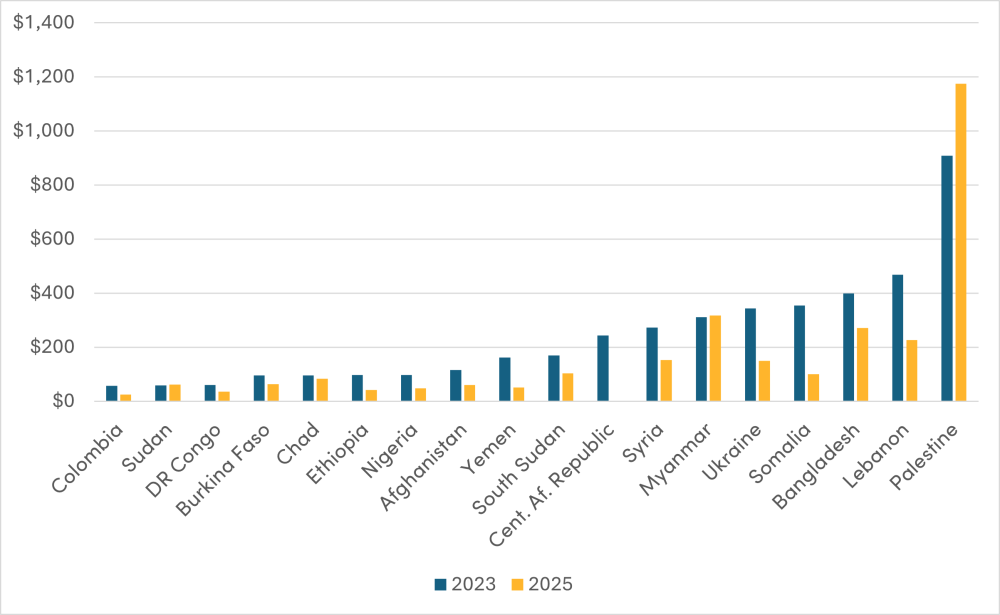
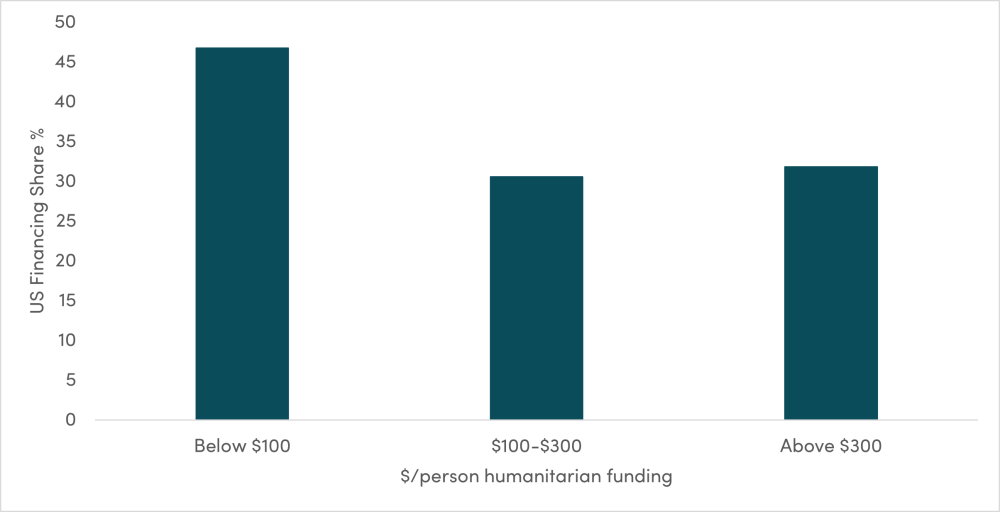
Traditionally, the US had a particularly large role in responding to neglected crises where other funding was already scarce—primarily in Africa. In 2023, Colombia, Sudan, Democratic Republic of the Congo, Burkina Faso, Chad, Ethiopia, and Nigeria all saw responses to large scale humanitarian emergencies that attracted less than $100 per person in need. But US support financed 46 percent of the bilateral response in those cases compared to an average of 31 percent in better-funded responses. US withdrawal will have an outsized impact in those countries and helps explain why all-donor funding cuts translated into per-person reductions in already disadvantaged countries that were almost as severe, in percentage terms, as the cuts to initially more generously funded crises.
The US was dominant not just in some of the countries most at need but also in some of the most vital sectors: responsible for 50 percent or more of recent humanitarian funding supporting nutrition, for example. This combined with the broader funding collapse will help to explain reports of rising malnutrition in humanitarian settings in 2025.
Figure 4. Humanitarian financing per person in need, 2023 & 2025
Source: Market Impact
Figure 5. US share of bilateral humanitarian assistance by overall generosity of humanitarian response (2023 data)
Sources: UN OCHA Financial Tracking Service (FTS) and Market Impact
It isn’t just about the level of funding but the speed of delivery. Humanitarian activities must be timely to be effective. And demand changes rapidly as new crises emerge and emergency situations recede. That means the need for agile response and, in particular regarding bilateral response from the US, the capacity to issue new awards. That capacity largelyvanished through much of 2025.
Data from FEWSNET suggests that the timing of the US funding collapse was in some sense “lucky” for a breakdown in new award-making capacity. Between December 2023 and November 2024, 13 of 16 countries tracked by the report saw rising numbers of people in need of food assistance, involving nearly 29 million additional people. Between November 2024 and December 2025, only six countries saw a rise in people in need and the total increase in those countries combined was only 8 million. Still, there were significant changes in needs over that period—a rise of three million in Afghanistan, two million in DRC. and a million in Mozambique—and the US in particular was in no position to respond.
Table 1. Countries seeing a rise in the number of people in need of food assistance in 2025
| Country | Nov 2024 | Dec 2025 | Change | Percent Change |
|---|---|---|---|---|
| Afghanistan | 6,495,000 | 9,495,000 | 3,000,000 | 46.2% |
| DRC | 14,495,000 | 16,495,000 | 2,000,000 | 13.8% |
| Mozambique | 2,245,000 | 3,245,000 | 1,000,000 | 44.5% |
| Haiti | 2,245,000 | 2,745,000 | 500,000 | 22.3% |
| Kenya | 2,745,000 | 3,245,000 | 500,000 | 18.2% |
| Madagascar | 1,245,000 | 1,745,000 | 500,000 | 40.2% |
Data: FEWSNET
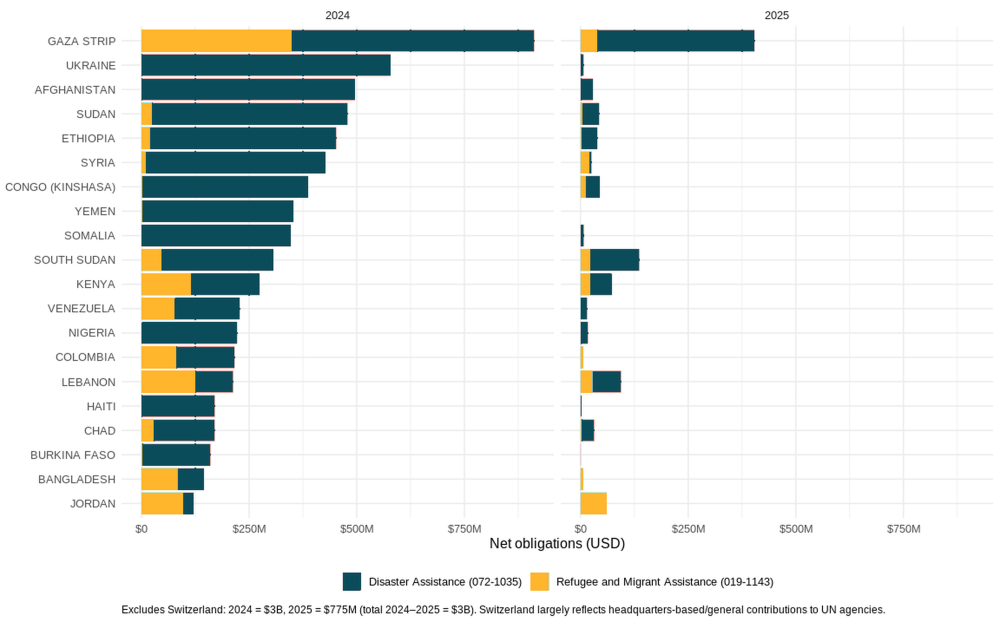
Using transactions-level data from USAspending, we can see how much the State Department and the remnants of USAID were able to respond with additional bilateral support to growing humanitarian challenges in (calendar) 2025 as compared to 2024 (although note some 2025 obligations may not have been reported yet). It is clear in Afghanistan, DRC, Haiti, and Kenya that new US bilateral support collapsed as much as it did elsewhere.
Figure 6. Country-level obligations for Disaster Assistance & Refugees and Migrants
Transaction-level, place of performance country, calendar years 2025 and 2025
Source: USAspending transactions-level data. Net obligations. Accounts included 072-1035 (International Disaster Assistance) and 019-1143 (Migration and Refugee Assistance). Note 2025 data may be incomplete.
At the end of last year, the US backed a new funding model that will help direct humanitarian support more rapidly to those situations where the need is greatest. Covering 17 countries, US financing will support UN pooled funds focused on lifesaving activities in humanitarian settings. It is a valuable reform that will help blunt the impact of significantly reduced US bilateral capacity to respond to crises.
But it is worrying that the proposed level of funding is currently $2 billion, compared to about $14 billion in US funding for the UN humanitarian system as a whole in 2024. While this was announced as “a floor, not a ceiling,” if the rest of the OECD contributed the same share of their GNI as the US $2 billion, it would amount to a collective $4.5 billion—or less than a fifth of what the UN suggests is needed to avoid widespread mortality.
The good news is that the US Congress appears keen to support greater generosity. It has increased the FY2026 budget for international humanitarian assistance and PL480 Food for Peace support from the administration’s $2.5 billion request to $6.6 billion. While still a significant decline from the $10.3 billion enacted in FY2024, it suggests the potential to considerably expand finance for a reformed global humanitarian response.
The US administration’s move to a more efficient model of international humanitarian financing should be applauded. But both Europe and the US bear part of the responsibility for a greater risk of malnutrition and death in humanitarian settings in 2025. Hopefully the US administration will use the finance Congress has made available to reduce that risk in the new year.
Topics
DISCLAIMER & PERMISSIONS
CGD's publications reflect the views of the authors, drawing on prior research and experience in their areas of expertise. CGD is a nonpartisan, independent organization and does not take institutional positions. You may use and disseminate CGD's publications under these conditions.
Thumbnail image by: USAID in Africa/ Flickr