Recommended
REPORT
A Call to Action to End Childhood Lead Poisoning Worldwide

Blog Post
A Lead-Free Future: Finally On Its Way?
Press Release
When aid workers and expats pack for foreign postings their checklist is long. Yellow fever jab, malarial prophylaxis, insurance, and getting their kids enrolled in school. Lead poisoning rarely makes the list—but it probably should.
In half of low‑ and middle‑income countries (LMICs), the average child’s blood contains at least 5 µg/dL of lead. That is above the level that triggers public health action in Britain and the United States. Lead stunts brain development and raises blood pressure—and unlike malaria, it is hard to spot until the damage is done.
The best prevention of lead poisoning is also the most equitable—removing lead at the source, and protecting entire populations from its toxicity. That’s why we’ve called to end childhood lead poisoning for everyone by 2040—and why we’re so heartened to see recent funding and political commitments to that end.
But in the immediate term, international employers still have a duty of care for their staff. Lead testing and mitigation should be included in this duty of care package for all expatriates in high burden-settings—including aid workers, diplomats, and deployed military families. In the US and UK, this should be considered a requirement to comply with workplace safety regulations—the Occupational Safety and Health Administration and the Health and Safety at Work Act, respectively—which require employers to take “reasonably practicable” steps to reduce workplace hazards.
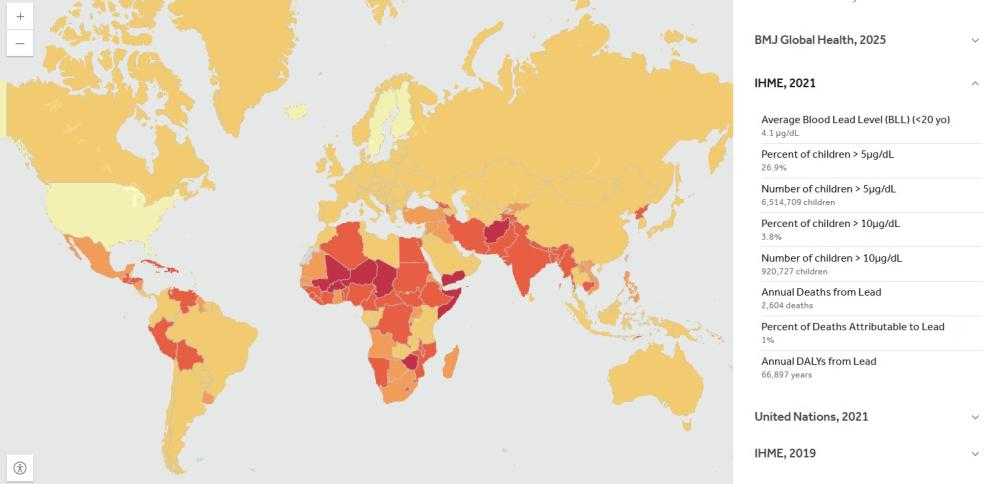
Note: Map reproduced from leadpollution.org, a project of Pure Earth
Wealth does not necessarily protect expatriates from lead
Isn’t lead poisoning a “poor people problem?” Not entirely. Anecdotally, one well-known American development economist told us that they’d discovered that their own children had elevated blood lead levels, after accompanying them on fieldwork trips in South America.
More broadly, we identified four large representative surveys that record both blood‑lead and household wealth; from India, Bhutan, Georgia, and Mexico. In most countries the poorest are more exposed than the richest. But even among the richest households lead exposure is common - 79 percent of the richest households in Delhi and Mumbai (in 1999), 52 percent of the richest in Bhutan (2024), 23 percent of the richest in Georgia (2018), and 5 percent of the richest in Mexico (2018). Gated compounds and international schools can’t protect against airborne lead dust from informal battery recycling a kilometre away.
Even children from richer families in poor countries have high blood lead levels
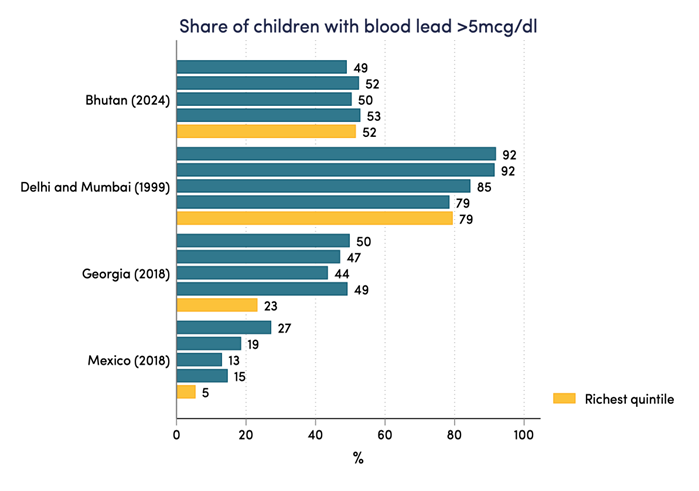
Note: This figure presents data on blood lead levels by wealth quintile from the 1999 National Family Health Survey in India, which included lead testing for Mumbai and New Delhi only; the 2024 National Blood Lead Survey in Bhutan; the 2018 MICS survey in Georgia; and the 2018 ENSANUT in Mexico.
What does this mean for HR departments?
What are practicable steps to address this problem? For other health issues, aid agencies typically subsidise preventative care, such as vaccines and malaria prophylaxis. We propose three cheap interventions for lead:
- Test: all staff and dependants should get a baseline venous blood‑lead test before departure, repeated every 6–12 months for posts in high‑prevalence countries. A lab test costs about $35 in Nairobi—less than most visa fees.
- Trace: if blood lead results exceed a reference value (5 µg/dL is the WHO guideline), investigate the source of exposure. Paint swabs and water test kits cost a few dollars.
- Treat: the priority is identifying and removing sources of exposure–repainting flaking walls, replacing contaminated cookware, or switching spices. Nutritional supplements can help a little but not completely, and chelation drugs are reserved for the small minority of people with particularly high levels of exposure (such as above 40 µg/dL, typically from industrial occupational exposure).
The cost of testing and basic remediation is a small fraction of a typical embassy budget. In return, agencies can avert lifelong health and cognitive penalties for staff and their children.
Testing expats = more data for everyone
An important side benefit of routine testing of expats would be helping to identify sources of local exposure that affect everyone. In New York City the health department has identified lead-contaminated products such as spices and cookware imported from Georgia and Bangladesh. This allowed the city to alert national authorities in Georgia and Bangladesh, who were then able to intervene in local markets and address the problem at source. Aid agencies could do the same, amplifying their development impact at negligible cost.
Don’t be the last to act
HR managers set travel rules and insurance requirements. Add blood‑lead testing to the checklist now and you safeguard your own staff. Plus, by identifying tainted products you can push local markets to clean up, protecting local families too.
This blog was updated on 07/23/2026.
Topics
DISCLAIMER & PERMISSIONS
CGD's publications reflect the views of the authors, drawing on prior research and experience in their areas of expertise. CGD is a nonpartisan, independent organization and does not take institutional positions. You may use and disseminate CGD's publications under these conditions.
Thumbnail image by: DarleneWagnerButler/ Adobe Stock