Recommended
POLICY PAPER
Will There Be an African Energy Revolution?
Blog Post
The US G20 Should Deliver on Energy Transparency
Blog Post
What We’re Losing: Energy, Growth, and Power Africa
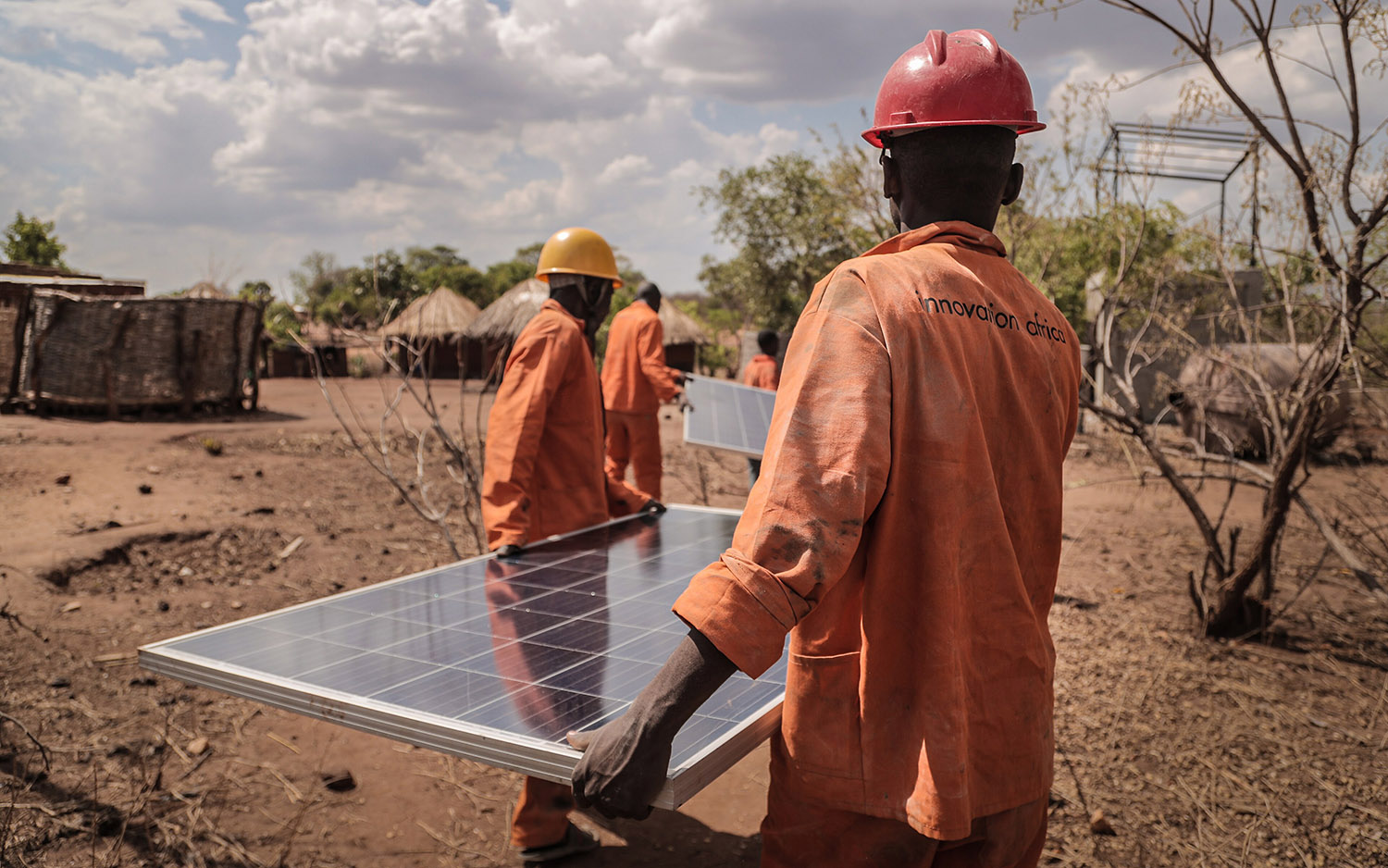
The falling cost of solar panels has already begun to change the face of power generation in Africa. Access to electricity is rapidly extending thanks to an explosion in imports of solar panels. This rollout is occurring largely without government subsidy or engagement: households and small businesses are increasingly buying their own solar systems through the private market. This is great news for people in the region, but presents a challenge to policymakers, regulators and utility power companies.
This is the subject of my new policy paper.
As more households and businesses generate their own solar power, they buy less electricity from the grid. This decrease in demand for grid-based electricity will make it harder for electricity systems to provide cheap, reliable, 24-hour power that is a vital part of structural transformation. The problem is exacerbated if public transmission and distribution companies are locked in to power generation deals with private utility-scale solar energy companies. The sustainable model for electricity in the region is more reliance on private small-scale solar for extending household access, alongside greater public financing of core grid infrastructure and generation to guarantee the electricity needed to power productivity growth.
An explosion in solar panels, nearly all small scale
The declining cost of solar panels has been associated with a massive rise in panel imports across Africa, with cumulative solar capacity increasing from an estimated 8 GW in January 2020 to 65 GW in March 2026. In the sub-Saharan Africa region outside of South Africa, those panels have a generating capacity of about 31 GW compared to utility generating capacity of about 80 GW (although note that this is a maximum capacity measure not a generation/usage measure). The vast majority of solar panel imports (perhaps 85 percent) have been used in distributed systems—standalone units owned by households and businesses.
Figure 1. Imported panels versus constructed utility scale solar capacity in Africa (MW)
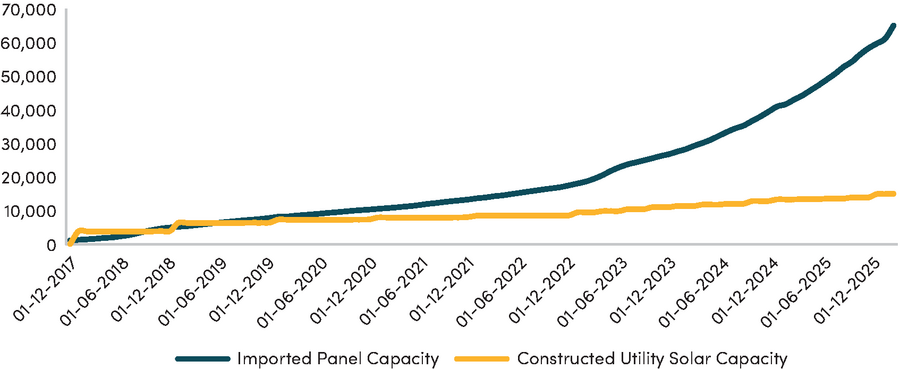
Source for imports, for capacity.
The rollout of distributed solar capacity is a considerable positive development. Solar (and especially solar plus even limited battery capacity) can provide the electricity demanded by lower-income households for lighting, phone charging, television, as well as by small farms and businesses—including refrigeration and pumping. And solar is considerably cheaper than small-scale diesel generation over the medium term.
The utility electricity sector in Africa is nearly all publicly financed
Because of economies of scale in generation, distributed solar power in Africa is still technically (and environmentally) inefficient compared to grid power, but utility-scale solar faces considerable challenges.
Utility-scale solar (and wind) investment in low- and middle-income countries is overwhelmingly part of a public-private partnership (PPPs). In 2017, about 85 percent of utility-level investments in solar involved PPP. But the private sponsors and investors involved in these partnerships want very high returns in order to accept the uncertainty and risk of a long-term infrastructure project in the region. In 2023, a private solar developer in Zambia could face borrowing costs more than eight times those of a comparable project in the US: (45.4 percent compared with 5.3 percent). In practice, this means considerable public financing.Two 50-MW solar projects in Zambia backed by the IFC (the World Bank's private sector arm) in 2015 took more than $3.50 of public international finance (equal to $2 in grant equivalent finance) to bring in each dollar of private finance.
Figure 2. PPI solar projects and utility-scale solar in sub-Saharan Africa (MW)
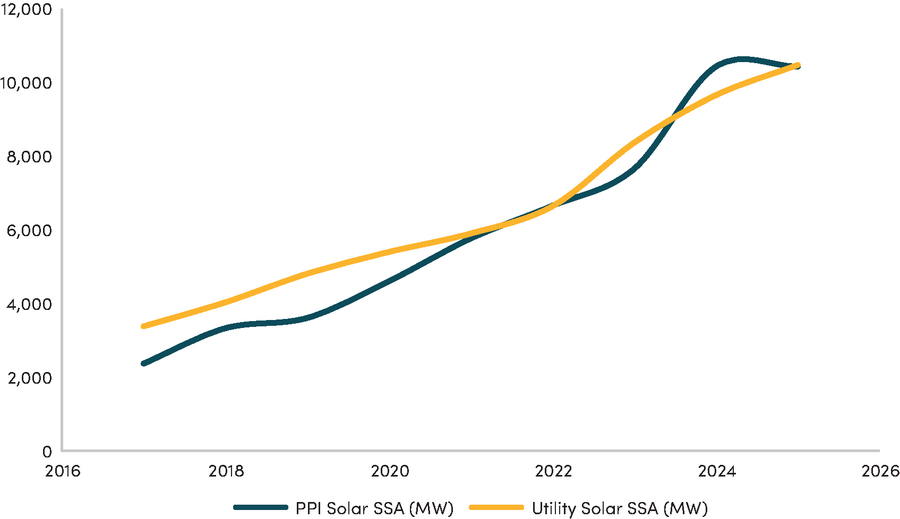
Notes: PPI Solar: World Bank PPI Database — cumulative MW of private solar deals with financial closure. Utility Solar: GOGLA 2025-Q4 satellite-detected utility-scale solar installations PPI Solar runs to 2024. Utility Solar uses satellite detection dates (constructed_before). South Africa accounts for roughly 50% of PPI and 61% of utility-scale solar across SSA throughout the series.
Thus, despite private sponsorship, utility-scale solar in the region outside of South Africa is overwhelmingly publicly financed. In 2024, an estimated $40 billion out of a total $60 billion of clean energy investment on the African continent came from public sources. Looking at projects that list multilateral or bilateral support to solar PPPs in sub-Saharan Africa outside of South Africa, that support amounts to 86 percent of total project costs.
The necessity for dominant financing from public sources will be one reason why utility solar is not seeing the exponential growth seen with panel imports in Africa, adding 1,590MW to constructed capacity in 2025 compared to 1,967MW in 2024.
Distributed solar and the utility death spiral
Distributed solar rollout adds to the financial challenge facing utility-scale solar in particular. Whereas generators are often used only as backup because of the high marginal cost created by the need for fuel, the marginal cost of solar is zero. Firms and households that have purchased solar panels are likely to use the power generated even if connected to a powered grid. As distributed solar reduces daytime demand for grid power, there is a growing risk that utility solar produces power for which there is no market. Under the common “take-or-pay” model of utility contracting, the distributor will still have to pay for that unneeded power, further reducing finance to improve grid reliability and reach.
Meanwhile, peak demand is in the evening. But solar isn't available after the sun goes down. Widespread community/individual solar uptake, if it involves already connected customers, still implies relying on grid power at night. This means that the fixed costs of grid construction and maintenance is distributed across fewer total megawatt hours of power, leading to a higher average cost. More expensive and less reliable grid power will encourage faster growth in distributed power, continuing the spiral.
A new policy model for African energy
The solar revolution means that governments and donors are trying to use market and state provision of electricity services in the wrong places in Africa. Private power generation and state-sponsored household electricity access through grid extension are both financially unsustainable. Core utility power generation should be predominantly publicly provided, while extending household access (especially in rural areas) should predominantly rely on private rollout of solar and battery systems. That suggests the following policy priorities:
- Meet most access ambitions with private distributed solar: Small-scale solar power should be the key tool to extend access in the short term. Grid expansion should only occur when an unconnected area has the financial capacity to pay for the costs of rollout through cost-reflective connection and electricity charges.
- Improve reliability: Governments and donors should focus greater attention on meeting peak needs and ensuring industrial power stability through public sector projects to support a robust grid, battery storage, geothermal and hydro, and gas.
- Reconsider the PPI Model in Africa: Governments and donors should adopt a wholesale approach using multilateral development banks to deliver low-cost finance for public generation. Nigeria's cost of debt for a private solar power project was in the region of 25 percent in 2023. Nigeria could take out a 10-year-dollar-denominated loan from the IBRD at about 5.8 percent at the end of April 2023.
If you want cheap, reliable power to drive industrial transformation in Africa, you are going to have to put the public sector behind it.
Topics
DISCLAIMER & PERMISSIONS
CGD's publications reflect the views of the authors, drawing on prior research and experience in their areas of expertise. CGD is a nonpartisan, independent organization and does not take institutional positions. You may use and disseminate CGD's publications under these conditions.
Thumbnail image by: Michael / Adobe Stock