

The MCAN compact entered into force in a risky and uncertain time in Nicaragua--less than six months before a highly-contested presidential election. This was cause for concern both in Nicaragua and in the U.S. In Nicaragua, there was potential for the MCAN to be manipulated for political gains by the incumbent (for example, by inappropriately accelerating road construction to claim the accomplishment) or to stagnate in the period of political transition. In the U.S., politicians and government officials might have been tempted to use the MCAN as political leverage to sway the elections. After all, the leading opposition candidate was Sandinista leader Daniel Ortega. Indeed, Nicaragua’s mainstream media circulated theories that the U.S. would cut off all aid (and even flows of remittances) if Ortega won the election.
The good news is that rather than succumbing to these political risks, the MCAN and the MCC stayed independent and strong. In fact, the MCAN navigated significant political risks at home and in the U.S. without missing a beat. How did it manage this? There are a number of reasons.
- The MCAN compact was ratified in the National Assembly. This gave it the legal backing necessary to survive a political transition.
- The MCAN is administered by an independent foundation. Unlike ministries staffed with political appointees, the MCAN has a transparent, competitive hiring process and formal employment contracts. This protected the MCAN from staff turn-over and changing political priorities, and gave it an advantage over donor-funded programs that are similarly subjected to these changes because they operate through ministries. That said, there is an important caveat to this independent approach, covered below.
- The MCAN board of directors includes members of the central government. This gives the new administration a legitimate, formal way to influence the program and less need to manipulate it for political reasons. The board members representing local authorities and civil society representatives did not change, giving the board credibility and "a retaining wall" during the transition.
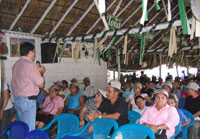
- The MCAN relied on broad consultation. Local authorities and civil society in León and Chinandega helped develop the program parameters, so local-level political support was unwavering.
- The MCAN is transparent. According to many people interviewed for this report, the transparent nature of the MCAN approach means that the "rules of the game are clear" and left little room for political manipulation.
- MCAN foundation was already established and operating. By the time the government transition occurred, MCAN was already up and running with key program activities and procurements underway.
- And most importantly, the MCC stuck to its principles. MCC CEO John Danilovich made a special trip to Nicaragua to make it clear that the MCAN was not at play in the elections. He was quoted in local media as saying the survival of the MCAN depended not on political personalities, but on meeting objective benchmarks and indicators.
These are still early days for the new administration in Nicaragua so it is too early to say that the MCAN has completely survived the political transition. New ministry officials are just getting up to speed on the panorama of aid programs in the country, and are likely to want to make some changes based on their priorities. But the MCAN is well positioned, for all the reasons named above, to hold its ground going forward.
An important caveat to MCAN’s independent approach is that it reflects the MCC’s practice of establishing separate program implementation units outside of existing government structures. The kind of accountability and protection these units afford is one of the reasons why the MCC and many other donors use them to implement their programs. However, while these structures offer protection and can increase program efficiency, they are also criticized for weakening government capacity by wooing away talented officials with high salaries, for complicating the government’s burden of managing a lot of different donors, and for circumventing and thereby weakening country mechanisms for financial management, budgeting, priority setting, procurement and results measurement.
In the Nicaragua case, no one complained of these factors too loudly, but they are definitely sore points in other countries covered by the MCA Monitor. Thus the MCAN’s independent approach should not be replicated without fully considering the potential drawbacks. The MCC is sensitive to these concerns, and in Nicaragua the MCC argues that, despite the creation of a parallel structure, it does build the capacity of the central government in a number of ways. For example, the compact includes funds for institutional support of both PRODEP and MTI, and the government representatives on the board get concrete experience in program oversight and budget management.
Next Section: The MCAN Approach--Innovation and Best Practices