|
An important new study reconstructs global temperatures for the past 11,300 years, showing that while it’s been hotter; temperatures have never risen as quickly. The US is not on track to reach its stated climate goals but public opinion is starting to shift and President Obama and Congress are stepping up. In developing countries, China introduces a carbon tax and the BRICS move ahead with a new development bank. CGD proposes more leadership on climate solutions and a possible new climate agency. And a new book by Oxford professor Dieter Helm makes the case for taxing carbon consumption rather than production.

Michele de Nevers
|
New research confirms that the rate of recent warming is unprecedented in last 11,300 years
|
|
A new study in Science reconstructing regional and global temperatures for the past 11,300 years finds that temperatures are shooting through the roof faster than ever. Although there have been higher temperatures, the lead author of the study, Shaun Marcott of Oregon State University, says that the rate of change in the last 100 years “is much greater than anything we've seen in the whole" geologic time period, which began around 11,300 years ago.
|
The US is not on track to meet stated climate goals but public opinion is shifting and the President and Congress are beginning to act
|
|
A recent World Resources Institute report shows that the United States is not on track to meet its self-determined pledge to reduce GHG emissions by 17% relative to 2005 emissions by 2020. (And this target, equivalent to a decline of 3% relative to 1990, is rated as inadequate by Climate Tracker). However, WRI estimates that with ambitious political and policy actions, the Administration and states can still reach their stated climate goals under existing federal laws.

Source: World Resources Institute
With rising temperatures and increasing weather disasters in the US in 2012, public opinion about climate change may be slowly changing. A survey by Duke University reveals that the percentage of Americans who believe in climate change has grown, with 50 percent of Americans “convinced the climate is changing” and another 34 percent believing it “is probably changing.” This is the highest level of belief in climate change since 2007, according to Duke. And the Government Accountability Office chimed in by adding climate change to the list of the greatest threats the government faces in carrying out federal programs, citing the record number of climate-related disasters in 2012.
Look for President Obama to use his substantial executive power through the EPA while urging Congress to take action. As a first step, Senators Barbara Boxer and Bernie Sanders introduced a bill that would price carbon, starting at $20 per ton and would impose a charge on the carbon content of imports from countries without similar charges. Moreover, the new bill proposed to mobilize funding to help poor countries deal with the impacts of climate change. Unfortunately, most observers are pessimistic about the bill’s chance of making it into law.
|
Meanwhile, China is set to introduce a domestic carbon tax
|
|
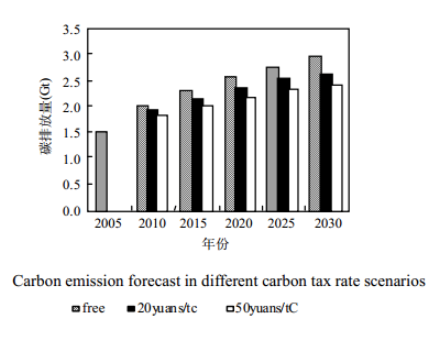
China will soon introduce a tax on carbon emissions. The country’s Finance Ministry proposed a levy that starts at 10 yuan ($1.60) per ton of carbon dioxide and increases to 50 yuan ($8) per ton by 2020. A study by the Chinese Academy for Environmental Planning shows even a small initial tax can help to reduce carbon emissions.
Source: Chinese Academy for Environmental Planning
|
Developing Countries: Call for More Leadership on Climate Change – New BRICS Development Bank & New Climate Agency?
|
|
The 2013 International Energy Agency World Energy Outlook says that the world needs $1 trillion a year over the period of 2012 to 2050 to finance a low-emission transition. The Climate Policy Initiative estimated that global climate finance flows reached $364 billion in 2011 from a variety of public, private and official sources. Given this discrepancy, can we look to emerging economies for leadership?
The proposal by Brazil, Russia, India, China, and South Africa to create a BRICS development bank is gaining traction and may help to fill the financing gap. My colleagues Nancy Birdsall and Lawrence MacDonald have previously suggested that the BRICS countries could also form a coalition to create a new climate agency to provide a core set of knowledge-based services. (Also available in Chinese).
In a similar vein, my colleague CGD Arvind Subramanian and his co-author Aaditya Mattoo launched their new book, Greenprint, which proposes that rapidly growing developing economies take the lead in forging a solution to global climate change. The launch event here at CGD on March 15 included remarks from Andrew Steer, President of the World Resources Institute, and Min Zhu, Deputy Managing Director of the International Monetary Fund. (Video posted soon.)
|
World Bank Exploring Options on Global Public Goods
|
|
The World Bank has commissioned a major study of its role in the provision of Global Public Goods (GPGs). CGD hosted a a roundtable discussion with the authors of the forthcoming report to explore options. CGD President Nancy Birdsall has been prominent among those who urge the Bank to seek a mandate from the member countries to scale up support for GPGs.
|
Taxing carbon consumption rather than production
|
|
In his new book, The Carbon Crunch: How We’re Getting Climate Change Wrong and How to Fix It, Dieter Helm identifies coal as the urgent threat to climate change and supports natural gas as a transition fuel. In a recent talk at CGD, he argued that there is too much support for “current renewable” energy technologies like wind and solar and suggested that research and development on “future renewables” needs to be scaled up. He also promotes better carbon pricing and border tax adjustments so that citizens of rich countries pay the cost of the carbon they consume and not just the amount that is produced within their own borders.
|