Recommended


Blog Post
The Case for Health Taxes

Noncommunicable diseases—such as cardiovascular conditions, diabetes, cancers, and chronic respiratory illnesses—now account for over 70 percent of global deaths, placing immense strain on health systems and costing the global economy more than US$514 billion annually. Much of this burden stems from preventable behaviors: tobacco use, excessive alcohol consumption, and high-sugar diets. These realities highlight the importance of health-related excise taxes—often called “sin taxes”—as powerful tools to reduce harmful consumption while generating much-needed public revenue.
Recent estimates by the Task Force on Fiscal Policy for Health suggest that a one-time 50 percent increase in excise rates on tobacco, alcohol, and sugar-sweetened beverages (SSBs) could raise US$2.1 trillion over five years in low- and middle-income countries. This revenue is equivalent to nearly 40 percent of these countries' current public health expenditures and would provide the added benefit of preventing millions of premature deaths.
The economic logic of sin taxes
Sin taxes are grounded in the economic concept of Pigouvian taxation, which seeks to internalize the societal costs associated with harmful consumption, such as healthcare expenses, lost productivity, and environmental damage. They also address “internalities,” where consumers underestimate or disregard the long-term risks of their consumption habits. Research consistently shows these taxes effectively reduce consumption, particularly among young and lower-income populations who are more sensitive to price increases.
Furthermore, health taxes can significantly expand governments' fiscal space, enabling increased investment in health and social services. However, the success of these taxes depends heavily on effective design. Complex, multitiered tax systems invite avoidance, administrative difficulties, and illicit trade, particularly in lower-income countries with limited enforcement capacity.
Politics, industry pushback, and public support
Beyond the technical challenges, political economy dynamics often complicate the implementation of health taxes. Industries typically respond with strong resistance, leveraging lobbying, misinformation campaigns, and delays. Public acceptance can also fluctuate unless revenues are transparently linked to health or social improvements.
Nonetheless, notable success stories exist. Mexico introduced a sugar tax in 2014, Ethiopia reformed tobacco taxes in 2020, and Colombia secured bipartisan support for comprehensive health tax reforms.
Despite these positive examples, excise revenues remain strikingly low across many countries—particularly in sub-Saharan Africa, the Middle East, and parts of Asia. A significant reason for this underperformance is the absence of a clear framework to assess the revenue potential of health taxes given each country’s unique economic and demographic conditions.
In a forthcoming paper, we address this gap using stochastic frontier analysis—a method that measures the gap between observed tax performance and the maximum attainable outcome, given a country’s structural and institutional characteristics. For a panel of 97 countries with available tax data, we estimate each country's maximum revenue potential from tobacco, alcohol, and SSB taxes, adjusted for structural factors such as GDP, demographics, consumption patterns, and governance quality. By comparing actual revenue collections to these theoretical benchmarks, we calculate “tax-effort scores,” measuring how close each country is to fully utilizing its revenue-raising potential.
Key findings from the benchmarking study
Our study reveals substantial room for improvement in tax policy across the board:
- Tobacco taxes: Our results suggest that countries collect on average just 0.4 percent of GDP in tobacco excise revenue—despite a feasible capacity of 1.5 percent—indicating an untapped fiscal gap of 1.1 percent of GDP. High performers like Argentina, China, and Niger approach their full potential, but many low-income nations lag significantly behind.
- Beer taxes: On beer, countries apply only 35 percent of feasible excise rates. Advanced economies such as Norway and Finland achieve high revenue relative to potential, whereas countries like Lebanon significantly underperform.
- Spirits taxes: On spirits, countries collect only one-fourth of the feasible rates. Countries like Turkmenistan and North Macedonia approach optimal taxation, but many others, including wealthy nations such as Japan, collect far less than their structural potential.
- SSB taxes: This category shows the largest gap, with collection of only 15 percent of feasible rates. With few exceptions (e.g., Bangladesh, Oman, Rwanda), most countries tax sugary beverages minimally or not at all, capturing less than 10 percent of their revenue capacity.
Structural factors—such as income level, demographics, and governance—explain much of the variation, underscoring the necessity of adapting tax policy to local contexts.
Figures 1–4 illustrate these gaps across products and regions. Tobacco tax collections fall particularly short in Latin America and the Caribbean, the Middle East and North Africa, and sub-Saharan Africa. In contrast, North America shows sizable gaps for both beer and spirits. The largest shortfalls, however, are in SSB taxation, especially in Latin America and the Caribbean and in the Middle East and North Africa.
Figure 1. Actual vs. potential tobacco excise revenues by region
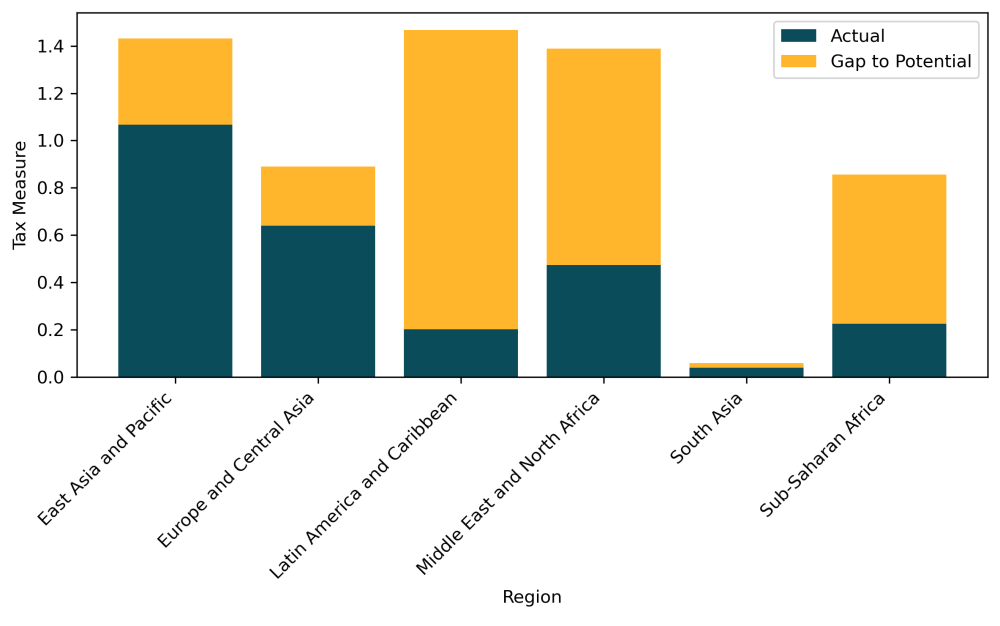
Notes: No data is available for North America. South Asia’s average is affected by Afghanistan’s tobacco tax collections, which exceed the potential. The gap between actual and potential reflects either under taxation, weak enforcement, or both.
Figure 2. Actual vs. potential beer excise revenues by region
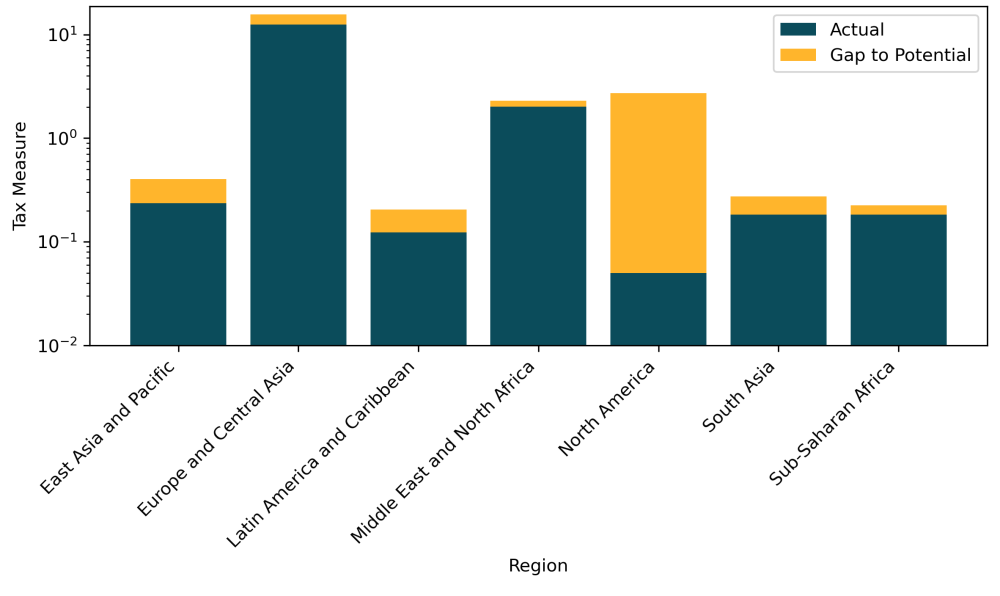
Notes: Y-axis is on a log scale to display both large and small values. The gap between actual and potential reflects how intensively beer is taxed relative to structural peers.
Figure 3. Actual vs. potential spirits excise revenues by region
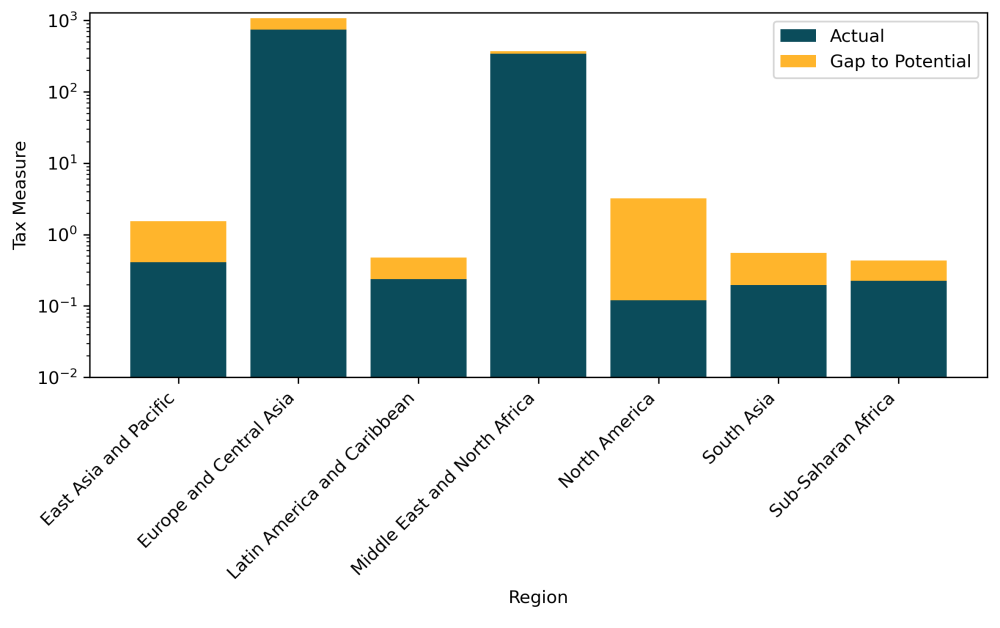
Notes: Y-axis is on a log scale to display both large and small values. The gap between actual and potential reflects how intensively spirits are taxed relative to structural peers.
Figure 4. Actual vs. potential SSBs excise revenues by region
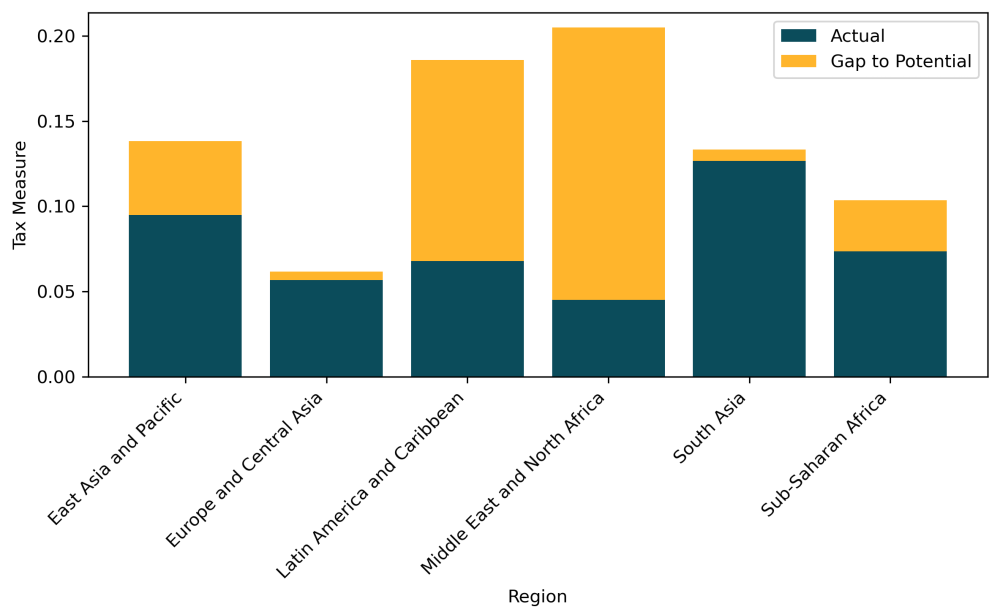
Notes: No data is available for North America. The gap between actual and potential reflects how intensively SSBs are taxed relative to structural peers.
Policy implications
Our findings carry three important implications for policymakers:
- Unlock excise potential: Even countries with established excise systems can achieve substantial health and fiscal gains by adjusting rates and enhancing compliance.
- Simplify the tax system: Moving toward simpler, unified excise tax systems, along with improved enforcement (such as track-and-trace methods), can significantly reduce evasion and administrative burdens.
- Build capacity and share peer learning: Technical assistance and peer-learning platforms are essential, particularly for emerging market and developing economies (EMDEs), where administrative and enforcement capacities remain limited.
Policy opportunities and challenges differ by income group:
- Advanced economies often perform well on tobacco and beer taxes but underutilize taxes on spirits and sugary drinks, usually due to industry lobbying or policy inertia. Moderate rate increases and improved indexation can unlock new revenue streams.
- EMDEs vary significantly in their approach to health taxes. While countries like Rwanda and Bangladesh demonstrate effective policy integration, many others collect far below half of their potential revenue due to weak enforcement and fragmented regulations. EMDEs thus require investment in tax administration, technical capacity, and simpler tax designs.
Conclusion: A dual dividend opportunity
By clearly benchmarking health tax potential across countries, our research provides policymakers with actionable insights to design smarter, fairer, and more efficient excise tax policies. Success hinges on tailored policy design, administrative capacity building, and sustained political commitment.
Governments must weigh health taxes against alternative revenue-raising measures like VAT, considering broader goals, including health outcomes and equity. The optimal tax strategy is country-specific, shaped significantly by administrative capacity, regional tax policies, and smuggling risks.
Whether driven by fiscal pressures, rising health burdens, or a desire for fairness, policymakers now have clearer guidance on what's achievable—and what's being left on the table. With targeted reforms and international cooperation, the dual dividends of health taxes—improving population health and enhancing fiscal sustainability—can finally be fully realized.
This blog was edited with assistance from AI and reviewed by the authors and a human editor before publication.
Topics
DISCLAIMER & PERMISSIONS
CGD's publications reflect the views of the authors, drawing on prior research and experience in their areas of expertise. CGD is a nonpartisan, independent organization and does not take institutional positions. You may use and disseminate CGD's publications under these conditions.
Thumbnail image by: Rawpixel.com/ Adobe Stock