Recommended
Blog Post
Assessing the UK’s International Development Reset
Event
How Should the UK Scrutinise Its Aid Spending?
HYBRID
February 24, 2026 12:00—1:00 PM ET | 5:00—6:00 PM GMT
Blog Post
UK Aid Cuts Now Deeper than the US After Congress Pushes Back
The UK development minister Baroness Chapman recently set out major changes to the UK’s development policy, and revealed further detail on planned aid spending from the Foreign, Commonwealth and Development Office (FCDO) over the next three years. Our colleagues have highlighted some important implications of this announcement, and how they stack up against key tests of aid quality.
In this blog, we focus on the biggest winners from the recent FCDO allocation: the British Overseas Territories, islands which are largely self-governing but remain under UK sovereignty. This tiny group of islands—whose ODA-eligible population could fit into a small sports stadium—has received a 41 percent increase relative to the latest available year’s data, and are set to receive eye-watering amounts of ODA per person. We set out how this compares to other groups and why the UK prioritises these islands. We argue that ending aid programmes in countries with entrenched poverty and at the same time increasing aid to these comparatively wealthy islands is indefensible.
The big winners of the FCDO aid allocation
In the allocation publication, the FCDO did not provide a full country breakdown, only regional budgets with a few notes on priority countries (such as Ukraine, Sudan, Lebanon, and Palestine). But examining the country information that we do have, along with regional spending, reveals a stark difference in the ODA per person received by each.
Per capita FCDO aid allocations in 2026/27, by region/country
| 2026/27 allocation (£m) | Population (latest figures) | Per capita regional allocation (£) | |
|---|---|---|---|
| Sudan | 120 | 50448963 | 2.38 |
| Lebanon | 33.5 | 5805962 | 5.77 |
| Palestine | 101 | 5289152 | 19.10 |
| Ukraine | 240 | 37860221 | 6.34 |
| Africa | 818 | 1291044964 | 0.63 |
| Asia Pacific | 113 | 2,141,122.26 | 52.78 |
| Middle East North Africa | 375 | 736401764 | 0.51 |
| Overseas territories | 130 | 8,419 | 15,441.26 |
| Eastern Europe central Asia | 13 | 250281521 | 0.05 |
Notes: Population data from World Bank Data apart from overseas territories. Exact names are “Sub-Saharan Africa (excluding high income)”, “East Asia Pacific (excluding high income)”, “Middle East, North Africa, Afghanistan & Pakistan (IDA & IBRD)” and “Europe and central Asia (excluding high income)”. There might be some discrepancies in groupings, but not enough to overturn a six-order of magnitude difference.
Sources: WDI, Saint Helena Government, Montserrat Government, Government of the Pitcairn Islands, FCDO allocations
The British Overseas Territories include numerous islands across the Pacific, Atlantic, and Caribbean. However, the majority of these (such as the Cayman Islands or Bermuda) are comparatively wealthy. Only two remain ODA-eligible: Montserrat and Saint Helena. It is worth noting that the tiny island of Pitcairn also receives UK ODA despite not being on the ODA-eligible list; the UK appears to claim in DAC statistics that it is going elsewhere.
These three territories (of which one doesn’t appear to be eligible, see below) currently have a combined population of 8419 people (4,399 in Monsterrat, 3970 in Saint Helena, and around 50 in Pitcairn), roughly equivalent to the capacity of Leyton Orient’s stadium, a third-tier football team. They nevertheless have a protected allocation of £130 million, meaning Saint Helena, Montserrat, and Pitcairn will receive ODA to the tune of roughly £15,441 per person per year on average. Sub-Saharan Africa has a population of 1.29 billion and is budgeted to receive £818 million from FCDO in 2026/27: a per person allocation of around 63p. The per-person ODA allocation from FCDO for the overseas territories could buy you nearly one year’s rent at the UK average. The per-person allocation for Sub-Saharan Africa could buy you a small packet of own-brand crisps.
Is the allocation fairer if you account for other finance?
However, there are two other things we should take into account. First, FCDO will also be shifting towards multilateral spending, which will not benefit overseas territories but will end up increasing aid received elsewhere. At a recent CGD event, the development minister Baroness Chapman made the case that support for Africa would come largely through multilateral contributions: the UK has made a substantial pledge to the African Development Bank, and remains a large contributor to the International Development Association which largely lends to Africa (although, analysis by colleagues suggests this is overblown). The share of the UK’s multilateral aid that goes to Africa is around 50 percent, and current figures suggest that multilateral aid will be over £2 billion. So that would bring Africa’s per person allocation up to around £1.40 (a slightly fancier packet of crisps).
Second, the UK is essentially the only country to give aid to these territories, whereas all the other regions/countries in table 1 will receive aid from other sources. However, even adding up all the finance Africa received from sources that report data to the Creditor Reporting System (whether concessional or not, multilateral and bilateral, even with philanthropic funding thrown in too) it comes to only £57 per person, still orders of magnitude below aid to the territories.
This is despite those territories being comparatively wealthy. Current GDP per capita is around £12,600 on average, or roughly ten times higher than in Africa. These figures are not adjusted for purchasing power parity (figures are not produced for the overseas territories to our knowledge) but this is unlikely to narrow the gap substantially.
Is this explained by UK obligations?
In its allocation breakdown, the FCDO notes the overseas territories allocation was protected to meet “constitutional and international obligations”. The UK does have a range of international obligations to the overseas territories under the UN charter, including to ensure their economic advancement (but nothing about providing ODA), although pinning down what is meant by constitutional obligations is harder. The UK has also reasserted that it will “[meet] the reasonable needs of Territories where financial self-sufficiency is not possible” in the most recent UK and Overseas Territories Joint Ministerial Council communiqué. It also notes that the overseas territories “continue to have the first call on the UK’s aid budget”, and this is also the only aid spending that is not legally required to reduce poverty.
But as FCDO officials have said, these commitments and obligations have nothing to do with ODA, and the UK would continue to meet them whether or not the countries are ODA-eligible. Counting it from the ODA budget is merely cost-cutting accounting exercise—these are government commitments not just FCDO commitments.
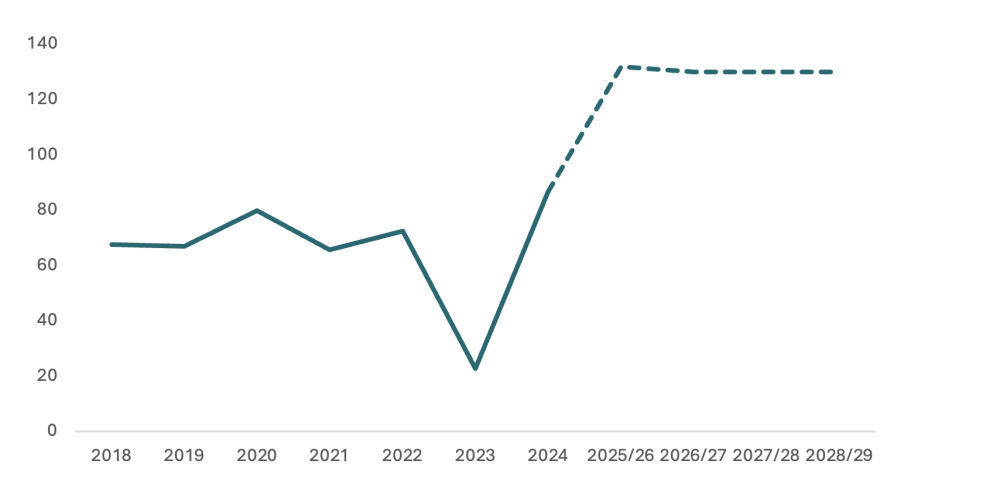
What’s more, these obligations have not changed, yet the planned allocation to the overseas territories represents a substantial increase (41 percent relative to the latest year) even as the rest of the aid budget goes in the other direction. The average aid received by the territories between 2020 and 2024 (the latest five years of published data) was £65 million per year. The recent plans announced by the minister represent a doubling of that amount. It is not clear why this is necessary.
UK aid to Overseas Territories, £million
Source: OECD CRS, FCDO
Montserrat should not even be eligible, Pitcairn might not be
Fixing the allocation until 2028/29 is all the more surprising given that Montserrat—which currently accounts for more than half the ODA-eligible population—will probably stop being eligible to receive ODA within that period. In fact, it should have stopped already. By 2026, it had met the test for graduation from ODA eligibility by remaining a high-income country for three consecutive years. It was only lobbying on the part of the UK that persuaded the DAC to keep Montserrat on the ODA-eligible list (the decision having already been delayed). But this discussion is due to re-emerge in 2027, at which time the DAC will likely (and should) decide that Montserrat graduates. If that happens, the £130 million would essentially all go to Saint Helena, amounting to over £32,000 per person. This is roughly equal to the median UK household disposable income. By contrast, Africa’s allocation will have fallen to £677 million, or about 48p per person.
Meanwhile, Pitcairn has never been on any ODA-eligible list. In its reporting the UK has got around this by labelling aid to Pitcairn as going to “Oceania, regional” or, more bizarrely, attributing it to Saint Helena (which is around 8,000 miles away).
The FCDO should rethink the increase to overseas territories
The amount of aid to the overseas territories has always been disproportionate relative to their wealth and population, but in the past it was a relatively minor concern: reallocating the £60-£80 million or so would not have made a huge difference to the budgets of other countries. But after years of steep cuts to other programmes, this is no longer a trivial allocation decision. By 2028/29, it is plausible that 4000 people get more aid than the whole of Sudan (a country with 50.4 million), supposedly a priority country.
The UK should find another budget to fulfil its commitments to these territories, rather than taking even more out of an already decimated aid budget.
Topics
DISCLAIMER & PERMISSIONS
CGD's publications reflect the views of the authors, drawing on prior research and experience in their areas of expertise. CGD is a nonpartisan, independent organization and does not take institutional positions. You may use and disseminate CGD's publications under these conditions.