The International Monetary Fund’s financial relationship with low-income countries (LICs) is approaching a historically rare shift. The share of LIC borrowers repaying more to the IMF than they receive in new disbursements reached a historic high in 2026. The exceptional increase in IMF financing during the COVID era was a response to extraordinary financing needs. Like any IMF lending, it must be repaid. As repayments on that exceptional wave of lending come due, aggregate net flows from the Poverty Reduction and Growth Trust (PRGT, the IMF’s main vehicle for providing concessional financing) to LICs are projected to turn negative around 2030. A forthcoming CGD paper shows that a sustained multiyear period of negative net flows would be a marked departure from the historical pattern and argues that the scale and pattern of IMF financial engagement with LICs should be a conscious choice for its members, rather than simply emerge from existing framework settings.
That choice would now have to be made in a much harsher environment. The external financing architecture around LICs has shifted materially, while repeated shocks have left many countries with high debt service burdens, diminished buffers, and limited room to support growth. Aid is falling sharply, external borrowing remains expensive, and LICs are highly exposed to further commodity price and global financial shocks. This blog asks how that changed financing landscape alters the stakes of the prospective contraction in net IMF financing, and, if that shift is deemed undesirable, what would be required to make a more supportive IMF financial role effective.
1. The financing architecture around LICs has changed
External financing to LICs has become scarcer and differently composed. Private financing has become more expensive and less reliable, bilateral grants and concessional lending have retrenched, and China’s role as a major source of sovereign financing has been substantially reduced. Multilateral institutions have consequently become increasingly important sources of net-positive financing.
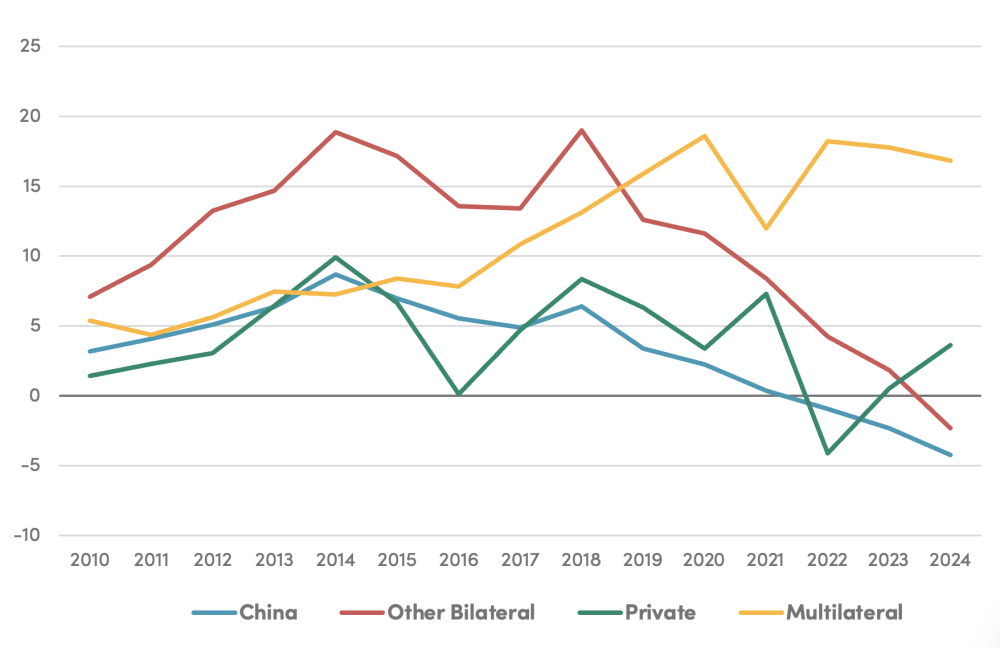
From 2010 through 2018, net transfers (gross disbursements minus principal and interest payments) from major creditor groups to PRGT-eligible countries were positive and, for most groups, rising (Figure 1). That pattern has broken down since. China’s net transfers turned negative in 2022 and have stayed negative. Other bilateral creditors also turned negative in 2024. Private creditors’ net transfers have been considerably more volatile over the period, including a negative year in 2022, before recovering somewhat in 2024. Multilateral institutions are the one group whose net transfers have remained positive and comparatively stable throughout, meaning they have provided a growing share of the financing LICs still receive on net as other sources have retreated.
Figure 1. Annual net transfers to PRGT-eligible countries by creditor group (USD billions)
Source: World Bank International Debt Statistics (IDS).
Note: Figures are aggregate net transfers for countries eligible for PRGT financing in 2026. Multilateral creditors exclude the IMF. IMF net financing to PRGT-eligible countries is analyzed in a forthcoming CGD paper.
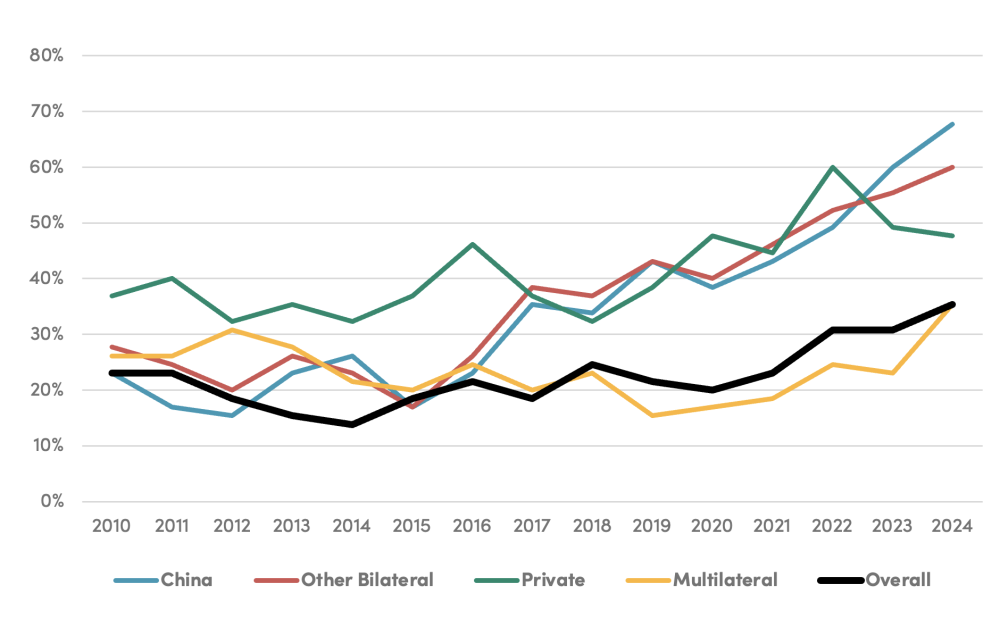
The same pattern shows up at the country level, and more starkly (Figure 2). By 2024, roughly two thirds of PRGT-eligible countries were making net transfers to China rather than receiving them, and 60 percent had net-negative transfers from other bilateral creditors. For both creditor groups, these were the highest shares with net-negative transfers in the 2010–24 period, while the share of LICs with net-negative transfers to private creditors remained just below its 2022 peak. This is not a story about a handful of large borrowers dominating the aggregate dollar figures. A broadening share of LICs are net repayers to several creditor groups at once, repaying more to each than they receive from it in new disbursements.
Figure 2. Share of PRGT-eligible countries with net negative transfers by creditor group
Source: World Bank International Debt Statistics (IDS).
Note: Shares are calculated among countries eligible for the PRGT as of 2026 with available data. “Overall” refers to total net transfers across creditor groups. Multilateral and overall figures exclude the IMF.
A near-term financing hurdle
One way to see how much this matters going forward is to compare what countries already owe against what they have recently been receiving. The table below compares average annual external public debt service due in 2025–26 with average annual gross disbursements received in 2023–24, by creditor group.
Table 1. Gross disbursements and debt service by creditor group
| Creditor group | Average annual gross disbursements, 2023–24 ($bn) | Average annual debt service due, 2025–26 ($bn) |
|---|---|---|
| China | 2.9 | 11.4 |
| Other bilateral | 11.3 | 11.1 |
| Private | 15.3 | 17.4 |
| Multilateral | 31.1 | 20.3 |
| Sum of creditor groups shown | 60.6 | 60.2 |
Source: World Bank International Debt Statistics (IDS).
Note: IDS reports actual disbursements and debt service payments through 2024. IDS data thereafter cover projected disbursements and debt service on loans committed as of end-2024 and therefore exclude subsequent new lending. Multilateral figures exclude the IMF. IMF net financing to PRGT-eligible countries is analyzed in a forthcoming CGD paper.
These are hurdles that future disbursements would need to clear for transfers to remain non-negative, not predictions of what those disbursements will be. The comparison suggests quite different near-term financing hurdles across creditor groups. Chinese disbursements would need to roughly quadruple from recent levels simply to keep net transfers from turning negative, at a time when its lending has been on a declining trend for several years. Other bilateral lending would need to hold around recent levels at a moment when bilateral aid budgets are already being sharply cut. Private disbursements would also need to rise from recent levels, against a backdrop of still-difficult market financing conditions. Multilateral institutions, by contrast, start from a position where a continuation of 2023–24 disbursement levels would be comfortably above scheduled 2025–26 debt service.
The IMF’s recently concluded 2026 Review of Program Design and Conditionality (ROC) reaches a related diagnosis. It finds that private and bilateral official flows have declined markedly and warns that the evolving global environment could mean less external financing for vulnerable countries, leading simultaneously to greater policy adjustment needs and more requests for IMF support. One implication is that the relative financing role of the institution needs to respond to changes in the financing architecture around it.
2. Is this the right time to allow the IMF’s net financial role to contract?
This shift in IMF concessional financing to LICs—from net-positive to net-negative flows—is projected to occur just as net financing from other creditors has weakened. At the same time, repeated shocks have eroded fiscal and external buffers, debt service absorbs substantial government and foreign exchange resources, external borrowing remains expensive, and many countries have already undergone several years of difficult policy adjustment. A shift to net-negative flows would therefore be occurring under very different circumstances from, say, a repayment cycle taking place against abundant external financing, supportive global conditions, and strong domestic buffers.
Persistent financing shortfalls ultimately require policy adjustment and changes that improve a country’s underlying external position. Financing nevertheless affects the feasible pace and composition of that adjustment, and the space available for reforms and investment that can strengthen growth and external viability over time. A persistently tighter financing environment can therefore change the appropriate balance between financing and adjustment, even though financing cannot substitute for the underlying adjustment. In IMF-supported adjustment programs, the institution’s own financing stance can also affect how that financing burden is shared. Calls for other creditors to maintain or increase financing may carry less weight if the IMF itself is simultaneously reducing its net financial contribution.
The 2026 ROC proposes welcome targeted improvements for individual programs facing this tighter environment, including more realistic financing assumptions, recalibration when anticipated financing does not materialize, and a stronger medium-term orientation for structural reforms. These changes largely operate within the existing program framework. A persistent change in the financing environment raises a broader set of questions, including whether that framework remains appropriately calibrated for the IMF exposure and burden sharing that may now be required, and whether the usual program and financing horizons provide enough time for a realistic adjustment path and deeper reforms to take hold.
The 2024 PRGT reform itself reflected a conscious membership judgment about sustainable concessional lending capacity. But the appropriate scale and pattern of IMF engagement should remain under consideration as external financing conditions change. This brings the issue back to the choice the forthcoming paper identifies. If IMF members conclude that the changed financing landscape and today’s exceptionally difficult external environment make contraction in the IMF’s net financial role in LICs undesirable at this difficult juncture, maintaining a more supportive net role may require accepting greater IMF exposure in some LIC programs. In that case, how would the IMF manage increased exposure, and what would make greater exposure worth the risk? Clearly, it would need to be motivated by more than filling a structurally larger financing gap.
3. What Greater IMF Exposure Would Need to Achieve
The case for greater IMF exposure would rest in part on what additional financing could enable: a more feasible pace and composition of adjustment, greater scope to protect high-return investment and priority development spending, and sufficient time and policy space for deeper reforms to raise growth and domestic resources. It could also help prevent liquidity pressures from developing into deeper macroeconomic and debt problems, and reduce pressures to resort to opaque and more costly financing alternatives or postpone adjustment until imbalances have built to the point of crisis.
Greater IMF exposure also creates important risks. Larger financing can weaken adjustment incentives if it substitutes for necessary policy change. Where debt sustainability is particularly uncertain, it can delay needed debt resolution. Rising senior multilateral claims can also weaken the IMF’s catalytic role with other creditors, a risk the 2026 ROC explicitly identifies in calling for action to address excess senior debt. And if higher exposure does not produce sufficiently durable improvement, the IMF could become increasingly drawn into rollover, with less room to be selective about continued support and the strength of the policy commitment accompanying it. The risks to the IMF therefore run in both directions: larger exposure carries financial and program risks, while underfinancing can weaken the growth, revenue, and repayment capacity on which its claims ultimately depend.
Accepting greater exposure in some LIC programs would raise the bar for what should be expected to be durably achieved in those cases. The objective of durably resolving underlying vulnerabilities is hardly new, but achieving it has often proved difficult. Greater exposure would therefore need to come with a credible prospect of a decisive boost to the country's capacity to overcome the macroeconomic and structural hurdles that repeatedly bring it back to IMF support. That is an exceptionally demanding standard. It would require country authorities to be in the driver's seat, able to pursue reforms ambitious enough to change the country's trajectory, supported by effective IMF financing and enhanced policy engagement capable of helping those reforms take hold. Meeting that standard would mean fundamentally stronger policies, built on institutions capable of sustaining macroeconomic stability and growth, not simply enough incremental improvement to ease immediate pressures.
Achieving that kind of change would itself mitigate the risks of greater IMF exposure. Stronger growth and own-resource generation would reduce future external financing needs, strengthen capacity to service existing debt, and lower the likelihood that higher exposure ultimately requires continuing IMF rollover.
The appropriate judgment about how much exposure is warranted will differ substantially across countries, reflecting both where additional IMF financing is most needed and where it has the potential to decisively improve the country's macroeconomic stability and growth trajectory. These considerations will not always point in the same direction. Those judgments will differ across LICs, including frontier markets, poorer countries and fragile and conflict-affected states, and countries facing different levels and types of debt risk. They will also depend on which sources of external financing have weakened and why, the country's reserve and financing buffers, and the strength of the authorities' reform commitment.
The forward-looking question is therefore when and how larger IMF financing, together with the right program design, implementation, and policy engagement, can help countries achieve that decisive improvement in macroeconomic stability and growth while containing risks to policy adjustment incentives, the IMF’s catalytic role, and its own balance sheet. Answering it requires looking beyond the scale of financing alone to how financing, adjustment, reforms, and other aspects of program engagement can work together to produce that outcome.
Conclusion
The prospective shift in the IMF’s financial relationship with LICs toward net-negative flows is arriving as the broader development financing architecture is undergoing a fundamental transformation. Many LICs are contending with high debt service burdens, thin buffers, expensive financing, and repeated shocks. IMF members may conclude that this is not the right time to allow the IMF’s financial relationship with LICs to move toward net-negative flows. Maintaining a more supportive net financial role could then require accepting greater exposure in some LIC programs. If so, the challenge would be to make that exposure sufficiently effective to deliver decisive and durable gains in macroeconomic stability and growth, underpinned by stronger policies and institutions capable of sustaining those gains and materially strengthening countries’ capacity to finance their own development, while managing the risks that greater exposure creates. The scale and nature of IMF financial engagement with LICs should reflect a conscious judgment about those tradeoffs at this difficult juncture rather than simply emerge from existing framework settings by default.
Topics
DISCLAIMER & PERMISSIONS
CGD's publications reflect the views of the authors, drawing on prior research and experience in their areas of expertise. CGD is a nonpartisan, independent organization and does not take institutional positions. You may use and disseminate CGD's publications under these conditions.