

Sarah Lucas
March 2006
Ghana is a star among low-income countries, described by many working in the country as "in a class by itself" for its political stability and economic progress. This reputation sets high expectations for the country's ability to make the most of the MCC's "country ownership" principle. This report looks at two important processes that the recipient country should lead or "own"--donor coordination and civil society engagement--to illustrate the potential implications of the MCC's ownership model for other prized MCA principles. It asks, "How much should the MCC rely on national governments, even in star countries, to 'own' and manage processes and principles fundamental to the MCA approach?"
What is Country Ownership?
By its very design, the MCC is ahead of other US aid programs in terms of placing partner countries in the lead on setting national development priorities and designing their own funding proposals. It extols this "country ownership" as a critical development value, essential for sustained growth and poverty reduction. But in the global arena, the MCC is not so unique. Other donors promote country ownership with a long-term view, working closely with countries to improve their capacity to manage all aspects of national development--planning, budgeting and financial management, implementation and evaluation. These ownership efforts had been in action for years in Ghana when the MCC arrived with its own brand of country ownership. 
How does the MCC's approach differ? A key difference is location. The MCC is in Washington, while other donors are in Accra. Another is that the MCC seems to front-load the ownership – that is, instead of being an evolution that matures along with increased government capacity, the MCC is hands-off from the start. One senior MCC staff member described this as a "reactive" approach, meaning that Ghana's government has the freedom to take the first steps, and the MCC only reacts if it sees something going astray.
Be it "hands-off" or "reactive," this approach has pros and cons. The Government of Ghana (GOG) has taken a strong and singular lead on the proposal process, and the Ghana MCA team (MCAG) feels proud and unequivocal about the proposal reflecting national priorities. They have no complaints, as they do with other donors, of the MCC pushing a particular agenda. However, some described the MCC's hands-off approach as a "cop-out." In the name of country ownership, they argued, the MCC has kept its hands too far off in terms of engagement with other donors and with civil society, allowing the MCAG to loosely interpret the processes and principles fundamental to the MCA approach.
Coordination with Other Donors: Fundamental to Effectiveness and Innovation
The MCA program was born in the spirit of innovation and effectiveness. To live up to these ideals, the MCC must learn from what has come before, and take time to understand how it fits in the broad spectrum of development programs. One way to do this at the country level is to learn from the past experiences of other donors, and to coordinate with them on current programs. It is not altogether clear the extent to which the MCAG and MCC have done this in Ghana. By some accounts, the MCC's hands-off approach to country ownership has contributed to very poor communication and coordination between MCAG and other donors. The MCC and MCAG disagree.
The Context: The Makings of a Conflict
In the words of one US official in Accra, donor coordination is a "big deal" in Ghana. This is especially true in MCA program sectors--agriculture, private sector development and social development. Donors share information, plan jointly with ministries, pool funding, and have an “ambitious and serious” commitment to the principles laid out in the 2005 Paris Declaration on Aid Effectiveness and Donor Coordination (to which the US is a signatory). It is in this context that the MCC arrived with a hands-off approach, no permanent on-the-ground presence, and little enthusiasm about the nuts and bolts of donor coordination. Not surprisingly, they ruffled some feathers. According to one donor, "we finally had a coordinated approach to growth and private sector development between donors and with government," when the MCC came in like "like a cat among the pigeons."
Why might the MCA program strain or disrupt relationships among existing programs? Because it is so big. At an estimated $120 million a year, the MCA program will more than double current US development assistance to Ghana annually (currently $75 million spread across the spectrum of U.S. development activities.) It will approximately equal the budget support offered by DFID, Ghana's largest bilateral donor. And its resources will swamp the World Bank's and DFID's existing investment in agriculture and private sector development. The size could be a huge benefit in helping the MCC be transformative, but it puts a high premium on MCAG and MCC coordination with other donors.
Divergent Views of Coordination
The story on MCAG/MCC coordination with other donors in Ghana boils down to two perspectives. On one hand, donors are frustrated that they have seen little programmatic detail despite the MCAG's ambitious plans in sectors where other donors are already invested. On the other hand, the MCAG and MCC say they are now doing everything they can to share information and coordinate with other programs.
How can these views be so divergent? First, the proposal timeline makes people nervous. Donors see how long it has taken for the MCAG to share information, and how little time remains before the planned compact signing in July. They fear that there will not be enough time to meaningfully engage on program details.
Second, expectations about coordination are different. The MCAG argues it is avoiding program overlap by working through ministries to catalogue donor activities (and indeed it has an impressive matrix of donor interventions by sector and region), and has disseminated a survey to donors to map planned activities in its 19 target districts. The MCC argues that it spends half its time in Accra in meetings with donors and is being "unfairly compared to donors on the ground" in terms of how much it engages. For their part, donors aren't particularly impressed by matrices, surveys or even sitting through meetings. They are looking for meaningful and detailed discussion of program design and implementation plans.
Third, perspectives on ownership are different. For example, the MCC recently agreed to meet with a large group of other donors to discuss Ghana's MCA proposal. Reiterating that it sees the MCAG as taking the key role in coordination during program development MCC staff suggested that the GOG minister leading the MCA process join the meeting. Apparently the donor group resisted. MCC staff took this as a sign that other donors were more interested in promoting their own agendas than promoting country ownership. Donors saw the MCC as naïve about internal political dynamics and the value of pure donor-to-donor exchange.
The bottom line is that other donors are miffed and the MCC and MCAG are confident they have covered the bases. It looks a bit like they are talking past each other, though additional meetings held in late March hopefully smoothed the dialogue. More will be revealed about how the MCAG program does or does not complement other development efforts when the compact is made public in July.
The Risks of Poor Coordination
Coordination can help individual donors make the most of their own investments by leveraging those of other donors and learning from the mistakes of those that preceded them. Perhaps the MCAG and MCC are missing great opportunities on this front. According to one representative of the donor community, "Donors are willing to be radical…happy to redeploy to other regions or sectors if the MCA focuses heavily somewhere we are working, but the MCC is not thinking creatively on coordinating with others." Other than the obvious risk of duplicating efforts (which the MCAG claims to have covered), what do the MCAG and MCC stand to lose in terms of program effectiveness and success by not engaging earlier and more meaningfully with other donors? Risks include:
- Repeating past mistakes. The MCA proposal is not the first to promise modernization of the agriculture sector. In fact, the Afram Plains, one of the three target regions, has "been the potential breadbasket of the country for forty years,” and the area is “littered with the carcasses of agricultural machinery" that donors and GOG officials of yesteryear hoped would inspire an agricultural revolution in Ghana. Land reform, said to be a "political black hole" in Ghana, has also been tackled before, most recently by the World Bank (whose current Land Administration Program has managed to disburse a very small fraction of its program budget). As another example, the GOG launched its President's Special Initiatives in agriculture with great fanfare a few years ago, but the focus sectors (cassava starch and palm oil, among others) have failed to get much attention from donors or the private sector. How well do MCAG and MCC officials understand what went wrong in each of these previous efforts? Have they collected lessons from optimistic investors and reformers of the (not so distant) past? Will the compact publicly demonstrate why they think they will achieve success where others have not?
- Complicating Matters. The MCC requires countries to establish "accountable entities" to oversee country programs. These entities can be a government ministry, an agency or an independent body - existing or newly-created. The Ghanaian government decided to set up a new independent authority to play this role, a decision that perhaps will allow better tracking of MCA dollars, but is contrary to longer-term development effectiveness lessons to work through existing government mechanisms rather than create parallel structures to oversee new aid programs. It also risks exacerbating an already complicated situation in Ghana. A primary concern among donors and civil society is the plethora of ministries, departments and agencies (referred to as MDAs) that have been created to oversee various policies and programs. A recent survey documented over 70 MDAs that have some bearing on the national Private Sector Development Strategy--a chaotic mix that threatens efforts to promote and strengthen the role of the private sector in economic development. It remains to be seen whether the MCAG's new authority will help rationalize this mix or further complicate it.
- Angering partners the MCAG may eventually depend on. Quite a few people close to the MCA process in Ghana expressed the concern that "if the MCAG and MCC don't deal with donor coordination seriously, there will be a major backlash." There is the real danger that the MCAG will undermine the potential for coordination with other donors when the team most needs it--like pitching in to co-fund the ambitious social infrastructure plan that was concocted in the MCA proposal process but which the compact will not fully fund.
At the very least, donor coordination is about doing no harm to existing programs, approaches, and strategies. At its best, donor coordination is about maximizing effectiveness and achieving results. Some in Ghana argue the MCAG is missing the opportunities that coordination offers, and that there is room for more proactive guidance from the MCC in this area. By its own accounts the MCC has been pushing itself and the MCAG team to reach out to other donors, actively learn from their experiences, and work hard to ensure complimentarity of programs. The MCC had planned a series of additional meetings which may have made progress on this front, but more meetings may not be the answer. Lack of creative thinking and substantive guidance on effective consultation and donor coordination at the beginning of the process is impacting the program now, and the concrete July 28 signing date may impact best practice consultation, coordination and due diligence. The compact itself, and ultimately the results it achieves, will indicate whether the MCC and MCAG have avoided the risks associated with poor donor coordination.
Consultation with Civil Society: Taking Ownership Beyond the Government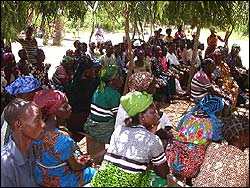 The MCC recognizes that ownership stretches beyond the government; that programs are more likely to be effective if they have buy-in from NGOs, the private sector, and citizens at large. For this reason, the MCC places a strong emphasis on civil society consultation. This emphasis is reflected in MCC's guidance on the consultative process (pdf). It is not, however, reflected in what has happened in Ghana so far. Consistent with the MCC's hands-off ownership model, it has left the MCAG in charge of initiating engagement with civil society. The result has not lived up to the MCC's standards for consultation, or even to the standards that Ghana has set for itself in previous consultation exercises. This section examines the track record of MCAG engagement with NGOs and community groups, and with the private sector.
Engagement with Private Sector: Where did it Go?
The MCAG's engagement with the private sector got off to a good start. Several private sector representatives were involved in the earliest MCA working group, and there are clear indications that some of their priorities were included in the proposal (e.g. investment in cold storage facilities to keep produce fresh from farm to port). Ghanaian business leaders played a role in the early MCAG team, and the first draft of the agribusiness proposal was an explicit collaboration between the GOG and two industry networks. As the process evolved, one business leader remarked, "The government had a hard time with us sharing the lead," which diminished the role of the private sector.
Context: History and Politics
What is behind the GOG’s discomfort with the private sector? The legacy of relations between the GOG and business is typical of a country that went through a socialist phase of governance. In the post-independence years, the private sector was suspect, and in the words of one donor, "The last administration saw the private sector as crooks." Because the business community was sidelined by the government in the past, it did not develop structured organizations to represent its priorities in the policy process. The business community's limited capacity to influence, along with the residue of its tense relations with government, means that the sector remains a bit of an underdog in Ghana.
Despite rocky relations between GOG and business generally, there are successful examples of public/private partnerships in the agriculture sector. These include collaboration between the national agriculture development bank and large poultry enterprises, and a government initiative of mass spraying of cocoa crops that has allowed private producers to substantially increase productivity and competitiveness. These innovations in partnership should set the standard for the MCA process to meet and surpass.
Product Reflects Process
The content of the MCA's proposal reflects the diminishing role of the private sector in the MCA process. While the early vision of Ghana's MCA proposal was one of private-sector led development, one USG official close to the process lamented that "Now you can't find the private sector in there." This may be over-stated, but the MCAG has put an increasing emphasis on government (rather than private sector) ownership of key infrastructure facilities. It claims to have a credible plan to transition to private ownership over time, but MCC staff are right to be cautious -- they surely have in mind the unhappy history of many parastatal enterprises around the world that failed to wean themselves off of government support.
A more hands-on MCC
The MCC is beginning to respond to the MCAG's skepticism about the private sector and is taking a more hands-on approach – both in terms of process and of product. On the process side, the MCC (along with USAID in Accra) finally pushed hard to bring business leaders from all three target regions to the table to discuss program details in February 2006. On the product side, the MCC continues to wrestle with the MCAG on the ownership of facilities. According to one senior MCC official, "We've had some spirited discussions about ownership," but, he added that the GOG is no different from other governments in that it "likes to have more control." The MCC has made it clear that private ownership is a priority and is "not backing off." This reflects an appropriate struggle for the MCC between letting country ownership take its course and exerting its own principles -- a good example of a "reactive" approach to ownership.
Consultation with NGOs: the Good, the Bad, and Raising the Bar
Engagement with NGOs and community groups is particularly important in the case of Ghana's MCA program. Why? Because it so aggressively tries to link the rural poor to economic growth (as described in Lessons from Ghana 3). NGOs have tangible, on-the-ground experience that can contribute to the success of the MCA program. NGOs and community groups can also help keep the process accountable to its aim of translating modernization of the agriculture sector into tangible improvements in the lives of the poor.
So far consultation with NGOs and community groups has been a mixed bag - some good early efforts coupled with disappointing follow-up. The overall outcome has been a process that does not do justice to their potential role in making the MCA program in Ghana a success.
The Good: Starting out Right
The community engagement process merits praise in several areas. First, MCAG drew inspiration for the fundamental direction of the proposal from the Ghana's recently revised Poverty Reduction Strategy (GPRS II), a plan that emerged from an effective public engagement process over which civil society groups have great ownership. According to one NGO leader, "it would have been a waste of time" to involve civil society again in the identification of constraints to growth, as the GPRS II did this through a meaningful and participatory consultative process. All NGO leaders interviewed expressed broad support for the agriculture and private sector focus of the program, both of which grew out of the GPRS II. Second, the MCAG involved NGOs in the earliest MCA working group, and asked (and partially funded) Ghana's major NGO network, GAPVOD, to organize and conduct regional meetings with civil society. The reports from these regional meetings reflect some overlap between local concerns and the MCA proposal, especially with regards to roads to market, irrigation and storage facilities. Finally, MCAG has developed a reputation for being accessible and cooperative with the few NGO leaders who have shown some interest. These leaders explained that when they do place calls to the MCAG secretariat, the team leader is always open and willing to share what information he has.
The Bad: Falling Short on Follow-Up
While the MCAG got off to the right foot on consultation with NGOs, it has stumbled farther down the road. First the quality of the engagement was poor. Despite the MCC's admonition that the process not just be "a rubber stamp," most meetings were described by NGO leaders as "validation meetings" in which they were expected to offer a nod of approval for MCAG's plans. Second, follow-up on the part of the MCAG was non-existent. After a round of meetings in Accra and in two regions in the fall of 2004, the MCAG did not initiate any more formal engagement with NGOs. In fact, the only way NGOs got an update on the proposal was when US congressional staffers paid a visit to Accra in August 2005 and requested a meeting with NGOs. Third, the MCAG relied almost exclusively on one network to serve as its liaison with all NGOs and community groups, despite the fact that the network is hopelessly under-funded and under-staffed. It simply was unable to serve as a reliable bridge between the MCAG and the public. Finally, based on conversations with NGOs, donors and the private sector, the description of the consultative process included in the MCAG’s October proposal is more robust and meaningful than what actually occurred.
Can the MCC Raise the Bar?
One of the hallmark design elements of the MCA is its focus on country ownership, which requires an active, continuous and credible consultation process with local stakeholders. This is particularly important in a program like Ghana 's that intends to make such direct links to small-scale producers and rural communities. To what extent should we expect the MCC to raise the bar on the consultation front? When compared to past experiences in Ghana, it appears that the MCA process has fallen short. To name a few examples: Many see the development of the GPRS II as being a genuine participatory process that included ongoing NGO input and GOG feedback throughout the development of the plan and into implementation and monitoring phases. The World Bank and the GOG have conducted nation-wide consultations in preparation for the Country Assistance Strategy and the Private Sector Development Strategy. Under the previous administration, GOG and NGOs worked collaboratively to design a broad-based policy to govern government relations with NGOs. One World Bank official said, "the GOG has come to accept (this type of consultation) as practice," and the GOG and donors alike see broad buy-in as a type of "insurance policy" for program success. The process conducted for the MCA program has not met the consultation standards that the country has set for itself in collaboration with other donors, let alone the high bar set by the MCC. NGOs feel out of the loop and sidelined by the absence of any formal process for engagement. The subsequent lack of NGO and community buy-in on program details (beyond the very broadest of sector focus) raises concerns about how the program may fare when it actually rolls out in 19 districts around the country. Unfortunately, the MCC has not yet "reacted" (as it has begun to do with donors and the private sector) to get NGO consultation back on track.
What Does all this Mean for the MCC's Ownership Model?
What does Ghana’s MCA experience tell us about how much the MCC should rely on national governments to 'own' and manage processes and principles fundamental to the MCA approach? These snapshots of the MCAG’s engagement with donors and civil society illustrate that, even in star countries, a totally hands-off approach to ownership has its limits in ensuring adherence to other key MCC principles like consultation, innovation and effectiveness. A “reactive” model works if it is consistent and timely in its application. The key for the MCC is to strike the right balance between hands-off ownership and appropriate guidance.
Clearly the MCC's ownership approach shouldn't hinder adherence to its other core principles. How can the MCC make the most of its commitment to country ownership while staying true to its principles of broad consultation, innovation and effectiveness? At the end of the day, the MCC's ownership model might be better served with a slightly more hands-on approach. For example:
- First, the MCC can be more clear about what it means by country ownership. Besides countries taking the lead on identifying constraints to growth and developing a program proposal, what should "ownership" really look like? The MCC has drafted a guidance package for eligible country governments which covers the proposal process and composition of the country team. But it needs to find ways to work more directly with countries to ensure that they fully understand the responsibilities implicit in the written guidance, especially when it comes to consultation with civil society and coordination with donors. The MCC should also take responsibility for communicating its approach to other stakeholders.
- Second, it can promote ownership beyond government by offering explicit, up-front guidance to countries about consultation (as it has for NGOs but not for donors or the private sector) and holding partner governments accountable to this guidance throughout the MCA process.
- Third, it can help NGO and private sector networks to better act as liaisons between the MCA team and the broader public by using pre-compact funding to support capacity building for these groups. This will make a stronger civil society a legacy of the MCA experience in countries in which the program operates.
- Fourth, it can appreciate that other donors’ models of fostering country ownership through long-term capacity building can be strong complements to the MCC’s more hands-off approach, and do everything in its power to coordinate with and support these models.
- Finally, and most concretely, the MCC should consider having a permanent on-the-ground presence earlier in the game, timing of which would depend on the MCC’s assessment of a country’s commitment to the process. This would likely smooth the "reactive" approach to ownership by shortening lag-time between a country's initiatives and the MCC's reactions. It would also make it easier to keep tabs on consultation with civil society, and allow for a deeper exchange with other donors.
The author wishes to recognize the substantive contribution of Jonathon Kass in the preparation of this report.