

March 2006
The MCA program was founded on the lofty ideal of supporting economic growth and poverty reduction in poor but deserving countries, regardless of their geopolitical importance to the US. For the most part, the MCC Board has selected countries based on their performance, avoiding the global political pressures that can affect other aid allocations (with a few notable exceptions). But steering clear of local political pressures at home and in partner countries is a harder task. It is unrealistic to think that the program could be immune to such pressures, especially as it strives to turn over more ownership to partner countries, so the MCC has to be savvy to protect its principles in the face of politics.
The Ghana case illustrates the MCC's struggle to stick to its guns in the face of considerable pressure at home and abroad. Political pressure from Washington and Accra has had several effects in Ghana. One is to accelerate the proposal process and push to sign a compact in July 2006 despite very recent and significant changes in program scope and cost. Another is to widen the scope of the program to substantially bump up a major new social infrastructure component. Finally, political pressure has helped drive up the price tag—from $300 million settling over the past fourteen months to $500 million.
This piece examines the nature and implications of political pressure on both the timing and content of the Ghana's MCA proposal. In so doing, it raises a red flag about how even well-intentioned political pressure can weaken the MCC's effectiveness.
Pressure on Timing
In Washington the MCC has been under enormous pressure from Congress to sign compacts and start the flow of funds. The MCA budget hearings in early 2005 were a clear sign of Congress' impatience with the MCC. Congressional members criticized the MCC for failing to live up to its bold vision and to spend any money in the countries it was designed to support. Even in a budget hearing a year later, after the MCC has signed eight compacts, MCC CEO Danilovich faced similar frustrations from members of the House.
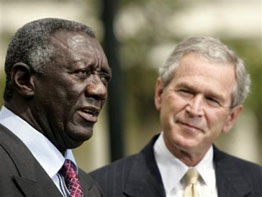
Pressure comes not only from Congress. President Bush also made clear his interest in an ambitious compact with Ghana, motivated in part by the desire to show support for an economic and political anchor in an increasingly fragile region. He hosted Ghana's President Kufuor and several other African heads of state in June 2005, and welcomed Kufuor back to the White House in October, just before the MCAG submitted a formal proposal to the MCC, and again in mid April 2006, where in his White House Rose Garden remarks, President Kufuor said, "Ghana and the United States will sign a compact by July."
Ghanaian officials in Accra recognized the pressure that the MCC was under back in Washington and saw the opportunity to apply a little heat of their own. President Kufuor clearly wants to make the MCA compact a legacy issue, and would like to see a compact signed to allow time for results before his term ends in 2008. He has apparently been pushing for a signing for a year, and some believe that he was particularly emboldened following his visit with President Bush in June when, after he expressed concern (along with other visiting African presidents) about the slow pace of the MCA, a change in MCC CEO occurred. This gave President Kufuor the impression that Ghana held a strong hand in its negotiations with MCC. He has driven the process hard, and has encouraged the MCAG team to do the same.
What's at Stake in the Push to Sign?
The July signing date is a product of these pressures. There is much at stake in the context of this political pressure to sign fast. On a positive note, there have been benefits from working under a firm deadline. For example, both USG and GOG officials acknowledge that the time crunch has worked to bring much-needed focus to the proposal and drive the process forward in a way that would otherwise likely not have happened. The MCAG team leader likened it to cramming for finals--nothing can get you motivated like a looming deadline.
These positive aspects do not, however, change the reality that substantive program development and assessments must precede the hard and fast signing date. Getting details right will be fundamental to the success of the ambitious MCA program in Ghana, and to the future support for the program in DC. And while there have been some benefits from the firm deadline, there are also potential risks for MCA-watchers to evaluate prior to the compact signing and beyond:
- The MCC's Negotiation Power. One USG official in Accra lamented that in the first half of 2005, the pressure to sign got so bad that it undermined the MCC's power to negotiate with the Ghanaian government. The MCC was rescued, in a sense, by the visit of three Congressional staffers to Accra. Unencumbered by pressure to move fast, Congressional staffers were able to talk straight to the MCAG about what it would take for a compact agreement to be reached. Since then the MCAG has apparently taken the process more seriously and the MCC has had a bit more room to push for a robust due diligence process.
- The quality of the program. The continued time pressure, especially when combined with late and significant revisions to the proposal, could lead to a compact lacking the due diligence and implementation detail necessary to be successful. Will there be time for thorough environmental and poverty impact analyses? Will there be enough program detail to ensure against politically-motivated tampering in the implementation phases? Will there be a clear enough vision to map out a strict disbursement schedule and meet the MCAG's claims that resources will start flowing "on signing plus one day?"
- Buy-in of other stakeholders. Getting the buy-in and input of other donors and civil society are key to the lasting success of the program. To date the processes to ensure this support have been wanting (as described in Lessons from Ghana 1), because the MCAG hasn't had enough detail to share. But as the MCAG and MCC put flesh on the bones of the proposal, will there be time to engage meaningfully with other stakeholders before signing occurs? Will they secure the support and cooperation of other donors, NGO groups and the private sector that is so important for program success?
- Future support for the MCA. The MCC could find itself in a delicate situation if the compact is not of sufficient quality by July. If it puts its foot down and does not sign by July, it will have to bear the wrath of all the US politicians watching this process. If it faces program failures as a result of premature signing, it will get lots of heat from Congress about not meetings its goals. Either way, the MCC could see a further erosion of support for the program.
The good news is that the MCC is clearly aware of the risks that time pressure creates, and is working hard to stand its ground on compact quality MCC staff apparently took the time to push back on the MCAG's proposed highway-widening plan based on the concern that it would displace a large number of roadside residents. While one MCAG staff member saw this as the MCC overstepping its "ownership" bounds, others would see it as the MCC sticking to its guns when it really matters. One senior MCC official was emphatic that they are putting broad quality assurances in place and that the compact will be detailed enough to "be clear what the results will be," and to "know how the benefits compare to the costs, "and that “it will not include any components in the compact that are not fully fleshed out."
Pressure on Content and Size
In addition to creating a push to sign the Ghana MCA compact soon, political pressure has influenced the content and size of the proposal. One example is the late addition of a substantially beefed up social infrastructure component. Second is the way in which ownership of "hard" infrastructure, such as cold storage facilities, will be handled. This section takes a brief look at the pressures behind each of these examples.
The Late Push for Social Infrastructure The MCAG floated an enormous bump-up – from $50 million to $500 million -- of an earlier (though ill defined) social infrastructure component (including a mash of schools, clinics, water and sanitation) in February 2006. This was on top of the existing $517 million proposal submitted to the MCC in October. Where did Ghana get the motivation and guts to make this enormous 11th hour addition? Political dynamics is part of the answer.
It is no secret that the MCC is under pressure from both Congress and DC-based NGOs to increase support for social development issues such as health and education. As recently as Danilovich's budget hearing in March of this year, House members were complaining about the MCC making the "wrong investments." Ghanaian politicians have made the most of this dynamic by floating a major addition in the sectors in which the MCC is most vulnerable.
This potentially puts the MCC between a rock and a hard place. If it rejects this last-minute addition out of quality concerns, it will have to explain itself to congressional members and NGO representatives who are closely watching the MCC's track record on saying 'no' more often than 'yes' to social development investments. If it accepts parts of the new component in the context of a fixed deadline for signing, it increases the risks of insufficient due diligence and program planning to ensure smooth implementation and program success. The MCC assures it will only support those investments in the social infrastructure component that clearly complement the broader proposal and have benefited from due diligence. The MCAG and MCC both emphasize that the Government of Ghana will work with other donors to secure their support for this broad investment in social infrastructure.
There are political drivers in Ghana as well. The current administration in Accra has the 2008 elections in mind. Serious campaigning is likely to ramp up just as the MCA-funded social infrastructure investments are being implemented in the target regions (two of which, incidentally, are said to lean toward the opposition). These high-profile investments will bolster support for the ruling party at a most convenient time and consultation on the choice of beneficiary districts is under fire in Ghana.
The Politics of Private- vs. State-Owned Facilities
Similar political motivations are perhaps behind the MCAG's push for government-oriented (rather than private sector) ownership of some infrastructure facilities. (This is more fully described in Lessons from Ghana 1). The government seems to think it can only make good on its campaign promises of job creation if it maintains greater control over means of production. This attitude is illustrated by the words of one minister at a recent meeting focused on attracting private sector investors to Ghana. According to one donor the minister blurted out, "Can the private sector guarantee me 25,000 jobs?"
While the MCAG is pushing hard to maximize government control of major new facilities, the MCC is arguing for a clearer private sector role. This creates an interesting challenge to country "ownership." The MCC is trying to strike the right balance between following the government's wishes and sticking to its own principles. To its credit, the MCC is trying to keep the private sector at the table, and to make sure the proposal includes the right incentives for private sector investment that can spark job creation and growth. But the political pressure to do otherwise continues to rear its head. According to one senior MCC official, "Everyone agrees (on arrangements for ownership of facilities) and then we have the same debate two weeks later."
Key Issues on Managing Political Pressures
The bottom line is that the MCC, like all development assistance agencies, should be wary of falling into political traps, especially when $500 million is on the line. So far, the MCC team has made a concerted effort to stand firm in Ghana. MCC staff argue they are "doing everything in our power to deliver a quality product” by July. Delivering a quality product -- one that has adequate program detail, reflects rigorous due diligence and impact analysis, includes the buy-in of key stakeholders and meets the MCC's standards for measuring costs against benefits -- depends on a smooth process over the next three months.
However the details fall out, the politics of Ghana's MCA experience invites some big-picture questions about broader MCA policy making:
- How can the MCC guard against political pressure in partner countries? One way is to adhere to strict standards of analysis throughout the proposal development process, which is no easy task in the face of intense time pressure at home. Another way is to learn as much as possible from other donors and civil society about political dynamics in partner countries (as discussed in Lessons from Ghana 1)
- Would multiple compacts ease the pressure? The MCC and MCAG are hurriedly putting together a complex and ambitious compact in a short period of time. Congress should reevaluate its decision to allow only one compact per country and consider a more sequential approach, allowing countries to plan and sign more than one compact (limited to one per year). This would help keep the money flowing without the pressure to sign components before they are ready.
- What is the right kind of pressure to come from DC? Some of the pressure applied by Congress and advocacy organizations has been essential to keeping the MCC on track in its first few years-- most notably, for keeping the MCA budget alive and for innovations like the Threshold Program and finding new ways to measure environmental impacts. But, as the Ghana case illustrates, pressure to sign quickly and to fund certain sectors have left the MCC vulnerable to pressures from partner countries. Congress and NGOs can make the most of their influence over the MCC by focusing on money spent well rather than spent fast. They can focus less on specific sectors and more on the MCC's adherence to its own principle of ownership -- that is countries deciding which sectors to invest in based on growth constraint analysis and poverty reduction impact assessment. Congress and NGOs should continue to demand transparency in how priorities are set in countries, and then accept the priorities that emerge. Likewise, they should insist on high standards for economic and social assessments, including a wide consultative process, that go into the creation of program proposals. And more important than trying to influence the specific type of investments the MCC makes, they should focus on how all types of investments can best link economic growth to poverty reduction. This means pushing the MCC to pick the right indicators for success, and being relentless in their scrutiny of the outcomes, but also allowing the MCC to take some risks.
The author wishes to recognize the substantive contribution of Jonathon Kass in the preparation of this report.