

Sarah Lucas
March 2006
While a debate on economic growth versus poverty reduction continues in Washington, people in Ghana seem to understand that the two go hand in hand, and they see potential for both in the MCA proposal. Donors, the private sector, NGOs, and academics all see the broad program focus--modernization of agriculture in both export-oriented and food crops--as fundamental to growth and poverty reduction in Ghana. MCC officials consider the proposal one of the best among MCA programs at making direct links between growth and improved livelihoods.
Of course the devil is in the details, and the details are not yet done. Despite an impending July 28 signing date for Ghana's MCA compact, little is publicly known about the program details. NGOs are particularly in the dark and are naturally interested in how the $500 million in investments will benefit the rural poor. This piece takes a look at the details behind the broad focus, and examines what the Ghana compact will have to include to ensure the most effective link between poverty reduction and economic growth.
The Right Focus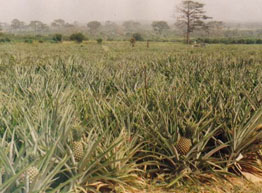 Many argue that the agricultural focus of Ghana's proposal creates strong potential for poverty reduction. Agriculture accounts for 60% of employment in Ghana, and more than 30% of GDP. With 80% of the poor living in rural areas, modernization of agriculture is critical for Ghanaian economic development and poverty reduction. According to one civil society leader, "everyone in Ghana would agree that if you want a quantum leap in development, you need to look at agriculture."
In addition, representatives of government ministries, donor countries, the private sector and NGOs have embraced the importance of economic growth for job creation and poverty reduction. The recently-revised Ghana Poverty Reduction Strategy (GPRS II) and the Food and Agriculture Sector Development Plan (currently under revision) both emphasize growth and wealth creation. Even NGO leaders talk about economic growth and a focus on mid-level business development as foundations for poverty reduction. People also appreciate the role of the private sector as a link between broad-based growth and the poor. According to the regional director of one major US-based NGO close to the MCA process, Ghana "needs to be helping the mid-layer of business to get the economy to the next level." He added, "it would be hard to criticize” a proposal with this focus." One leader of a network of local and regional NGOs said sympathetically, "the private sector is hungry for resources so it can generate jobs." The private sector, she added, is key for "bringing the small scale farmers into the market economy."
As broadly defined, Ghana's MCA proposal has the potential to make these links between growth and poverty reduction, and between private sector investments and the rural poor. But they are by no means guaranteed and need to be explicitly included in implementation plans. (For more on this topic, see Connecting the Poor to Economic Growth: Eight Key Questions). According to one US official, the October draft of the proposal was not explicit about the strategies to create these links. So how can the MCAG and MCC ensure that this connection exists?
Reaching the Poor
The MCAG describes several aspects of the proposal that are designed to directly benefit the poor. First, the MCAG agues that the recent inclusion of the social sector component aims to increase the benefits for the rural poor. Certainly improved access to health, education, water and sanitation are as important to rural families as increased income. Ideally, this component will link to the others in an overall poverty reduction and growth framework that identifies the beneficiaries and the projected benefits of the program.
Second, the MCAG argues that the proposal's evolution from a horticulture focus (export crops such as mangos, papayas and pineapples) to one that also includes basic food crops, was a concerted effort to reach the poor. The key here will be linking output to markets for food crops so that increased productivity leads to increased incomes. This challenge been the death knell of past agriculture development programs that focused on production without an eye toward markets, and which ended in disappointment for many poor farming families.
Third is the link between growth in export crops and small-scale producers. This is essentially the opposite of the challenge of the food crops, where production is easy and markets are hard. In this case, there are clear markets with unmet demand for Ghana's high-quality horticulture products. (And this author can vouch for the mangos from southern Ghana being about the best in the world.) The tough part is connecting small producers to these markets so the growth and increased income reaches them directly. The next section looks specifically at how to make this kind of connection.
The Nitty Gritty of Making Links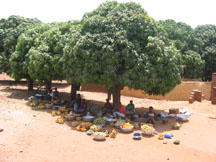
How can the MCAG and MCC ensure there is a link between export-oriented agriculture production (arguably the component with the most potential for contributing to economic growth in the near term) and increased incomes for small farmers and their families? A variety of experts, including a professor of agricultural economics at the University of Ghana, NGO leaders, an agricultural businessman, donors with agriculture expertise, and members of the MCAG team, made the following recommendations:
- Create networks. Networks foster partnership between "nucleus farmers" and "out-growers." Out-growers tend to be producers with small land holdings and limited capacity to interact effectively with input suppliers and merchants who take products to market. Nucleus farmers tend to have greater capacity for storage of products and the technical capacity to comply with market standards. Each out-grower is associated with a nucleus farmer who both provides technical support and facilitates access to markets. As the out-growers become part of a more organized, higher-quality production chain, the hope is that they will receive higher prices for their products. According to one member of the MCAG team, nucleus farmers can be anything from larger-scale local farmers to private sector firms to churches that have significant land holdings. Each nucleus, therefore, is suited to the local conditions. This model is already applied to Ghana's growing pineapple export sector, which apparently relies on small-scale producers for 40% of its product.
- Improve and expand agriculture extension services. Access to agriculture extension is very limited in Ghana. According to one expert, the current ratio of extension worker to farmer is 1:2500. It will be vital to scale up capacity to ensure that small scale farmers and nucleus farmers have the information and skills necessary to produce in accordance with market specifications on product quality, sanitary standards, traceability from plot to market, etc.
- Choose products carefully. If you are looking to augment small farmers' income, but not displace their food production, it is important to select horticulture crops that require little land and little time to attend. Mangos, papayas and pineapples fall into this category. By investing in several fruit trees, farmers can diversify their income-generating activities without jeopardizing their capacity to produce traditional food crops.
- Analyze the value chain. Understand each step from farm to port and who plays the most effective role at each point along the chain. Programs must be designed to empower small producers, larger farmers, private sector and government to take the lead in areas best suited for each. For example, while the government is responsible for improving the broad policy environment for credit and land markets, private and community banks may be best suited to provide capital for new investments. Likewise, the government plays an important role in providing key infrastructure such as roads and irrigation, but the private sector will be better placed to own and manage storage facilities and to transport produce. While private firms are likely necessary to ensure quality control, a broad network of the small-scale producers is necessary to meet quantity demands.
What to Watch and What to Ask
There is reason for cautious optimism that the MCA program will make the promised links between economic growth and poverty reduction. The MCAG team says that its plan reflects all of the above recommendations, and it particularly prides itself on the complementarity of interventions that span the entire length of the production chain--from small rural producer to export markets. The degree to which this is true, of course, is still hidden in program details and implementation plans not yet finalized. The fact that so little is known about the program plans has some observers nervous that the MCA program won't live up to its potential to make these important links. Why?
For one thing, NGOs have been left out of the past 18 months of program development (as discussed in Lessons from Ghana 1). An ambitious program seeking to link directly to thousands of Ghana's rural poor is missing a big opportunity by not drawing on the expertise of NGOs and community-based organizations operating around the country. Will the MCAG reach out to these groups before signing the compact, and will it make room for coordination with them throughout program implementation?
Second, there has been no public discussion of how the MCC and MCAG will measure the impacts of the program. Have they selected the right indicators to assess whether the economy is on a better path to growth? Have they found the right measures to capture improvements in the livelihoods of the poor? Waiting a couple of years to measure improvements in GDP per capita clearly won't do the trick.
A lot is a stake in the Ghana's MCA compact. It is a big-money test of the MCC's approach to "poverty reduction through economic growth." Success will be a boon for Ghana's poor, for the MCC's political support, and for continued faith in US development assistance more broadly. The MCAG and MCC clearly think they have it right, but the jury is still out. All eyes should be on the signing and implementation of the Ghana MCA compact to make sure that it sets a high standard for linking economic growth to the poor, and that it is implemented and evaluated in a way that allows it to be a model for the future.
The author wishes to recognize the substantive contribution of Jonathon Kass in the preparation of this report.