

In June 2005, the Government of Honduras signed a $215 million, five-year compact with the MCC. The compact has two major components, rural development and transportation.
Rural Development Project ($72.2 million): This component is designed to increase the productivity and business skills of farmers on small and medium-sized farms around the country. It has four parts:
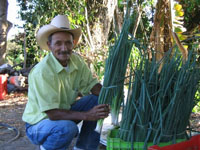
- Farmer training and development ($27.4 million): This program is well underway. It is being implemented by Fintrac, a private firm specializing in market-oriented technical assistance to farmers. So far Fintrac is working with about 400 farmers (of the 8,255 that will "graduate" from the program over the life of the compact).
- Farm-to-market roads ($21.5 million): This program will upgrade 1,500 km of rural roads and is in the advanced planning stages. In order to select roads in a transparent manner, MCAH has created an inter-institutional committee and is developing a model to estimate economic rates of return for potential road investments that is informed by detailed social, economic and topographical geographic information system (GIS) data. The MCAH expects to have a list of target roads by July 2007.
- Access to credit ($13.8 million): This component will provide technical assistance to credit institutions via a contract to be signed in early May, create a guarantee fund and a national lien registry, and most importantly, foster legal reforms to allow for moveable property to be used as collateral. The MCAH is currently working on the legal reform aspect of this component.
- Agricultural public goods facility ($8 million): The public goods facility will be available to farmers’ groups or communities to invest in agricultural infrastructure such as irrigation or post-harvest storage. The MCAH is in the process of seeking implementers for this program.
Transportation Project ($125.7 million): This component is designed to reduce transportation costs between production centers and national, regional and global markets. It has three parts:
- CA-5 Highway ($96.4 million): This activity will widen and improve a 109 km stretch of the CA-5 highway that is part of the logistical corridor that connects central Honduras to ports on both the north and south coasts. The MCC/MCAH are working in conjunction with the World Bank, the Inter-American Development Bank (IADB) and the Central American Bank for Economic Integration (CABEI) that are each funding part of this corridor. The MCAH has hired a private firm (Louis Berger) to be the Transportation Project Manager (TPM). The TPM is working with the Ministry of Public Works, Transport and Housing (Soptravi) to finalize the road designs, while MCAH’s Director of Social and Environmental Impact is overseeing the creation of a resettlement plan for those affected along the MCC-funded stretch.
- Secondary roads ($21.3 million): This component is designed to pave and improve approximately 90 km of secondary roads. The MCAH Board has approved a list of roads, and MCAH is in process of reviewing designs and preparing bidding documents.
- Vehicle Weight Control Program ($4.7 million): This program will improve road safety and extend road longevity by providing the legal framework and physical infrastructure for the operation of eight weigh stations around the country. Implementation of this project is awaiting a decision by the government as to the legal structure for the system.
(For more information on the MCAH compact, see the Honduras page on the MCC’s website and the MCAH website)
Disbursement: While it is officially a year and a half into its compact, the MCAH has disbursed only $5 million of the $90 million target for the first two years (Y1 $27.7 million, Y2 $62.2 million).[4] Disbursement delays are due, in part, to the premature EIF. Because program designs were not completed and basic MCAH structures and staff were not in place at the time of EIF, the MCAH has had to complete planning and recruitment during precious compact time. In addition, shortly after EIF, Honduran elections were won by the opposition party, which brought in a whole new government with little institutional memory or commitment to the MCAH. This essentially stopped the MCAH in its tracks for six months. These issues, as well as other reasons for delay are discussed in the part three of this report.
Honduras is not alone in being behind schedule in disbursements. All MCA countries, with the exception of Armenia, are falling short of initial disbursement goals. While it is clearly essential for the MCC to improve its track record on the pace of expenditures, it is also important that MCC and MCA countries’ success not be measured solely or even primarily on disbursement rates. The numbers in disbursement rates are a poor proxy for actual progress in implementation. The next section focuses on early achievements of the MCAH program that are underway even though very little money has been spent.
Next Section: MCAH Program Successes
4. See the MCC’s March 2007 Honduras Country Status Report