

CGD helped end a system in which unexpected spending in another part of government could derail the UK’s Foreign, Commonwealth and Development Office development programme. By changing how aid budgets are allocated across government, the UK created a more predictable system, releasing a larger share of spending for planning and delivering development programmes.
The challenge
The UK's aid budget had become increasingly unpredictable because spending on domestic refugee costs and other departmental pressures could reduce the Foreign, Commonwealth and Development Office (FCDO) budget during the year. As a result, according to the Second Permanent Under-Secretary in the FCDO, as late as January 2025, around 20 percent of country aid budgets were routinely held back in case they were needed to cover unexpected overspends elsewhere in government. That made it harder to plan programmes, commit funding, and deliver effective development assistance.
What we did
CGD experts spent two years building the case for reform. They worked with partners including the Institute for Fiscal Studies and the Institute for Public Policy Research to show why the existing system undermined effective aid spending by producing research, blogs, and joint papers that reached key decision-makers ahead of the 2025 Spending Review. They also engaged directly with HM Treasury and Parliament through roundtables, committee evidence, and briefings, ensuring the issue remained on the agenda as spending decisions were made.
What we helped achieve
The 2025 Spending Review fundamentally changed how the UK budgets for aid by allocating and publishing fixed ODA budgets for government departments and removing the requirement for the FCDO to cover overspends elsewhere in government. Although it meant FCDO would not automatically benefit from others’ underspends, the spending review also allocated a declining amount towards those departments hosting refugees, the FCDO was beneficiary of those savings which reduced pressure on its declining budget. HM Treasury told CGD experts that their work helped shape the decision.
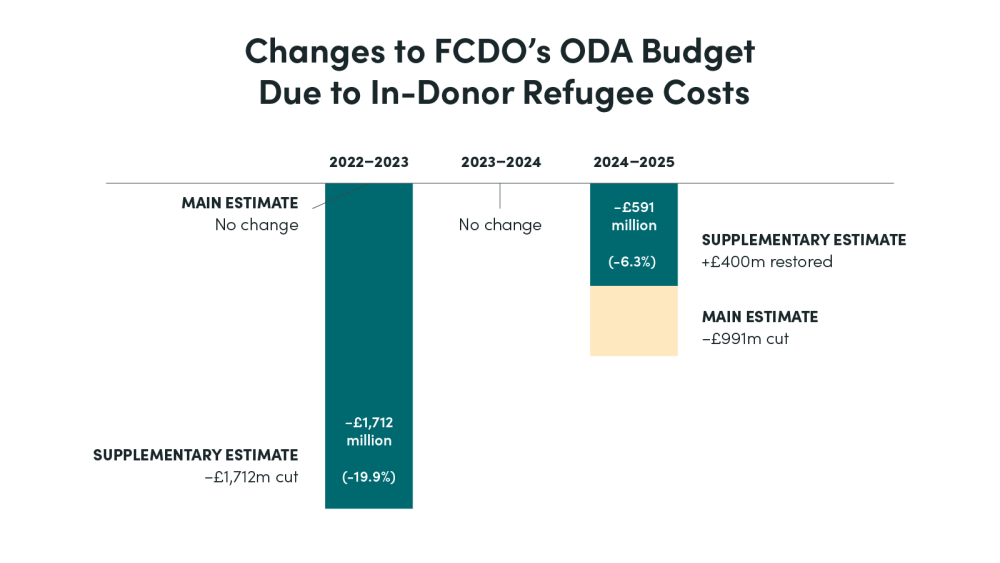
These reforms give the FCDO much greater certainty over its budget, allowing it to plan programmes more effectively and reducing the need to hold back funding for unexpected costs elsewhere in government. Publishing other departments’ ODA budgets for the first time also provides transparency and enables greater scrutiny
The Spending Review also explicitly committed to ODA reaching 0.3 percent of national income in 2027, guarding against the risk that the real value of fixed budgets would be eroded by additional growth or inflation.
What’s next
CGD experts continue to work to ensure that the UK's aid budget is focused on international development. This includes developing a new measure of “international assistance”—the UK aid actually spent abroad—and continuing to scrutinize the amount spent supporting refugees inside the UK that is reported as official development assistance. More generally, CGD experts are providing evidence and analysis to inform government decisions about allocating aid to the countries and programmes where it can have the greatest impact.
Support More Work Like This.
Your contribution makes it possible for the Center’s researchers to devise practical, evidence-based solutions for today’s most pressing development challenges.