You are here
Forest Monitoring for Action
This work has now concluded.
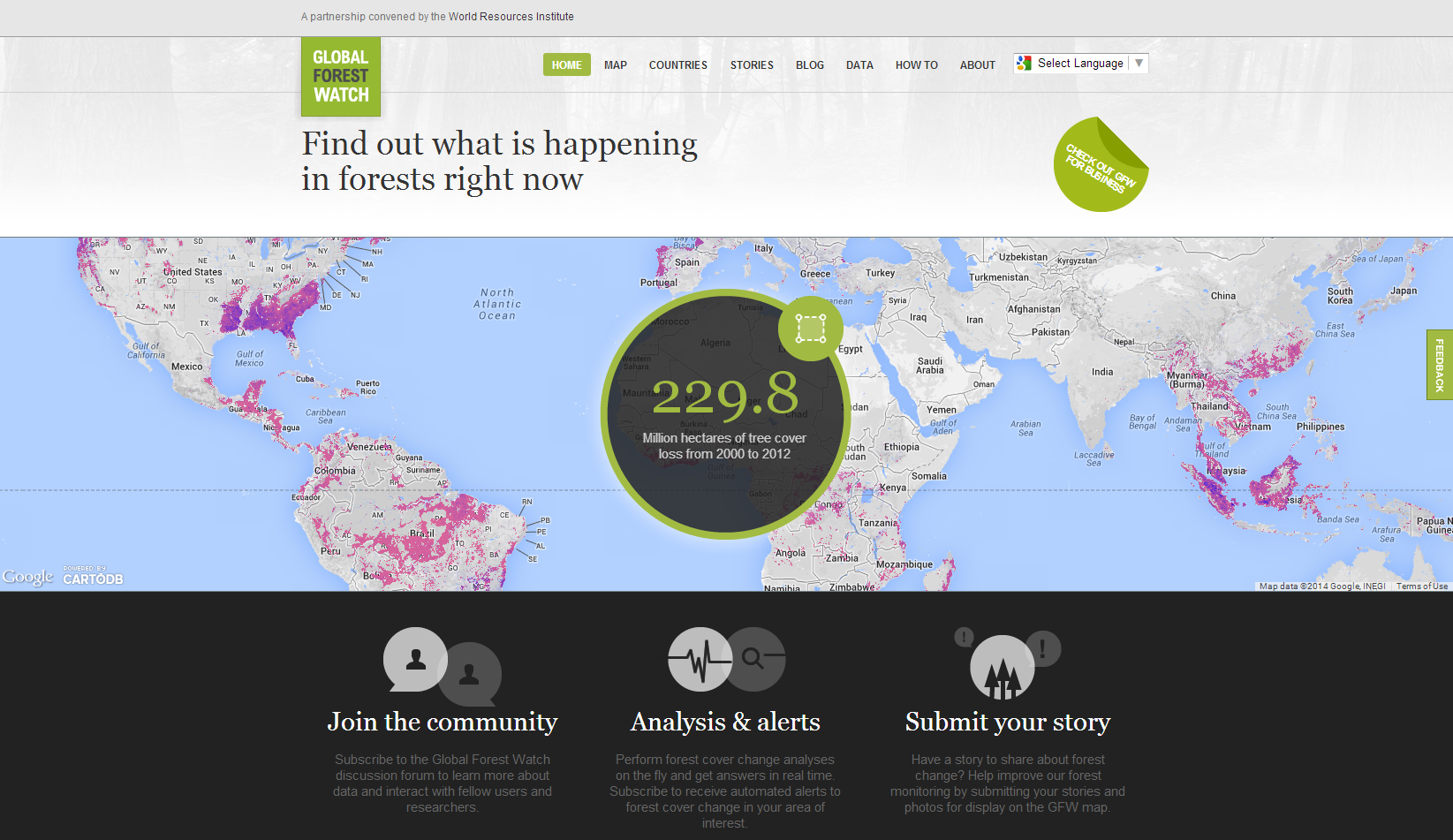
Forest Monitoring for Action (FORMA) uses satellite data to generate regularly updated online maps and alerts of tropical forest clearing. David Wheeler, now a CGD senior fellow emeritus, assembled and led a small team that created FORMA, which has since become a core component of the World Resources Institute (WRI) Global Forest Monitoring (GFW) platform launched in February 2014.
FORMA is now available for visualization, analysis, and download at GFW, a dynamic online forest monitoring and alert system that empowers people everywhere to better manage forests. CGD continues to work closely with WRI on forest monitoring issues as part of our Forests for Climate and Development initiative.
Using current data accessed via GFW, FORMA can be used to support international efforts to curb greenhouse gas emissions by demonstrating to those willing to pay for forest conservation (for example, through the Forest Carbon Partnership Facility (FCPF), bilateral programs such as Norway’s Forest and Climate Initiative or UN-REDD) that protected forests are indeed still standing. CGD has developed the Forest Conservation Performance Rating (fCPR) system as a set of benchmarks that showcase global progress in reducing forest clearing and that could form the basis for such payments.
Get Development Finance Updates
Related Experts
Parent Topic
Related Forest Monitoring for Action Content
When a tree falls in a forest, does anyone realize that it’s fallen? You might be surprised to learn that until now, the answer to this question has basically been “no.”
Over the last few months, in the context of my new affiliation with CGD, I’ve been making a transition from “Forestry World” — which I inhabited for six years at the Center for International Forestry Research in Indonesia — to “Development Finance World,” headquartered here in Washington with the World Bank, the IMF, and myriad think tanks and advocacy groups interested in development.
Imagine for a moment a world in which rich countries followed through on their rather vague promise at the 2009 climate conference in Copenhagen to mobilize $100 billion per year by 2020 to help developing countries reduce their emissions and cope with climate change. How should that money be spent?
On my summer vacation in Montana this year, I made my much-anticipated first trip to Glacier National Park. The
On Friday in Stockholm the IPCC released the first of a series of four reports comprising its Fifth Assessment Report (AR5), documenting the “physical science basis” of climate change.
The latest news from FORMA demonstrates the power of global and regional economic cycles as drivers of deforestation. My previous post highlighted the rapid growth and spread of forest clearing during the first phase of the global economic recovery. Fortunately, new clearing has declined sharply since then, as the chart of FORMA's global indicator shows below. The effectiveness of forest protection may vary somewhat from quarter to quarter, but not nearly enough to explain such pronounced swings.
Pages
My guest this week is Frances Seymour, our newest senior fellow at the Center and one of the world’s top authorities on the complex issues at the intersection of tropical forests, development and climate change.
This paper briefly summarizes how the FORMA tool and the fCPR rating system could provide provide a performance scorecard and an interim performance-based payments scheme for safeguarding forests.
This paper updates Working Paper 294. Forest Conservation Performance Rating (fCPR) is a system of color-coded ratings for tropical forest conservation performance that can be implemented for local areas, countries, regions, and the entire pan-tropics.
This report summarizes recent trends in large-scale tropical forest clearing identified by FORMA (Forest Monitoring for Action). FORMA produces indicators that track monthly changes in the number of 1-sq.-km. tropical forest parcels that have experienced clearing with high probability. This report and the accompanying spreadsheet databases provide monthly estimates for 27 countries, 280 primary administrative units, and 2,907 secondary administrative units.
On Friday in Stockholm the IPCC released the first of a series of four reports comprising its Fifth Assessment Report (AR5), documenting the “physical science basis” of climate change.
The latest news from FORMA demonstrates the power of global and regional economic cycles as drivers of deforestation. My previous post highlighted the rapid growth and spread of forest clearing during the first phase of the global economic recovery. Fortunately, new clearing has declined sharply since then, as the chart of FORMA's global indicator shows below. The effectiveness of forest protection may vary somewhat from quarter to quarter, but not nearly enough to explain such pronounced swings.


Commentary Menu