Recommended

Blog Post
Letting Asylum Seekers Work Is Not a “Pull Factor”
Blog Post
How Much Aid is Actually Spent Abroad?

The UK’s recently introduced “Immigration and Asylum Bill” proposes that asylum seekers pay £10,000 each towards the cost of their accommodation and support, which the state covers. In this blog, we model how much that would raise, and compare that with the taxes and avoided public spend from asking asylum seekers to work after six months.
The £10,000 charge
On 30 June, the UK Home Secretary Shabana Mahmood introduced a new “Immigration and Asylum Bill”. As part of the Bill, she outlined “new powers for the Home Office to recover costs from adults who have received asylum support such as subsistence or accommodation, provided they have access to sufficient funds.” The charge amount is not in the Bill itself, and is set by the Home Secretary through regulations: her accompanying press release noted a “total sum of around £10,000”.
New asylum seekers will need to pay off an amount each month above a set income threshold. This is similar to the way in which student loan repayments work in the UK. At this stage it looks as if payments will be made directly to the Home Office, but the Bill also enables HM Revenue & Customs to collect the money through the tax and benefit systems. Failure to repay the full amount could make asylum seekers ineligible for settlement and prevent them from returning to the UK after leaving.
The cost of asylum support
In 2023/24, the cost of supporting an asylum seeker for a year was around £41,000 (figure from the Institute for Public Policy Research, IPPR). That’s over four times the £10,000 charge, and a massive increase from the cost just a few years prior (£17,000 in 2019/20). The total cost to the government is around £4.7-£5.4 billion a year (figures from the National Audit Office (NAO) and Migration Observatory, respectively). The majority of that (£3.1 billion) went on hotels. Most of these costs were reported as aid (official development assistance, ODA); the UK reported the highest in-country refugee costs across the OECD.
Since taking office, the current government claims they have cut hosting costs by nearly £1 billion, closing 31 asylum hotels. They have done this by increasing removals of people with no right to remain, while moving others out of hotels into larger, more basic, accommodation, including army barracks. This has meant savings to the aid budget of £432 million in 2025, leaving the remaining “foreign” aid budget spent on refugees in the UK at £2.4 billion, the lowest level since 2021 (although higher than any year before that).
Links with asylum seekers’ right to work
Critics have expressed scepticism that the £10,000 charge will raise any money, largely due to the low rate of earnings among asylum seekers. One major factor holding back refugee earnings is that, for their first year of waiting, asylum seekers do not have the legal right to work. Home Office data shows just 24 percent of refugees work in the first year after having been granted legal status, rising to 45 percent by year two and 48 percent by year eight. And earnings are low, with only 13 percent earning at least £20,000 according to the Migration Observatory, with the rest either not working or on lower earnings.
In addition to forcing the government to pay for their accommodation, employment bans also have a “scarring effect” on the asylum seekers’ future likelihood of being in work. The longer you’re out of a job, the harder it is to get one. The waiting period is longer in the UK than all other assessed high-income countries (Figure 1). After waiting for a year, asylum seekers can apply for permission to work, but they are restricted to roles on the Shortage Occupation List and precluded from self-employment.
Figure 1. The UK has a very long waiting period before asylum seekers are allowed to work
Sources: UK Visas and Immigration (2024); Glover et al. (2024); European Union Agency for Asylum (2024); OECD (2016); ECRE (2024); and European Migration Network (2020).
Note: Refers to the minimum period after an asylum application is lodged before someone can apply for permission to work. In many countries, this will only be granted if the asylum claim is still pending and delays are not attributable to the applicant. Some countries allow immediate access (e.g., Canada, Greece, Sweden). Rules may include sectoral restrictions, labour market tests, or permit requirements.
Reducing this waiting period—as championed by the #LiftTheBan coalition—would save taxpayers money (it could actually add billions to the public purse), support integration, and allow asylum seekers to improve their own situation.
The gains from the £10,000 charge…
We wanted to know how much money the £10,000 charge may net the UK government, and how that would compare with asking asylum seekers to work after six months.
The government hasn’t yet published full details of the scheme, but does say payment is conditional on whether “they have access to sufficient funds.” Based on this, we assume a repayment scheme similar to student loans: nine percent of earnings above a threshold of £25,000.
The reality of the situation is that, under the current restrictions, most refugees don’t earn enough to pay the charge. Home Office data follows individuals for up to eight years after they get status. Even at year eight, only around 13 percent of all refugees earn above the £25,000 threshold. Overall, two-thirds would be unlikely to ever pay any of the charge, and only the top 22 percent pay it off completely over a 40-year period.
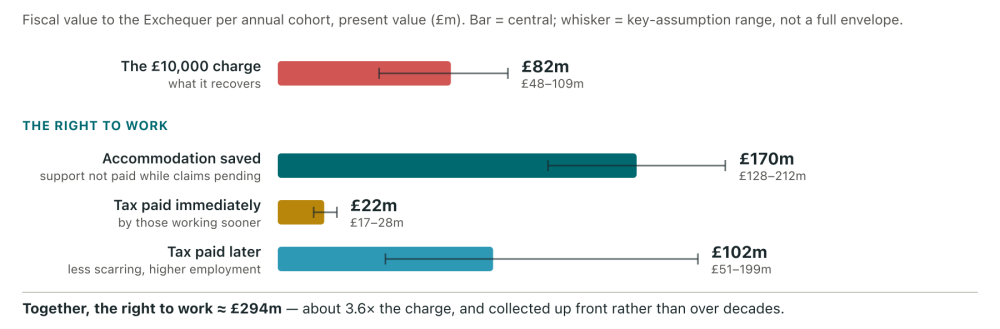
Around 100,000 people claim asylum in the UK every year. Roughly 85,000 of those are adults. Around 60 percent are granted asylum after appeals, so about 51,000 would ever be in a position to potentially repay. Spread over a full working life the charge recovers only about a sixth of its face value, roughly £82 million per annual cohort (in real terms).
… vs. asking asylum seekers to work
What would happen if instead the Home Office asked asylum seekers to start working after six months, while their claim is pending? We would expect three effects. First, we would expect accommodation costs to fall. We're generous in assuming the government succeeds in getting accommodation costs down by half (to £20,000 per year) and conservative in assuming only a fifth of people newly able to work find their own accommodation (saving £10,000 each). That adds up to £170 million across the cohort.
Second, on the tax side, those same people would add another £22 million immediately. Together that's about £11,300 per person, and it accrues whether or not the asylum claim ultimately succeeds.
Third, getting people into work sooner also has dynamic benefits. Work bans have effects long after the initial period, due to well-documented “scarring” effects. Hainmueller et al. (2016) find that for each year that Swiss asylum seekers are prevented from working, future employment rates fall by 4-5 percentage points. Fasani et al. (2020) compare across Europe, finding that exposure to an employment ban cuts future employment by refugees by 15 percent, with effects lasting up to a decade. These studies imply that reducing the UK work ban from 12 to six months, for example, could lift later employment by around 3 percentage points, contributing a further £102 million per cohort in today's money (£122 million over the decade).
In total, therefore, the right to work is worth roughly £294 million per cohort, about three and a half times the £82 million charge (Figure 2). If the right to work was granted earlier than six months, the savings would be even greater.
Figure 2. The £10,000 charge recovers a fraction of what the right to work is worth
Sources: CGD analysis of data from Home Office Refugee Integration Outcomes (RIO); IPPR; NAO; Fasani et al. (2020); and Hainmueller et al. (2016).
Note: Full derivation on Github, here.
Risks are over-stated
Both the current Labour government and the Conservative opposition make the unevidenced claim that letting asylum seekers work sooner would act as a “pull factor”, increasing the number of refugees arriving. But repeated studies find that there is no relationship between asylum applications and the length of bans on working. Asylum seekers make their decision based on a range of factors, such as colonial ties and common language, rather than work rights.
Another potential objection is that a failed asylum seeker with a job is harder to deport. But again there is no evidence for this claim, and the truth might in fact be the opposite. The law explicitly states that little weight should be given in removal decisions to a private life built during "precarious status." A legal job brings someone into the tax system, with employer and address details on record. An employment ban pushes people into informal work that is invisible to the Home Office.
A double inefficiency is wasting public money
The current approach to supporting asylum seekers suffers from two fundamental flaws. First, it puts applicants into hotels that cost £144 per night, over five times more than accommodation that the applicants might choose. Second, it prevents them from working while their application is processed.
Asking asylum seekers to work, pay tax, and find their own accommodation would save hundreds of millions for the UK taxpayer. It would also disperse the highly visible and politically damaging clusters of applicants that find themselves with nothing to do but stand around outside town-centre hotels. This is surely a better way forward than a tokenistic attempt to reclaim some of the costs 20 years down the line.
Topics
DISCLAIMER & PERMISSIONS
CGD's publications reflect the views of the authors, drawing on prior research and experience in their areas of expertise. CGD is a nonpartisan, independent organization and does not take institutional positions. You may use and disseminate CGD's publications under these conditions.