Recommended



The poorest and most heavily indebted countries are bearing the brunt of growing global uncertainty, rivalry, and intensifying competition. Financing needs for urgent development priorities are huge and continue to grow. The annual shortfall for achieving the Sustainable Development Goals (SDGs) is estimated at between USD 2.5 and 4 trillion. Geopolitical tensions and shocks, fiscal constraints in European countries, shifts towards defence spending with substantial cuts to aid, an increasingly destructive US global role, and growing public scepticism of aid and its effectiveness are putting enormous pressure on official development assistance (ODA).
In a previous CGD paper, we highlighted a series of policy interventions to maximise the use of EU concessional finance, including a strategic review of the deployment and effectiveness of the EU guarantee instrument. Now, in collaboration with colleagues from Lions Head Global Partners, we put forward a set of proposals aimed at eliminating the inefficiencies and maximising the impact of the EU’s guarantee instrument, thereby freeing up grants for those countries that need them most.
What are guarantees and why are they such a useful tool for development?
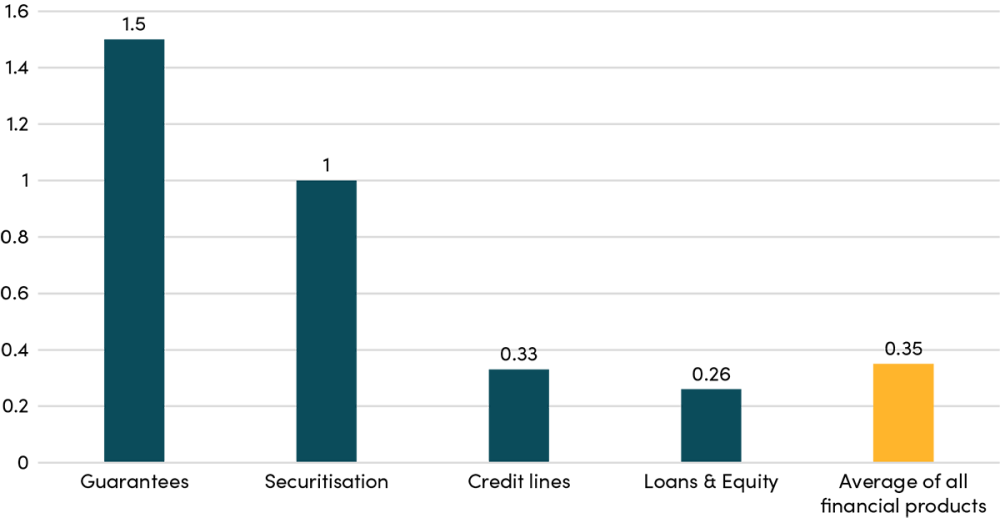
Mobilising private capital in emerging markets and developing economies (EMDEs) is often very challenging due to high perceived risk, limited collateral, and underdeveloped financial markets. Guarantees play an important role in overcoming these barriers. In simple terms, a guarantee lowers the risk for private investors so that they feel comfortable entering the market and allows the newly unlocked capital to achieve a much greater return. Guarantees are a key (and increasingly popular) tool for mobilising private capital, generating on average, USD 1.50 in private investment for every USD 1 of donor funding.
Figure 1. Mobilisation rates of financial instruments (2016–2020 MDB aggregate data)
Who are the major guarantee providers?
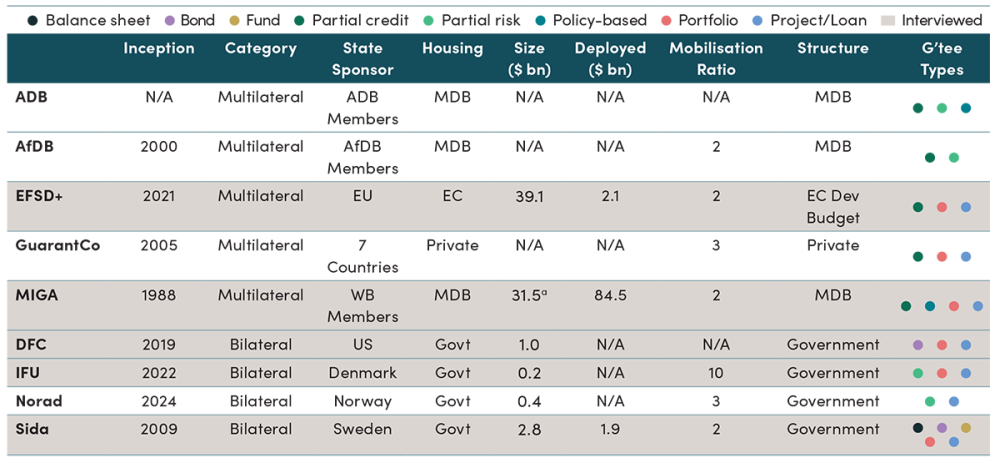
A large variety of DFIs and multilateral development banks, including the Multilateral Investment Guarantee Agency (MIGA), the United States Development Finance Corporation (DFC), the Swedish International Development Cooperation Agency (Sida), and the Danish Investment Fund for Developing Countries (IFU) provide guarantees. MIGA is the leading provider of guarantees in the development finance space in terms of annual commitments in volume.
The European Commission, through its European Fund for Sustainable Development Plus (EFSD+) is a major guarantee provider with a budget of EUR 39.1 billion, deployed by a range of development banks and DFIs (mostly European). The EFSD+ has expanded lending across its 13 partner institutions and is set to mobilise up to EUR 135 billion in public and private investment for developing countries.
Figure 2. Overview of guarantee providers
What are the problems with the EU guarantee?
There are, however, serious challenges the EFSD+ that hinder its deployment, its ability to mobilise private sector investment and its financial efficiency:
- The EFSD+ is highly complex—so much so that it slows down the deployment of funds. This complexity creates administrative bottlenecks between the European Commission and its implementing partners (the DFIs), discourages private-sector engagement, and ultimately undermines both efficiency and transparency.
- The lack of robust, standardised indicators in its monitoring frameworks makes it difficult to track progress towards the EU’s development policy goals as well as the “additionality” of the investments. The ambiguity surrounding how “additionality” is assessed further weakens private-sector participation, reduces leverage, and blunts the EFSD+’s catalytic impact.
- Risk is managed inefficiently, with a single, uniform provisioning rate that does not reflect the diversity of the portfolio, tying up capital that could otherwise support new, high-impact projects. And without an effective mechanism to hedge foreign exchange risk, the development banks and DFIs are left either absorbing that risk themselves or passing it on to local partners—both of which threaten market stability and undermine the socioeconomic objectives the EFSD+ is meant to support.
How can the EU guarantee be improved to maximise effectiveness and efficiency?
Following a benchmarking analysis of the major guarantee providers, financial modelling of EFSD+ provisioning and risk exposure, and interviews with key stakeholders, we suggest improvements in three areas: (1) structural and operational efficiency, (2) impact and effectiveness, and (3) financial efficiency and risk management.
1. Structural and operational efficiency
To address administrative complexity and improve implementation, we propose:
- Unifying the EFSD+ under a single “umbrella” guarantee framework to standardise implementing partner agreements and consolidate operations into fewer, larger contracts.
- Enhancing collaboration and coordination with the DFIs and development banks to overcome competition and “over subsidisation,” including through co-guarantees, where relevant
- Introducing a guarantee instrument backed by the EU’s balance sheet, to reduce reliance on rigid multi-annual budgets, improve capital efficiency, and enhance long-term financial stability. The EU’s strong credit rating could also reduce the cost of guarantees, increasing attractiveness to private sector investors.
2. Impact and effectiveness
To strengthen transparency, ensure the EFSD+ complements rather than displaces private capital, and encourage wider market participation, we propose:
- Leveraging better information sharing between DFIs and guarantee programmes to identify when transactions are additional, ensuring that the private sector is not being crowded out. Greater harmonisation of the standardised result and monitoring framework would ensure more effective implementation.
- Publishing up-to-date project- and programme-level data on publicly accessible platforms to enhance accountability and investor confidence.
- Creating a special niche oriented towards private-sector mobilisation by bringing in financial institutions directly regulated by the European Central Bank, including private banks under its purview.
3. Financial efficiency and risk management
To optimise capital use and improve risk-sharing mechanisms, we propose:
- Introducing greater flexibility in provisioning rules, informed by the EFSD+’s own default data and by international benchmarks, to avoid unnecessarily conservative capital reserves.
- Making use of reinsurance contracts to increase guarantee capacity while protecting internal capital reserves. Reinsurance can improve portfolio diversification and enable more strategic risk-sharing.
- Expanding support for local currency lending by reinvesting reflows from existing guarantee programmes or allocating dedicated budget resources. This would help mitigate foreign exchange risk and enhance the financial sustainability of local investments.
These fixes could turn the EU guarantee instrument into a stronger catalyst for private capital—and deliver better value for EU taxpayers. With development budgets set to shrink further, ensuring maximum impact and efficiency of EU development finance is more critical than ever.
We are grateful to the Multilateral Investment Guarantee Agency (MIGA), the United States Development Finance Corporation (DFC), the Investment Fund for Developing Countries (IFU), the Swedish International Development Cooperation Agency (SIDA), the European Bank for Reconstruction and Development (EBRD), the European Investment Bank (EIB), and the European Commission for sharing their valuable insights.
Topics
DISCLAIMER & PERMISSIONS
CGD's publications reflect the views of the authors, drawing on prior research and experience in their areas of expertise. CGD is a nonpartisan, independent organization and does not take institutional positions. You may use and disseminate CGD's publications under these conditions.
Thumbnail image by: Thijs ter Haar/Flickr