Recent aid cuts—including to the US Global Health Supply Chain project, which provided $1.15 billion to 73 countries—have forced low- and middle-income countries (LMICs) to rapidly scale up domestic financing of supply chains. This is, however, challenging. Too often, domestic financing is slow, unpredictable, fragmented, inflexible, donor-dependent, and inefficient. Moreover, optimising the domestic financing of supply chains is a neglected policy area at both the global and national levels. Global organisations such as the World Health Organization do not provide guidance, and national policies on health financing rarely consider supply chains. This has direct human consequences: 1 in 4 individuals do not have access to essential medicines, and out-of-pocket spending on medicines contributed to over 150 million people being forced into medical poverty in 2019.
In response, CGD joined forces with the Africa Resource Centre earlier this year to launch a new working group on improving the financing of supply chains. To underpin the policy solutions of the working group, today we have published a novel conceptual framework on which we are seeking feedback. By integrating the health financing and supply chain fields, we hope this framework inspires a new community of practice, better national policies and global guidance, and ultimately improves access to essential commodities.
Unpacking the proposed framework
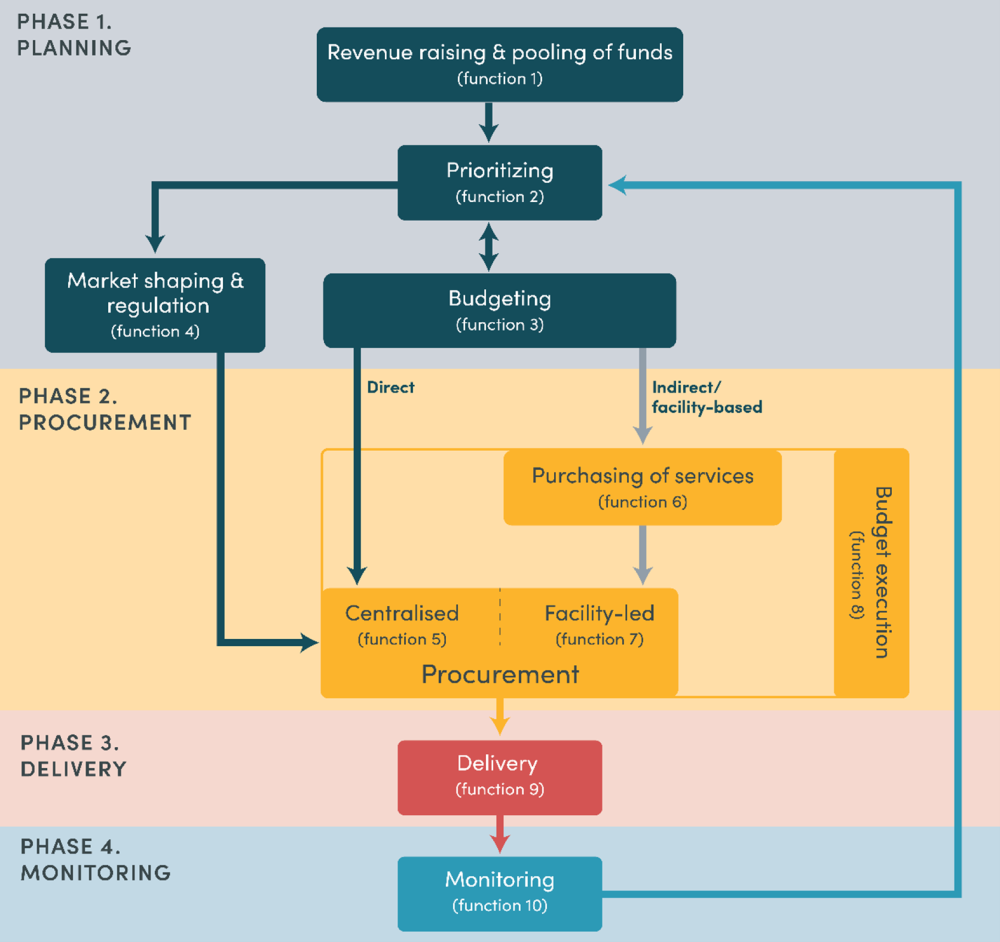
We define the financing of supply chains as the policies and practices necessary to provide financial resources to the supply chain, and ensure their optimal use, in order to achieve health system goals. Our framework was developed by analysing existing frameworks and maturity models from the health financing and supply chain fields, reviewing case studies and key papers, and conducting a series of consultations with experts from both fields. The result is a framework of 10 key functions categorised into four phases (Figure 1). For all these functions, a pre-requisite is integrated sectoral governance—the coordination of a range of powerful sectoral actors, including national and sub-national budget holders, procurement agencies, insurance agencies, service providers, the private sector, and donors.
Figure 1. Financing of supply chains: Proposed conceptual framework
Phase 1: Planning
Within the planning phase, countries must raise revenue and pool funds, set priorities, and formulate detailed budgets. However, these processes can be disrupted by multiple revenue streams leading to fragmented budgets, with a lack of overall visibility. For example, 22 different partners procure drugs on behalf of Nigeria—and most of this procurement is not in line with Nigeria’s Essential Medicine List. As part of this phase, countries must also conduct market shaping and regulation of the private sector to ensure later procurement efforts are most efficient.
Phase 2: Procurement
The next phase entails procurement, either through direct centralised procurement, or indirect facility-led procurement via purchasing of health services: Figure 2 details the flows of money and commodities entailed. For both routes, budget execution is crucial—but health budgets are plagued by pervasive under-execution, resulting in an annual loss of $4 per capita. Poorly managed decentralisation can make this phase more challenging. For example, Kenya’s 47 different districts each procure separately and with different levels of ability. Similarly, if not implemented well, national health insurance and provider payment reforms can interfere with procurement—such as when slow insurance claim payouts reduce cash flow at facilities or the payouts are inadequate to cover drug costs. And an additional procurement challenge looks set to emerge, as the current aid cuts mean countries are losing access to the benefits of donor pooled procurement prices and quality controls.
Figure 2. Major flows of commodities and finances in supply chains
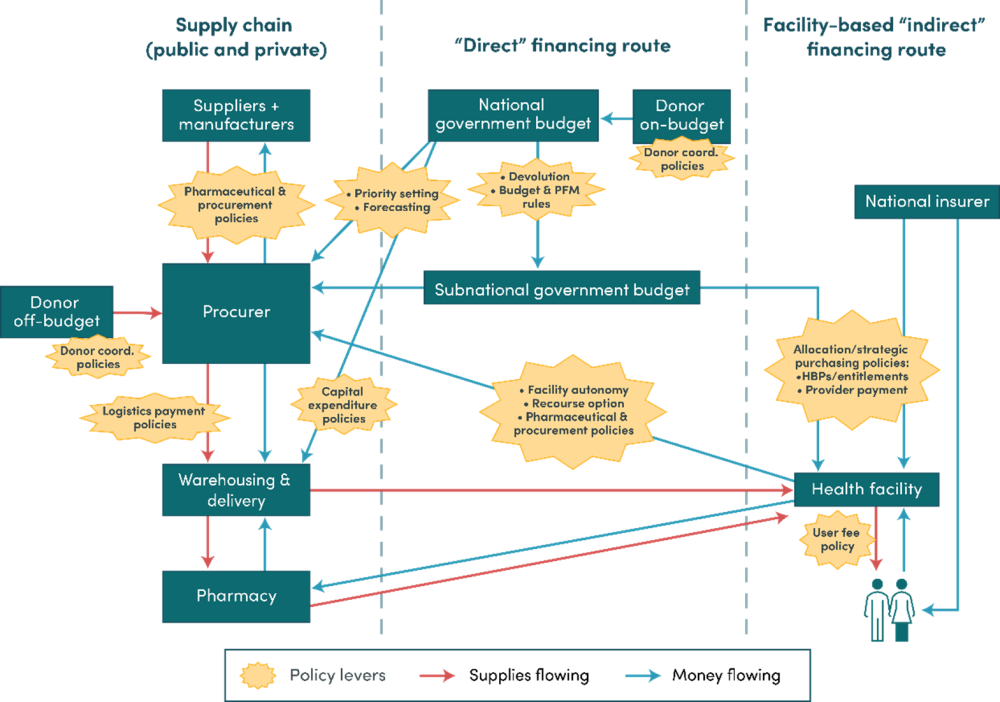
Note: HBPs = health benefits packages; PFM = public financial management.
Phase 3: Delivery
Once commodities have been procured, they must be stored and then delivered to the health facilities. This stage is often ignored by the health financing community, even though it can be a significant expense (with transportation costs alone sometimes exceeding the value of distributed medicine), and can be plagued by financing issues. For example, in Senegal, when delivery costs were covered by patient user fees, the resultant payments to private logistic firms were delayed. As a result, private firms left the market causing the supply chain to collapse.
Phase 4: Monitoring
Finally, the entire supply chain financing operation must be monitored. Data on commodity consumption is needed for optimising future planning according to need, data on supply availability at each level can detect blockages in the supply chain, and data on financial flows is needed to detect challenges with public financial management and budget execution. Importantly, integrating these data for decision-making can substantially increase efficiency by reducing stockouts and unnecessary overstocking. However, this is often hampered by insufficient data collection, limited digitalisation, a lack of system inter-operability, and low analytical capacity.
Next steps
The framework published today is a draft, designed to elicit comments and feedback—please reach out to us with any thoughts. As the working group continues deliberating and conducting research studies on topics such as governance, decentralisation, pooled procurement, supply chain finance instruments, and integrated data systems, we will revise the framework to incorporate updated thinking. We will also conduct a range of case studies to test the applicability of the framework in various settings.
These research papers and case studies will be published in the first half of next year, followed by the revised framework and working group report in late 2026. We hope that this work provides a new way of thinking about the financing of supply chains. Over time, we aim for it to foster to a new community of practice, strengthen national policies, and improve global guidance to enhance access to essential commodities.
To sign up for updates on the working group, please click here.
Topics
DISCLAIMER & PERMISSIONS
CGD's publications reflect the views of the authors, drawing on prior research and experience in their areas of expertise. CGD is a nonpartisan, independent organization and does not take institutional positions. You may use and disseminate CGD's publications under these conditions.
Thumbnail image by: USAID/ Flickr