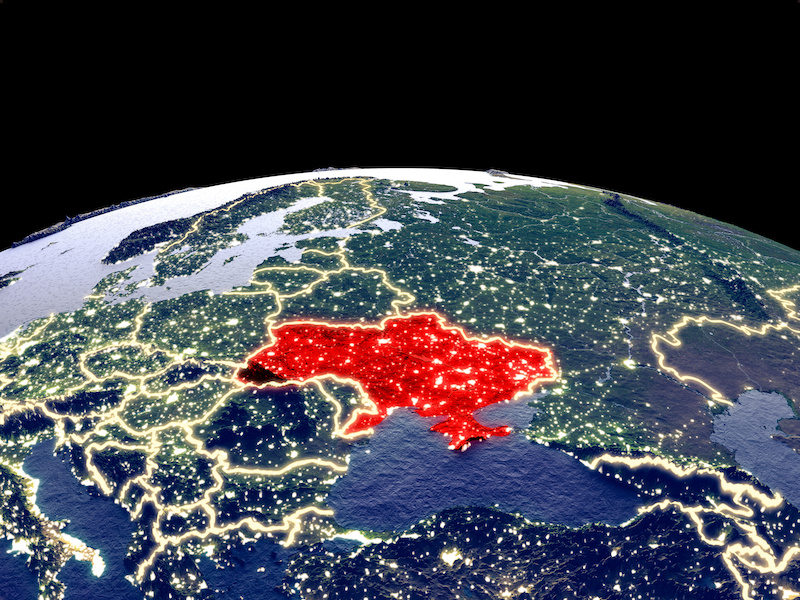
In the present struggle for access to information and digital services playing out in Ukraine, Iran, and many other countries, a new generation of “non-geostationary” (NGSO) satellites is testing the autocrat’s playbook.
Ukraine, in the midst of resisting a Russian invasion, is benefiting from both conventional and creative international support. As widely reported, SpaceX recently donated a truck full of Starlink terminals, essentially providing satellite broadband to the Ukrainian government at a time when its terrestrial telecommunications infrastructure is under siege. One half of this hardware, consisting of briefcase-sized “plug and play” terminals, is confirmed to be in the hands of the Ukrainian government. The other half—Starlink satellites, owned and operated by SpaceX—are sitting in low Earth orbit. Russia will probably attempt to destroy terminals in Ukraine. It’s unlikely Russia would attack “US-flagged” satellites in orbit because doing so would risk a direct US-Russia confrontation. (Russia is, however, interfering with other satellites still on earth by delaying the launch of a batch of 34 Oneweb communication satellites. Russia is demanding guarantees they won’t be used for military purposes and that the UK gives up its ownership stake.) Assuming the “service” side of being an internet service provider (ISP) is being handled virtually by SpaceX, which is headquartered in the US, it would be far more secure than ISPs based physically in Ukraine.
In war, actors wanting to destroy ground-based telecommunications infrastructure haven’t needed much finesse—kinetic attacks can degrade or destroy important components such as routers, exchange points, data centers, fiber relay, cellphone and radio towers, and so on. We’ve seen this occur in modern conflicts in Mali, Yemen, and Iraq. Small “plug and play” satellite terminals from Starlink, OneWeb, and others create user access points able to send data directly to and from satellites. This data is then relayed to a stable internet “gateway” elsewhere, skipping over damaged or threatened telecommunications infrastructure. These small satellite terminals are more accessible than ever thanks to a relatively low technical, power, and cost threshold. It’s not a free-for-all, though. Most countries require ISPs be officially authorized to operate in-country. National requirements for this authorization vary. Russia, for example, has a history of requiring that ISP’s install surveillance hardware that enables Russian security services to monitor users’ communications metadata and content, ranging from credit card transactions to email.
To explore what difference access to NGSO satellite broadband might make, it is worth looking at how countries not at war limit internet access. In peacetime, nations don’t usually damage or “shut off” their own hard infrastructure to shut down the internet. Rather they generally order Earth-bound, authorized, local mobile operators and ISPs to throttle (slow down) service, block websites and services (like WhatsApp, Facebook), or fully block access in particular areas. ISPs, in turn, use an array of tools, such as turning off the Domain Name System (DNS) and altering the Border Gateway Protocol of their services, URL-based blocking, and/or IP blocking, as well as other software-based measures. Sometimes countries do try to eliminate user hardware with mixed success. In Iran, for example, it’s illegal to own a TV satellite dish, though about 70 percent of Iranians have one anyway. Countries such as China and Russia use a variety of tools to restrict their citizens’ access to the wider world, but they are far from the only ones. The nongovernmental organization “Access Now” documented at least 50 internet shutdowns in 21 countries between January and May of 2021 alone.
The internet access community seems to be generally pessimistic about the chances of a NGSO satellites’ ability to circumvent peacetime state control of the internet. Articles such as “Why Elon Must Won’t Save Us from Internet Shutdowns” point to the power of nations to regulate domestic telecommunications, and private sector interest in not upsetting powerful countries like China. In all circumstances, critics note that satellite internet services can reveal location information, allowing determined adversaries to detect users. This has led to tragic consequences, and reminds us to always assess the security risks of new and emerging technologies, in the face of repression and persecution of journalists, human rights defenders, and other democratic actors.
It’s clear norms are changing. In an article exploring Iran’s tactics to lock down its internet, Lakasz Olejnik, from the Center for Technology and Global Affairs commented, “The more networks and connections a country has, the more difficult it is to cut access for good.” With SpaceX, Amazon, and other US companies, OneWeb, SES, China (“Starnet”) and Russia (“Sfera”) planning to launch between them a total of at least 56,600 communication satellites and produce millions of small receivers over the next decade, that makes for a lot of new networks and connections to police.