Recommended
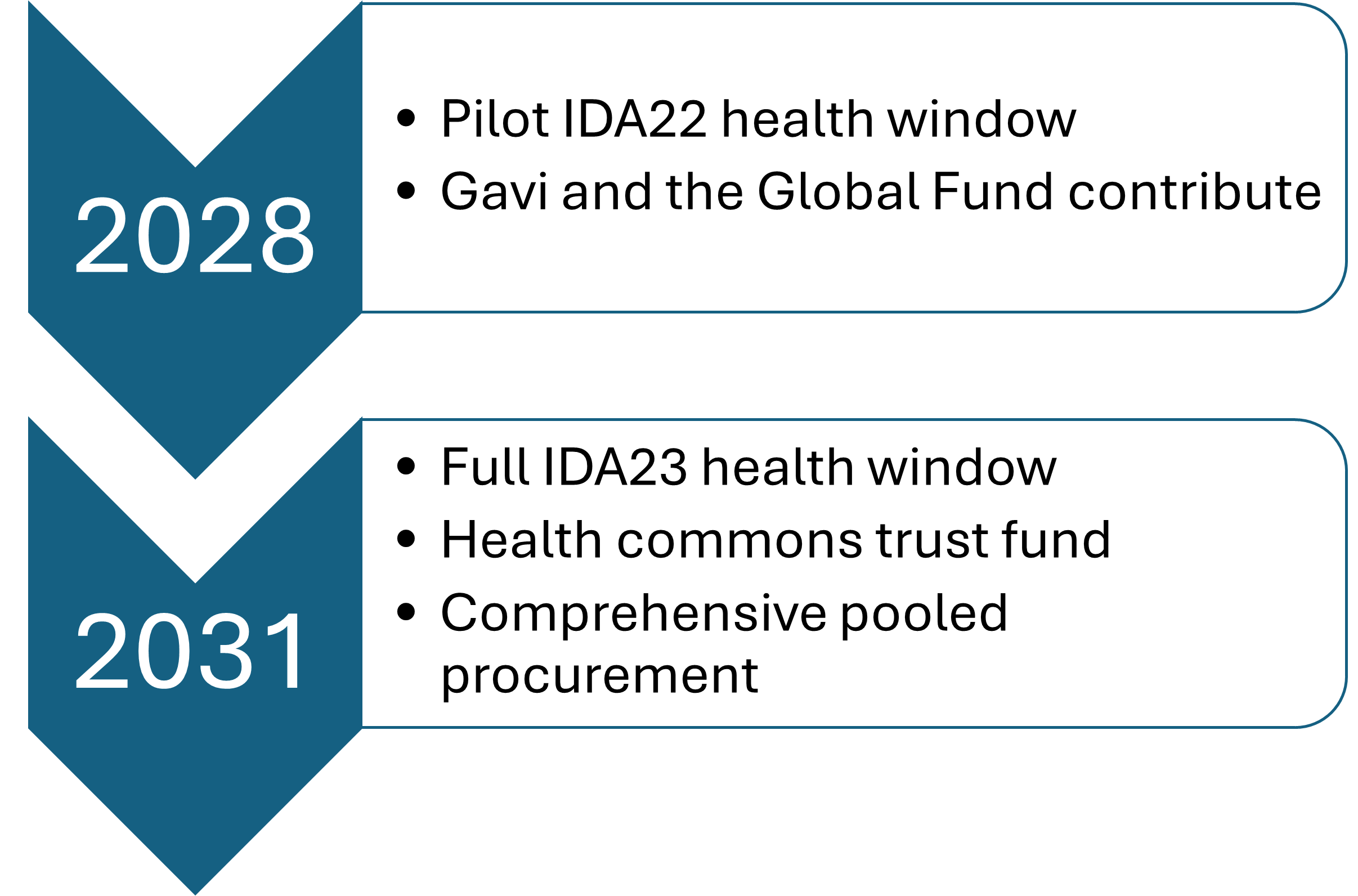

I recently proposed an IDA Health Window as the future of multilateral global health financing. The proposal is beginning to gain traction. It has received interest (mostly positive, but always with good, constructive challenges) from colleagues associated with the Accra Reset; Africa CDC and the African High-Level Ministerial Committee on Global Health Architecture Reform; low- and middle-income country health and finance officials; key high-income donors including the UK, France, Germany, and Norway; the World Bank and the Asian Development Bank; the World Health Organization, Wellcome, and civil society.
To stimulate further discussion on the proposal, below we publish four commentaries from:
- Gerald Manthalu, Head of Division for Public Financial Management and the Lusaka Agenda at the Africa Centres for Disease Control and Prevention
- Kalipso Chalkidou, Director of Performance, Financing and Delivery at the World Health Organization
- John-Arne Røttingen, CEO of Wellcome
- Agnès Soucat, Director of Health and Social Protection at Agence Française de Développement
There are two key challenges they raise about the proposal that I think require more detailed consideration:
- The proposal doesn’t fully cover the financing of global public goods (GPGs). I agree that the proposed Health Commons Trust Fund is only a partial solution. A non-official development assistance stream of financing for GPGs, and how it relates to the IDA Health Window, needs further consideration.
- There needs to be a clearer role for regional and wider public development banks. I agree that they are major financiers, and the proposal currently notes they could have a role through the Global Collaborative Co-financing Platform, but leaves the exact mechanism of co-financing between the wider banks and the IDA Health Window open. The World Bank remains the key player though: it has a larger capital base to leverage for providing loans, it is better at securing G20 support than regional banks, and it has excellent coverage—IDA already provides health system financing to 90 percent of IDA-eligible countries.
Please read on to hear their views in full:
“The logical progression should be to eventually move all country-level GHI grant financing into the IDA Health Window”
Gerald Manthalu, Head of Division, Public Financial Management & Lusaka Agenda, Africa Centres for Disease Control and Prevention
An IDA Health Window is arguably the most pragmatic and feasible pathway for restructuring the global health financing architecture, as I have argued before. It builds on existing institutions, and if implemented as proposed, allows the system to transition with minimal disruption.
Redirecting global health initiatives’ (GHIs) health-systems strengthening grants to the IDA Health Window is an important first step, but it does not fully resolve fragmentation. The funds GHIs provide to countries are mostly spent on disease-specific health systems strengthening, which still poses a fragmentation problem to countries. The Global Financing Facility may be an exception because its broad maternal, newborn, child, and adolescent health mandate effectively requires mainstream health-system strengthening and, hence, financing. Regardless, the logical progression should be to eventually move all country-level GHI grant financing into the IDA Health Window.
The consequence of this step is that what remains of GHI funds would mostly be the market-shaping and pooled procurement functions, which is duplicated among GHIs, with each focusing on its commodities of interest. These parallel arrangements should ultimately converge into a comprehensive disease-agnostic procurement and market-shaping architecture devolved to the regions. In Africa, for example, I refer to the African Pooled Procurement Mechanism, championed by Africa CDC.
While I agree with establishing country coordination platforms, these are already in place in many countries—and donor behaviour has been the constraint to their effectiveness. I therefore suggest that the author considers the IDA Health Window a prerequisite for effective country coordination. Many of the same donors fund GHIs and the World Bank, and provide bilateral funding to countries. Unless their behaviour and incentives change, effective country coordination will remain elusive.
I also support the proposed evolution of the Pandemic Fund to support the Health Commons to address international externalities. However, the Pandemic Fund should cede its country-level grant-giving function to the IDA Health Window because pandemic prevention, preparedness, and response is fundamentally a health-systems function, and through One Health, extends into other sectors. This is precisely the kind of multisectoral financing for which IDA is better suited. Effectively, IDA, complemented by the IDA Health Window, can provide the financing platform for PPPR at the country level, provided countries are able to prioritise and coordinate investments effectively across sectors.
"It makes an important point worth spelling out: on-budget financing matters”
Kalipso Chalkidou, Director of Performance, Financing, and Delivery, World Health Organization
This is a well-researched piece, refreshing for addressing institutional (dis)incentives and offering practical steps towards implementation beyond statements of intent, principles, pledges, lengthy board papers, and slide decks. It makes an important point worth spelling out: on-budget financing matters because it:
- introduces an incentive on global health initiatives/external donors to strengthen public financial management (PFM) systems rather than perpetually citing fiduciary constraints (PFM has become fashionable with vertical funds, but on-budget reporting remains an unfulfilled commitment for decades),
- addresses acute and worsening liquidity issues many LMICs/LICs face with limited market access,
- reduces contingent liabilities by increasing sovereign visibility of what’s funded and by whom, so governments can plan even when donors exit abruptly,
- crowds in funding, domestic and potentially external too; the matching mechanisms proposed for IDA22 donors and recipients reinforce the point.
However, the paper is almost silent on global public goods (GPGs): who will fund them and how? PPR and antimicrobial resistance get a brief mention, but GPGs aren’t about infectious outbreaks alone, nor is it wise to exempt PPR from domestic financing even in the poorest countries (see our work with ADB and G20). Health systems that work in peacetime are what allow them to work in crises; surging from nothing is both ineffective and inefficient.
Another blind spot is the ascending role of concessional financing in crowding in, derisking, some would say subsidising, private investment. Questions remain about who bears the risk and the opportunity cost of scarce IDA resources. The potential is significant as alternatives to MDB sources of additional financing are non-existent, but the terms of lending and investment priorities need to be carefully designed/selected—the quality of the funding is as if not more important than its quantity and this is where WHO’s technical role is of the essence.
WHO has both an active structure and a clear mandate to play a constructive role in supporting the implementation of an IDA Health Window. The 2025 Resolution on Strengthening Health Financing Globally and the UHC Knowledge Hub, offer the right platforms for WHO engagement. The latter formalises the World Bank/WHO collaboration on UHC for the first time, with a focus on capacity building, bringing together ministries of health and ministries of finance, and driving additional investment through National Health Compacts. This “marriage of the finance and health communities” is a tangible example of defragmenting the health financing landscape. We are on the right path: now we need to accelerate.
“The objective should not be to recreate vertical programmes, but to create a financing mechanism that enables country-led, integrated, and sustainable health investment at scale”
John-Arne Røttingen, CEO, Wellcome
The emerging consensus on global health financing reform is clear: external support should increasingly be shaped and led by governments, integrated into national plans and budgets, and, where possible, provided on budget. Recent regional and global dialogues on priorities for global health financing reform have noted how this would strengthen country ownership, improve alignment with national priorities, and move away from fragmented, externally driven approaches.
Multilateral development banks (MDBs) are, in principle, well placed to support this transition from disease- or solution-specific vertical programmes towards more integrated health systems financing. However, experience also shows that simply expecting general development finance through these institutions to flow to health sector needs has not been sufficient to ensure adequate investment in health and other social sectors.
MDBs’ policies, incentives, and institutional frameworks for prioritising concessional loans for social sectors have varied considerably and depend on leadership priorities and cascaded expectations. This has not been consistent over the years and is one of the reasons for the establishment of substantial funds dedicated for health priorities. In countries, ministries of finance often have stronger incentives to prioritise infrastructure investments in sectors such as transport and energy, where returns may be more visible and immediate, over investments in health where economic benefits are longer term and less easily captured in conventional investment frameworks.
This is why a sector-specific financing mechanism within MDBs could be valuable. A dedicated health financing window could help counter these tendencies while still embedding health financing within a broader development finance architecture and domestic financing systems. It could reinforce the recognition of health as a critical investment in human capital, rather than treating health primarily as a social expenditure.
A Health Window or a similar mechanism within IDA, alongside comparable dedicated mechanisms within regional development banks, therefore merits serious consideration by their governing bodies. The objective should not be to recreate vertical programmes, but to create a financing mechanism that enables country-led, integrated, and sustainable health investment at scale.
Tangible ideas need to be explored if we’re to enact the change needed. Wellcome looks forward to working with others to deepen the analysis on this and other potential models for streamlining in the global health ecosystem. Further analysis of equity considerations, and the incentives needed to operationalise reform, will be particularly important.
“An IDA Health Window could be a catalyst for leveraging a broader ecosystem of public investment towards domestic health investment”
Agnès Soucat, Director of Health and Social Protection, Agence Française de Développement
The IDA Health Window proposal is particularly timely and deserves serious consideration. This commentary highlights some of the most compelling features of the proposal and offers several complementary perspectives.
First, the proposal addresses several well-recognised weaknesses in the current architecture of global health financing, notably its maldistribution—with a large share of official development assistance (ODA) flowing to middle-income, including upper-middle-income countries—and its persistent fragmentation. Importantly, however, it also tackles the “elephant in the room:” the fungibility of domestic resources and the risk that external assistance may substitute for, rather than complement, domestic health spending. By proposing a consolidated investment framework that incorporates domestic financing alongside external lending and embeds health investment within national budgetary processes, the proposal offers a more coherent approach to mobilising and aligning resources.
Second, the proposal rightly recognises the growing role of development finance institutions and public development banks (PDBs) in financing health investments during and in the aftermath of the COVID-19 crisis. Today, public development banks collectively account for approximately $2.2 trillion in annual financing, equivalent to about 10 percent of global investment. Even if just 10 percent of these flows were directed towards health, this could generate approximately US$220 billion in annual health investment—an order of magnitude greater than the less than US$30 billion currently provided through ODA. The IDA Health Window should therefore consider co-financing from MDBs and PDBs, potentially through a Financial Intermediary Fund mechanism, as is the case with the Pandemic Fund.
Third, and most importantly, the proposal draws on lessons about the critical role of evidence, measurement, and accountability in improving health systems. The experience of the Health Results Trust Fund, in particular, suggests that financial support to health programmes should be systematically accompanied by investments in the production and use of high-quality data. This should include demographic and health surveys, health-expenditure surveys, public expenditure reviews and public expenditure tracking surveys, impact evaluations, and regular and rigorous assessments of country performance and health-system financing. An IDA Health Window should finance the information systems and institutional capacity required to determine whether those investments are delivering results and make sure the information is available to citizens in both recipients and donor countries.
An IDA Health Window could be a catalyst for leveraging a broader ecosystem of public investment towards domestic health investment. Its greatest value would ultimately lie in helping to reshape the incentives, institutions, and evidence base through which health investments are made.
With thanks to Gerald, Kalipso, John-Arne, and Agnès for their thoughtful responses.
DISCLAIMER & PERMISSIONS
CGD's publications reflect the views of the authors, drawing on prior research and experience in their areas of expertise. CGD is a nonpartisan, independent organization and does not take institutional positions. You may use and disseminate CGD's publications under these conditions.
Thumbnail image by: Kristina Blokhin/ Adobe Stock