Recommended



There has been a great deal of recent focus on the collapse in aid flows and the consequences for emerging markets and developing economies (EMDEs). Less attention has been paid to worrisome developments for a much larger source of finance: private investment. In a new CGD paper, we took a close look at trends in foreign and domestic private investment and bank credit to the private sector in EMDEs—and we found a disturbing picture.
Trends in private investment in EMDEs as a share of GDP are weak or declining. That bodes ill for all other major economic objectives: sustained growth, job creation, productivity and wage growth, poverty reduction, resilience, and technology diffusion and innovation. It also suggests that boosting private capital formation must be among the top items on policymakers’ agendas.
EMDE policymakers cannot prevent the kinds of exogenous shocks that have contributed to these trends. But they can do something about the public policies and administration that shape their private investment climates. So we took a step further in our paper: we explored the extent to which private investment outcomes are related to the structural policy aspects of the investment climate.
We summarize here our findings on both issues: private investment trends and their correlations with structural investment climate policies.
Slump and stagnation in recent years
Figure 1 below shows median ratios of private foreign and domestic investment to GDP in EMDEs for this century.
Figure 1. Median private foreign direct investment inflows and private domestic investment for EMDEs (2000–2023)
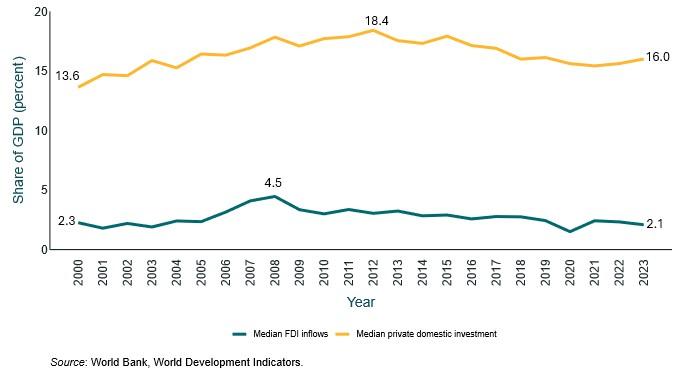
FDI ratios never recovered from the shock of the global financial crisis, with ratios now at 2.1 percent, compared to 4.5 percent in 2008. The peak ratio for domestic gross fixed capital formation in the private sector came a little later in this century, reaching 18 percent in 2012. The ratio in 2023 was down to 16 percent. But levels are as important as trends. The star performers for sustained high growth in the last century had much higher domestic private investment ratios: the ratio for Hong Kong, Singapore, and South Korea, for example, averaged 26 percent between 1980 and 2000.
Notably, research suggests that foreign and domestic investment tend to move together, highlighting the risk of a mutually reinforcing negative interaction.
Interestingly, this lackluster performance emerged despite growth in EMDE banking sectors and ratios of bank credit to the private sector relative to GDP.
Figure 2. Domestic bank credit to the private sector for EMDEs by income group (2000–2023)
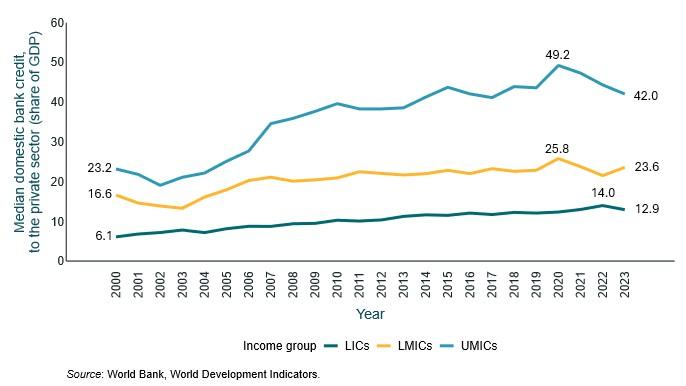
Ratios rose for all three country income groups, suggesting that easing constraints on the supply of domestic finance may be necessary, but not sufficient to drive major increases in domestic private investment ratios.
Recent World Bank analysis finds evidence attributing declining investment growth to slower economic growth, adverse commodity price shocks, rising investor uncertainty, high government debt levels, and declining trade openness. On the structural side, it finds that financial development and institutional quality are also significant drivers.
But governments need an analysis in greater depth to identify specific changes in policies and administrative performance that would help boost capital formation. Our paper takes a more granular look at that question, making use of the World Bank’s new B-Ready database, which scores governments’ investment-related policies and services across nearly 1,200 indicators per economy (for an initial sample of 50 economies), organized into 10 topics and 3 pillars (Regulatory Framework, Public Services, and Operational Efficiency).
The paper explores whether there are significant correlations between those scores and private investment outcomes. The B-Ready dataset’s level of detail helps governments identify areas of strength and weakness. But governments need help in setting priorities across nearly 1,200 indicators. Setting priorities requires evidence not only about the scores themselves but also about which indicators are most correlated with actual private finance flows.
Investment climate reforms: Where to focus
We do find significant correlations between investment ratios and some of the B-Ready topic/pillar combinations—evidence that the B-Ready system is indeed likely measuring aspects of the investment climate that are relevant to country-level outcomes for foreign and domestic investment and bank lending.
We observe differences in correlations between foreign investors, domestic investors, and banks that are consistent with reasonable explanations of which factors would matter most to each. Broadly, the trade and investment rules themselves seem to matter more to foreign investors, while the administrative burden and the cost of complying with the rules appear to be significant factors for domestic investors and banks.
Notably, all three sources of finance are significantly associated with the cost of making and receiving e-payments and with the extent of a country’s participation in trade agreements. And one or more aspects of competition and antitrust regimes are also relevant for all three—the policies themselves, the quality of the institutions that implement them, or their enforcement powers.
Government support for innovation appears important for domestic investors. While intellectual property rights are usually thought to be foreign investor concerns, this analysis finds that domestic investment is positively correlated with the quality of licensing and technology transfer regulations (royalties and patents) and government support for initial public offerings (IPOs) and intellectual property. In addition, domestic investment is correlated with e-procurement for government contracts, which likely opens up contract opportunities that might otherwise be locked in crony relationships and corruption.
Overall, our findings suggest that governments would do well to pay attention to policies and systems that confer economy-wide benefits attractive to a wide array of finance providers, including:
- trade openness (participation in international trade agreements and efficient trade administration)
- strong and efficient e-payment systems
- better access to data for assessing creditworthiness
- policies and systems for protecting competition
- support for local innovation
- open government procurement through e-procurement systems
- well-functioning dispute settlement mechanisms that don’t require court litigation
Caution is important in drawing policy conclusions at this stage: these results should be viewed as indicative, not definitive. Correlations do not demonstrate causality. The B-Ready database is new, and the sample size is small. It does not yet include time series, so it is not possible to construct panel data. Testing for significant correlations across many investment climate scores raises the risk of false positive findings (type I errors).
Future work as the database grows will allow more robust estimates. And larger samples will enable us to disaggregate the analysis by country income level to explore whether there are differences in these relationships for countries at different levels of development.
In the meantime, these cross-country results suggest a point of departure for countries that can help them build structural policy strategies aimed at achieving private investment ratios large enough to underpin sustained, robust growth.
Topics
DISCLAIMER & PERMISSIONS
CGD's publications reflect the views of the authors, drawing on prior research and experience in their areas of expertise. CGD is a nonpartisan, independent organization and does not take institutional positions. You may use and disseminate CGD's publications under these conditions.
Thumbnail image by: AmazingAerialAgency/ Adobe Stock