

Recommended

Blog Post
Comparability of Treatment: Pause for Thought

Blog Post
Senegal’s Referee Problem
Five main multilateral development banks (MDBs)—the Asian Development Bank, African Development Bank, European Bank for Reconstruction and Development, and Inter-American Development Bank and the World Bank—are all treated as having preferred creditor status (PCS) in sovereign debt restructurings. Rating agencies explicitly include PCS adjustments when they analyze their risk, basing the approach on the historical record—see for example S&P Global Ratings’ methodology update in 2025. But given ambiguity regarding the status of a couple of small MDBs in recent restructurings, two recent papers argue that this should change. Reza Baqir and Ali Hakim seem to argue that only the IMF and the World Bank should be preferred, while Martin Guzman and colleagues suggest that only concessional MDB contracts should be treated as senior. Both papers envisage that someone should decide who or what gets to be preferred.
But preferred creditor status is a “market custom,” not enshrined in contracts. How could it be? As Anna Gelpern outlines, in the current system it’s sovereigns who decide on the seniority of creditors. There is no international bankruptcy court to establish seniority—sovereigns are sovereign. In what follows, I discuss where PCS comes from and then make three main points: (1) refinements to the current system could reduce ambiguity “at the edges” of PCS, but that is no reason to take away PCS where it is firmly established; (2) given increases in PCS lending, MDBs with established PCS need to take care to maintain their status; and (3) perhaps we should consider changing the system, but in that case, we should think of a much deeper overhaul of sovereign credit!
PCS is not granted by any institution or body; it is earned. Some institutions, given the nature of their shareholders, their capital base, their governance and their operating procedures, are able to offer repeated appealing contracts in normal times, and they may be the only institutions offering financing at difficult times. To maintain future access, it is then in the borrowers’ own interests to treat these institutions as senior.
As a colleague and I show in a recent paper in the Journal of International Economics, PCS can be understood as a dynamic sustainable equilibrium. It doesn’t need to be written into contracts, even if they were enforceable. It is not that a particular contract offered by an MDB deserves to have PCS, it is that offering repeated appealing contracts provides the right incentives for sovereigns to maintain that institution as senior.
Our work also highlights that having PCS institutions around makes borrowing countries better off. Sovereign credit markets are highly incomplete and commercial lending is procyclical, so having different types of contracts is beneficial. Taking away PCS where it is already well established could be very costly.
Does this mean every MDB can maintain PCS? Not necessarily. Theoretically, only those institutions that offer contracts that are valuable enough (where the thought of being denied future access is sufficiently costly) will be treated by the sovereign as preferred.
Official bodies may influence borrowers’ incentives to repay. The Paris Club, an informal group of major creditor nations, currently excludes MDBs from its comparability of treatment policy. The G20 does not envisage MDBs being included in comparability of treatment discussions but says they should provide new financing. IMF rules state that if an MDB’s shareholders compose at least 50 percent of the voting power in the IMF Executive Board, the strong presumption is that the IMF would not tolerate arrears with that MDB; any arrears should be resolved within the context of an IMF program. Anything short of the 50 percent, and the base case remains arrears non-tolerance, unless the claims of that MDB have been included in a restructuring, with the final say given to the IMF Executive Board. The G20’s stress on new financing goes in the direction of an MDB providing incentives for repayment, while the IMF’s reference to whether the MDB has been included in a restructuring is consistent with the view that in the end it’s the sovereign’s decision.
One approach to reduce ambiguity might be to ask the sovereign borrowing members of every MDB whose voting members together compose less than 50 percent of the voting power on the IMF Executive Board to commit to treat that institution with PCS—the presumption being that the PCS of those with greater than 50 percent is already well-established. If any borrowing member refused, then the MDB could eject that member or decide not to consider itself as preferred. Some MDBs might elect not to go through this process and would not be considered as senior. The IMF could keep track of the commitments (and monitor adherence) and align its own tolerance of arrears policies to the result. The Paris Club could also align. This would respect the current system, that sovereigns are sovereign, and would provide incentives for MDBs to offer appealing contracts and extend new financing in tough times; otherwise a sovereign might not extend such a commitment, or renege on one it had made.
Note that having established PCS does not mean that an MDB can do whatever it wants. In particular, lending too much might weaken the incentives for a country to repay. In our paper the sustainable equilibrium breaks down if there is too much PCS lending. Perhaps this issue has also become more contentious because PCS debt has increased. Figure 1 plots MDB plus IMF debt for developing and emerging countries, the median is 49.9 percent of total public and publicly guaranteed debt.
This is not just an issue for MDBs or for poor countries, normally more reliant on official financing. For example, concern was raised about the IMF’s $57 billion program with Argentina in 2018; with no access to international capital markets, the country would have found IMF repayments very difficult indeed, unless the IMF agreed and disbursed on a new program, which it did in 2022. That IMF evaluation also focused on a key question, namely, why did the program fail?
Figure 1. MDB and IMF debt as a percentage of total external public and publicly guaranteed debt (including IMF debt)
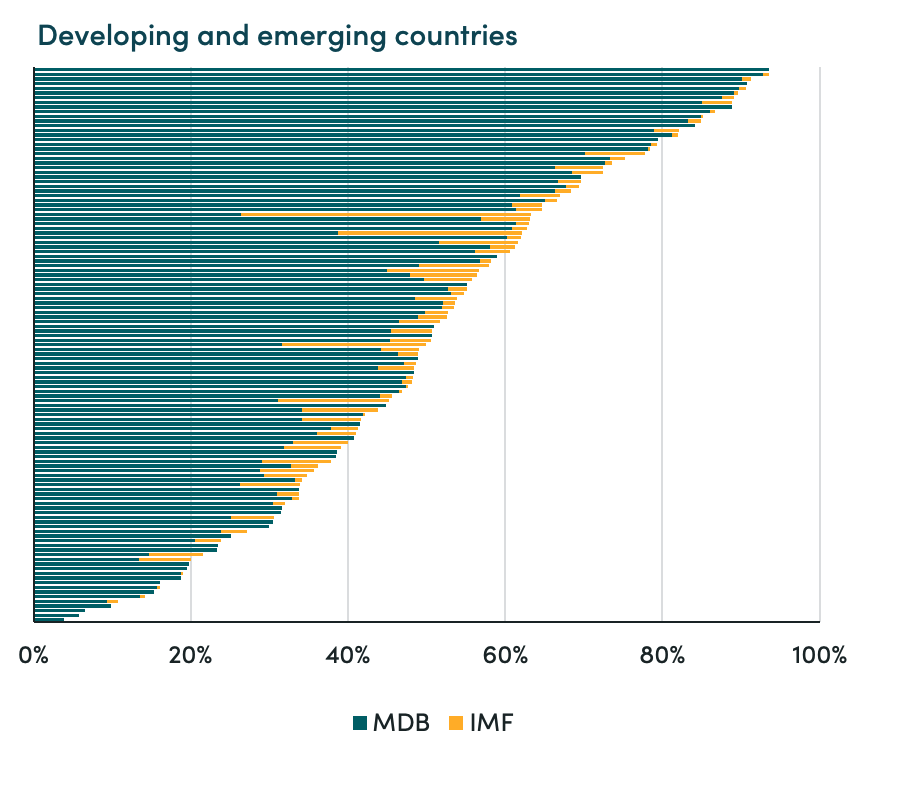
Source: World Bank International Debt Statistics. Note: Data is for 2024, the latest available. MDB is the multilateral debt divided by the total public and publicly guaranteed long-term external debt, MDB plus IMF is the multilateral debt plus IMF credit divided by total public and publicly guaranteed external long-term debt plus IMF credit.
Twelve countries currently combine a total debt-to-GDP ratio of greater than 60 percent with a ratio of MDB-plus-IMF debt to external public debt above that same figure—see figure 2. Sixty percent is an arbitrary number, but the general point is that where a risk of payments problems might develop and PCS debt is high, the MDBs and the IMF should be coordinating very closely to ensure that their programs are being as effective as possible. Still, the majority of developing and emerging countries have either a lower debt ratio, a lower PCS to external debt ratio, or both.
Figure 2. Selected country debt ratios
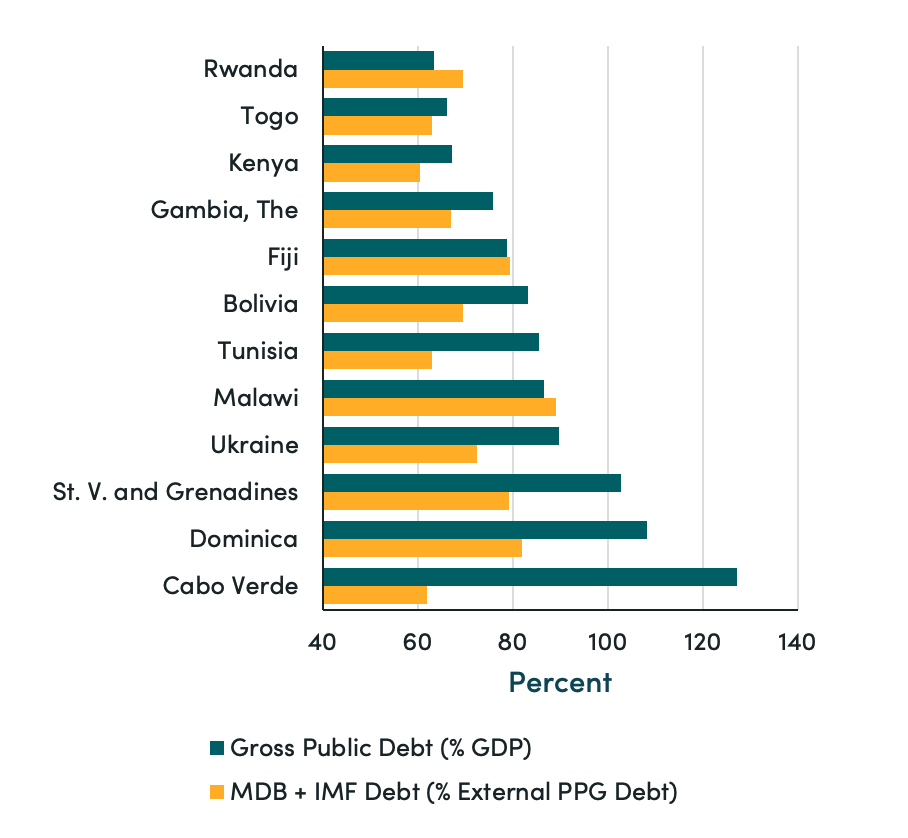
Source: World Bank International Debt Statistics and IMF World Economic Outlook.
Note: Data is for 2024. Debt-to-GDP is public gross debt to GDP. MDB + IMF PPG external debt is the sum of MDB debt and IMF credit divided by total external public and publicly guaranteed debt plus IMF credit.
Suppose there was a body able to enforce seniority among creditors, such as who or what should have PCS. There is another and likely much more important task that such a body should take on, namely who should have seniority among commercial creditors, where debt dilution may be a serious problem. If a country issues debt, let’s call it debt A, and there is a probability of default, then that country has an incentive to issue more debt, let’s call it debt B. The country will benefit from the proceeds of issuing debt B, but in default, if payments are limited it’s the A creditors that may bear the cost of the B debt issuance, not the country. The A creditors are diluted. The upshot is that countries have an incentive to issue more and more debt, and debt becomes more and more expensive. This can be self-defeating. If the country could tie its hands and commit not to issue more debt, then it could be better off, but if it can’t then debt ratios soar, default becomes more likely, and the country and existing creditors suffer.
The incentives for dilution depend on what happens in default. Some claim that comparability of treatment is the gold standard for restructuring. While comparability of treatment (if it could be enforced) may stop some freeriding, in its strict form it also makes the incentives for dilution transparent. Patrick Bolton and Olivier Jeanne advocate for a bankruptcy scheme to enforce seniority to eliminate dilution. If such a rule had existed perhaps debt ratios would be lower and the talk of an impending debt crisis would not be so loud. If someone could enforce who among the smaller MDBs should have PCS, it would be well worth considering if we could also improve the underlying sovereign debt market!
To conclude:
First, those arguing for someone to enforce who or what has PCS need to tell us how that is going to be achieved, and while they are at it, whether a wider seniority system to resolve deeper problems in sovereign credit could be implemented.
Second, if they wish to remove PCS where it is well established, then what would be the cost?
Third, a simpler alternative under the current system (where sovereigns are sovereign) would be to ask for (and monitor) commitments from sovereign borrowers to treat MDBs as preferred and ensure official statements align with the result.
Fourth, we should be analyzing the extent of PCS lending and the economic programs they support. Greater coordination among PCS lenders may be required to ensure that programs are highly effective and that PCS is not weakened.
Fifth, in those (hopefully few) cases where a country has payment difficulties and a large fraction of PCS debt, we should be asking why the underlying economic program failed, how those specific cases can be best resolved, and how we can avoid such situations in the future.
Topics
DISCLAIMER & PERMISSIONS
CGD's publications reflect the views of the authors, drawing on prior research and experience in their areas of expertise. CGD is a nonpartisan, independent organization and does not take institutional positions. You may use and disseminate CGD's publications under these conditions.
Thumbnail image by: EBRD / Flickr