Recommended


More than one billion people are affected by poverty-related and neglected diseases (PRNDs), including the 21 recognized neglected tropical diseases, as well as HIV/AIDS, tuberculosis, and malaria. These diseases cause avoidable illness and death, reduce schooling and labor productivity, and impose large economic costs. However, funding for PRND research and development (R&D) remains far below need. In 2024, R&D funding was still more than $1 billion below its 2018 peak. At the same time, thousands of drugs are already approved for at least one use, and some may hold promise as treatments for PRNDs. However, without a viable commercial market, existing drugs’ potential for PRNDs often go underexplored.
One solution is to create the missing incentive. A prize could reward innovators that discover and prove that an existing drug can treat a PRND. This philanthropy-funded prize would catalyze the search for underexplored treatments and generate large welfare gains for people who have been underserved by the existing market. Because these drugs have already undergone safety testing and accumulated real-world data, the path to identifying promising candidates may be faster and less risky than for entirely new compounds. And when a widely used drug is successfully repurposed, patients can often access it more quickly through existing supply chains and, if it is off patent, at lower cost.
Repurposing is not hypothetical. Doxycycline, originally developed as an antibiotic, was later found to treat filarial diseases such as river blindness and lymphatic filariasis by targeting the bacteria required for the parasite to survive. Clinical studies show that a six-week course can sterilize adult female worms and kill a substantial share of adult worms. Doxycycline illustrates the broader point that existing drugs can generate clinical value when applied to diseases they were not originally designed to treat.
So why does this not happen more often? The first reason is the limited purchasing power of the populations most affected by PRNDs. These diseases affect the world’s poorest people, who cannot afford to pay high enough prices to offset the costs of discovering and testing new drugs. Also, even global health donors can be tempted to bargain down prices once a drug’s use for PRNDs is proven, promoting access but weakening incentives for drug development. For these reasons, firms have little financial incentive to invest in pharmaceutical R&D for PRNDs, and total investment remains far below what the disease burden warrants (see Figure 1).
Figure 1. Cancer and Alzheimer’s disease receive many times more R&D spending per disability-adjusted life year (DALY) than poverty-related and neglected diseases (PRNDs)
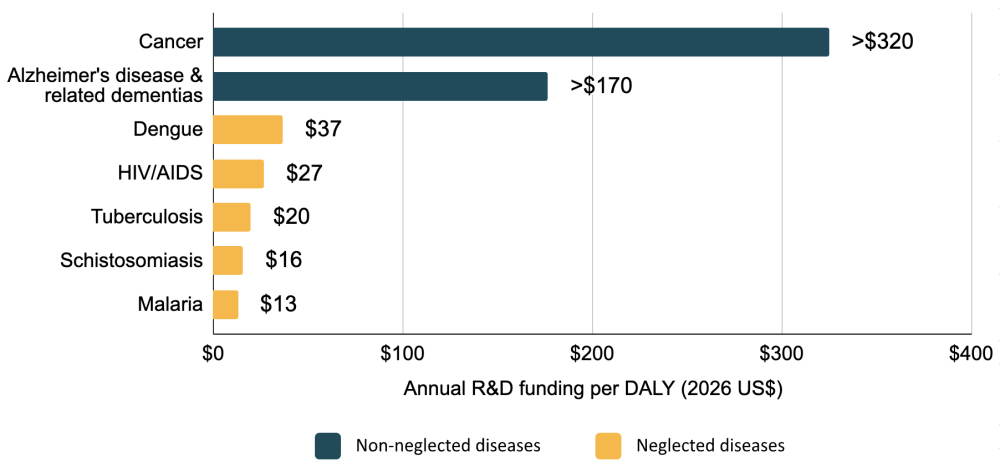
Source: Center for Global Development analysis, 2026. R&D spending data for cancer and Alzheimer's disease is not comprehensive. R&D spending for cancer is sourced from the National Institutes of Health, 2024 and Bloomberg, 2024. R&D spending for Alzheimer’s is sourced from National Institutes of Health, 2024, Alzheimer’s Association, 2021, Alzheimer’s Association, 2024, and Horizon Europe research programme, 2020. R&D spending data for dengue, HIV/AIDS, tuberculosis, schistosomiasis, and malaria are sourced from Impact Global Health, 2021. All monetary values are expressed in 2026 US dollars. Disability-adjusted life year data comes from the Institute for Health Metrics and Evaluation, 2023.
Another reason for low investment is specific to repurposing existing drugs. Financial incentives to discover new uses for drugs are often weak, especially once a drug is off patent. However, proving that a drug works for a new disease can still require expensive clinical trials and regulatory work. As a result, promising new uses for generic drugs may go understudied.
Existing efforts do not fully overcome these issues. For example, the US Priority Review Voucher program rewards companies that develop new drugs for neglected tropical diseases with a transferable voucher worth over $100 million. Repurposed drugs, however, are ineligible for the program. Also, grant funding from organizations like the Drugs for Neglected Diseases Initiative and Coefficient Giving has driven important progress but has limitations. Grants only fund teams that the funders select in advance and, therefore, tend to favor applicants already working in the space.
A prize would complement grants by creating a standing reward for anyone who successfully repurposes a generic drug for a PRND. This would encourage academics, nonprofits, and companies with relevant data and expertise to pursue promising repurposing opportunities that they might otherwise ignore.
This prize would reward any organization that demonstrates, in a clinical trial, that an existing drug improves outcomes for patients with an eligible PRND. The prize would have several key elements:
- A reward large enough to spur investment: We estimate prizes worth roughly $30-$50 million per successful drug-disease combination is enough to spur investment.
- A requirement that treatments improve on standard of care: Payments would be tied to expected, additional health impact. This impact would come through improved efficacy, safety, ease of delivery, or suitability for low-resource settings relative to standard of care.
- A cost-effectiveness threshold: This would ensure that the prize only funds high-value opportunities.
- Access conditions: Winning the prize would require or incentivize drug manufacturers to make repurposed drugs available broadly.
Drug repurposing is a promising but under-supported opportunity for funders interested in global health and development. A philanthropically funded prize for PRNDs would create an incentive to develop effective treatments that might otherwise have gone untested.
This blog was updated on 07/23/2026.
Topics
DISCLAIMER & PERMISSIONS
CGD's publications reflect the views of the authors, drawing on prior research and experience in their areas of expertise. CGD is a nonpartisan, independent organization and does not take institutional positions. You may use and disseminate CGD's publications under these conditions.
Thumbnail image by: Adobe Stock Images