Recommended

Event
Shock Absorbers in Debt Contracts for Poor Countries
HYBRID
April 14, 2026 1:30—3:00 PM ET | 5:30—7:00 PM BST
CGD NOTE
Debt Suspension Clauses to the Rescue?
WORKING PAPER
Lessons from the Global Shocks of 2020-2022
Key messages
- Low-income countries face mounting, diverse, and large exogenous shocks, now including the Iran war.
- Existing debt suspension clauses are too narrow and bespoke, leaving countries highly exposed to many of the most damaging shocks.
- We propose broadly applicable, standardized "debt shock absorbers" that are activated based on the size and impact of the shock, not the source.
- Temporary debt service suspension would be automatic if objective, quantitative activation tests are met.
- A four-part test (insolvency, liquidity, debt service burden, growth impact) would ensure relief is well targeted and triggered only when needed.
- Debt suspension clauses would be deployed in contracts with both public and private creditors, ensuring comparable treatment.
- Both creditors and debtors would benefit by helping countries avoid default.
- Building better debt contracts for poor country sovereign borrowing should be a prominent part of the debt relief arsenal.
- This proposal complements, not substitutes for, efforts to make debt restructuring, when necessary, more efficient and to promote net positive flows from international financial institutions.
This century has seen a sharp rise in the vulnerability of poor countries to exogenous shocks. The shocks have come in many forms: the pandemic; other health emergencies; wars; sharp reversals of capital flows; large deteriorations in terms of trade; and climate-related heat waves, droughts, floods, and storms. Once, such shocks were unusual or concentrated in regions. But over time, they have proliferated as these countries have become more integrated into the global economy and as climate change—to which many are especially vulnerable—has accelerated.
Poor countries are now buffeted by another major global shock, the Iran war. For many, it is making existing debt sustainability challenges bigger and more urgent.
While we have seen the emergence of some temporary debt suspension clauses (DSCs) in bespoke cases, the current system lacks the means to respond rapidly enough and at sufficient scale to offer poor countries breathing room for the wide array of shocks they regularly confront. In a new paper, we propose adding broadly applicable, standardized shock absorbers—temporary DSCs—to their debt contracts with both public and private creditors for this purpose.
Exogenous shocks affected all poor countries in our sample with varying frequency
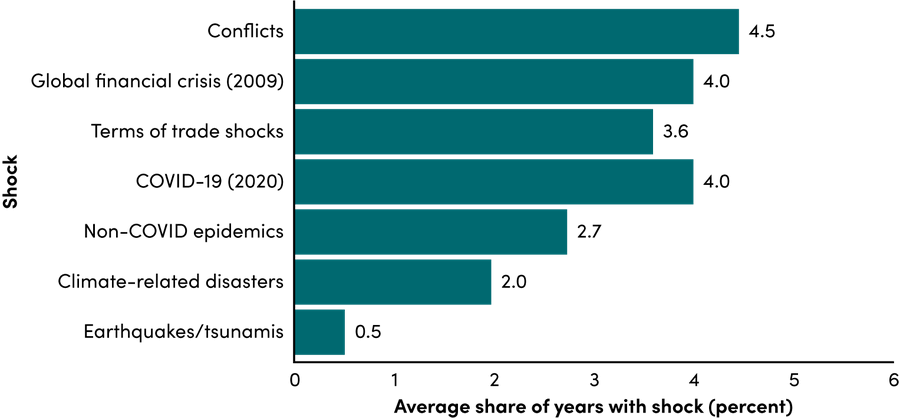
As a first step, we examined the scope of the problem. We looked across different categories of exogenous shocks to gauge their relative frequency. Low-income and lower-middle-income countries (LICs and LMICs) were subject to each category of non-climate-related shock on average about 4 percent of years during the period. That was double the frequency of climate-related shocks, which have received more attention.
Figure 1. Frequency of large exogenous shocks in LICs and LMICs (2000-2024)
Source: EM-DAT; UCDP; World Bank, WDI.
Note: The number to the right of each bar indicates the average share of years in which the countries in our sample were affected by the given shock. Our sample consists of 79 LICs and LMICs.
Definitions: Exogenous shocks are those not driven by domestically determined economic or financial policies. A country was considered a LIC or LMIC if it fell into either category for at least twelve years over the period. Conflicts are defined as years with more than 1,000 conflict-related deaths. Terms of trade shocks are defined as declines in the terms of trade index two standard deviations below the median. The terms of trade index is defined as the ratio of the import value index to the export value index. Non-COVID epidemics are defined as epidemic disease events for which states of emergency were declared. Climate-related disasters and earthquakes/tsunamis are defined as such events with more than $1 million in associated damages. Climate-related disasters include droughts, extreme temperatures, floods, storms, and wildfires.
Poor countries lack cushions
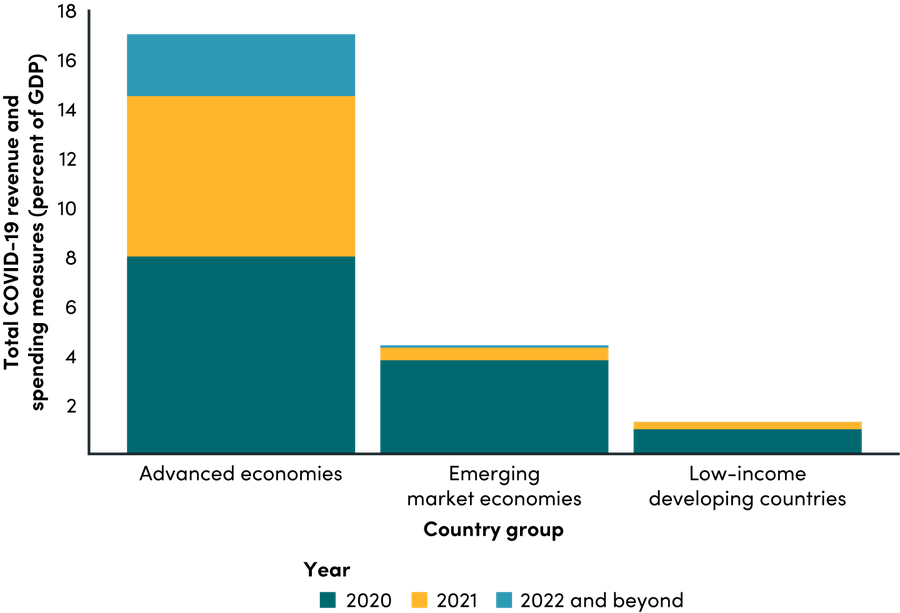
Poor countries lack the fiscal space to soften the blow through countercyclical or reconstruction spending.
Figure 2. Fiscal support for COVID-19 responses by country income group
Source: Figure from IMF, 2021. Data based on IMF Fiscal Monitor database of Country Fiscal Responses to COVID-19 and IMF staff calculations.
And we know that the costs of the largest shocks persist.
And now another major global shock: The Iran war
We don’t yet know the war’s duration or the extent of its damage, but as the IMF points out, “all roads lead to higher prices and slower growth.” The consequences for debt service burdens in many poor countries are inevitable. Even before the war, 59 out 68 poor countries were experiencing debt strains according to the IMF. According to UNCTAD, 45 developing countries spend more on interest than on health. And now we’re seeing clear impacts on debt spreads for oil importers, some of which already have spikes in debt service this year.
We don’t know at this point if more countries will be driven to default. But a substantial number will certainly need temporary debt service relief, precisely to avoid default and restructuring and to mitigate effects on growth, poverty reduction, and social protection.
Our proposal
It is in the interests of both the creditor and debtor countries to help countries avoid default. Temporary suspension of debt service payments in the face of exogenous shocks permits countercyclical spending that can help avoid the long-term damage to growth and investment we saw post-pandemic. That increases the chances creditors will be repaid.
We have already seen both multilateral development banks (MDBs) and bilateral lenders adopt climate- and health-shock-specific DSCs. But the shock we are now confronting is unrelated to either, as are the wide range of other shocks that poor countries face. To avoid the inefficiency of having to generate bespoke DSCs, it’s time to design and deploy DSCs that are applicable across a broad range of large shocks, and to do so in a way that is standardized and transparent, keeps transaction costs low, holds creditors harmless, and is well targeted to the countries that need it most.
This is what our proposal for debt shock absorbers for poor countries aims to achieve.
Five features distinguish the proposal:
- Shock-agnostic triggers. Activation depends on the magnitude of the impact, not the source of the shock.
- Simple, quantitative benchmarks. A four-part test—to exclude insolvent countries and to assess the shock impact on liquidity, debt service burdens, and growth—determines when clauses can be activated. All four tests must be met.
- No creditor approval required. If triggers are met and verified, the clause activates automatically. This is an embedded provision, not a change, in the contract.
- Coverage across public and private creditors. MDBs, bilateral lenders, and sovereign bond issuers would all include the clauses—addressing the comparability-of-treatment problem for which the G20 Debt Service Suspension Initiative was criticized.
- No strings on spending. Unlike debt-for-nature or debt-for-development swaps, governments decide how to use the freed-up resources.
We constructed our proposed DSC with eight principles in mind:
- simplicity and easy replicability
- net present value neutrality
- comparable treatment of public and private creditors
- broad applicability across different shocks
- efficient targeting of relief
- non-applicability to insolvency countries
- use of objective and quantitative criteria for clause activation
- automatic activation if criteria are met
The four-part activation test
To activate temporary debt suspension (for debt service payments due the year following suspension), poor countries must meet the following requirements:
- Insolvency test: Countries already in debt distress (as assessed by the IMF/World Bank DSA) may not invoke the clause. DSCs are the wrong tool for insolvency and are not a pre-restructuring step—they're designed for countries that can still service their debt under normal conditions.
- Liquidity test: The country's reserve adequacy, as assessed by the IMF, must be in, or rapidly approaching, the "risky" or "inadequate" range following the shock.
- Debt service burden test: The country's external debt service-to-revenue ratio must meet or exceed the ceiling defined by the IMF/World Bank Debt Sustainability Analysis as its debt-carrying capacity.
- Growth impact test: IMF-revised growth projections for the year following the shock must forecast negative growth: economic contraction.
Why negative growth?
Our aim is to set the growth rate benchmark in a way that benefits countries severely affected by various shocks while avoiding frequent resort to DSC activation.
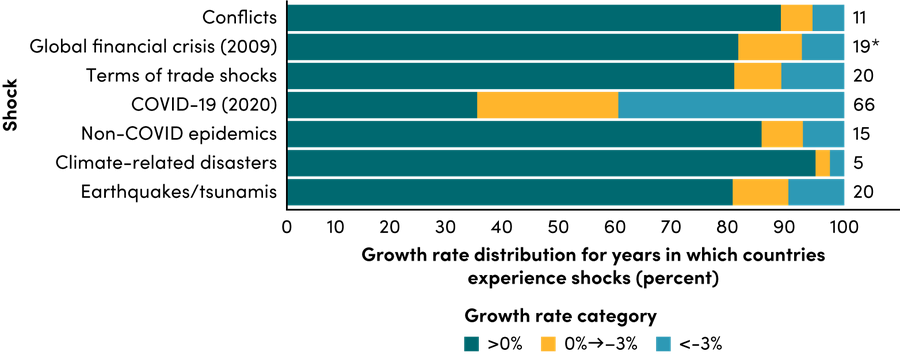
To set the bar at the right level, we compared growth effects across major shocks. Figure 3 covers shock-affected GDP growth rates for poor countries experiencing significant conflicts, large declines in terms of trade, a global financial crisis, COVID, non-COVID epidemics, major climate-related events (droughts, extreme temperature events, floods, storms, wildfires), and earthquakes.
Figure 3. Growth rate frequencies by shock type in LICs and LMICs (2000-2024)
Source: EM-DAT; UCDP; World Bank, WDI.
Note: The growth rate distributions were calculated using the sample of countries experiencing both that shock and a growth rate within that range during a given year. The number to the right of each bar indicates the share of years with negative growth for that shock.
Definitions: A country was considered a LIC of LMIC if it fell into either category for at least twelve years over the period. Conflicts are defined as years with more than 1,000 conflict-related deaths. Terms of trade shocks are defined as declines in the terms of trade index two standard deviations below the median. The terms of trade index is defined as the ratio of the import value index to the export value index. Non-COVID epidemics are defined as epidemic disease events for which states of emergency were declared. Climate-related disasters and earthquakes/tsunamis are defined as such events with more than $1 million in associated damages. Climate-related disasters include droughts, extreme temperature, floods, storms, and wildfires. (*) The total share for the global financial crisis differs from that found in Figure 7 because (a) this figure uses actual growth rates and (b) there is a sample size difference.
Negative growth was much more prevalent for the COVID-19 shock, while it was relatively rare among countries confronting climate-related disasters. For countries affected by other kinds of shocks, growth was negative in 10-20 percent of the years in which they were impacted.
That frequency can be seen as desirable from the perspective of both creditors and debtor countries, as it is consistent with the efficiency principle for temporary debt relief. That is, it would be well-targeted and quickly available to the countries that need it most, but not available to the majority of countries that suffer more limited damage from a given shock.
The relief can be large compared to other sources
Jamaica’s post-disaster finance sources after Hurricane Melissa in late 2025 offer a recent example. The country’s catastrophe bond paid out $150 million; IMF emergency lending provided $415 million. But temporary suspension of Eurobond and MDB debt service would free up $1.1 billion—against $8.8 billion in damage (41 percent of GDP).
Quick and straightforward DSC activation
Our proposal could free up resources quickly, a critical advantage for poor countries where the shock has sharply constrained fiscal space and depleted international reserves. Because debt suspension clauses and terms of activation would be clearly delineated in debt contracts, invocation of DSCs can be distinguished from an event of default or a distressed operation under the methodologies used by credit rating agencies.
The activation process would be relatively straightforward. Countries would obtain the relevant data and shock-driven growth projections from the IMF, make the information public with IMF verification, and activate the DSC, which would permit suspension of their external debt payments in the 12 months following the shock for eligible issuances that include the DSC. The deferred interest would automatically be added to the outstanding principal. Clause activation could be limited to once during the tenor of a given debt issuance. Depending on the bond maturity, the payment profile, and other factors, issuing countries would decide when activation would offer the most benefit.
Transparency
A crucial aspect of better debt contracts is transparency. It is especially important for contracts with DSCs to be transparent, given understandable initial uncertainty from creditors and stakeholders in issuing countries about how this innovation would work. Any contract with these DSCs should be published in full on sites readily available to the parties and to the public.
Part of a larger toolkit
The proposal is meant to complement, not substitute for, ongoing work to explore refinancing options that lower the cost of capital, and to make the debt restructuring process more efficient. This is especially true as these clauses would be deployed only in new issuances, so their benefits will take time to build, as was the case with collective action clauses.
The aim is better long-term solutions to strengthen the resilience of poor countries and to help avoid a recurrence of today’s pervasive debt strains. We know these countries will continue to be subject to frequent exogenous shocks. A forward-looking approach of building better debt contracts for poor country sovereign borrowing should be a prominent part of the debt relief arsenal.
The role of the official sector will be critical in advancing this approach. Including DSCs in the loan contracts of the MDBs and bilateral DFIs (including China’s) would go a long way toward addressing the comparability of creditor treatment disputes that hampered the DSSI effort. It would ensure consistent and timely temporary debt service pause for countries that borrow heavily from these sources as well as from private creditors. Ensuring the cooperation of the IMF, the World Bank, and other MDBs will require strong support from the G20, the G7, and a critical mass of potential issuing countries.
Topics
DISCLAIMER & PERMISSIONS
CGD's publications reflect the views of the authors, drawing on prior research and experience in their areas of expertise. CGD is a nonpartisan, independent organization and does not take institutional positions. You may use and disseminate CGD's publications under these conditions.
Thumbnail image by: Mirek/ Adobe Stock