Recommended
Blog Post
We Can Spend $50 Billion a Year Effectively
The AI boom could see anywhere from $37 billion to $100 billion in annual philanthropic spending over the next few years. The question is, how can this money be spent effectively? A new blog series from CGD makes the case for highly cost-effective areas that philanthropists may want to consider funding. This second blog in the series makes the case for a maximum vaccination strategy focused on developing and rolling out new vaccines for diseases that affect the world's poorest people.
Nan Ransohoff suggests AI-related wealth may add $37 to $100 billion a year in philanthropic spending in the near future. Optimistically assume that 33 percent of new AI-related giving goes to global development writ large. That’s more than $12 billion a year, or somewhere close to France’s overseas development assistance in 2025, or about 3 percent of the collective gross national income of low-income countries. Rachel Glennerster and Leah R. Rosenzweig have suggested numerous ways to spend those billions with very high impact, and existing organizations to direct it. I’d add that support for a maximum vaccination strategy focused on developing and rolling out new vaccines for diseases affecting the world’s poorest people could have a massive return.
Why vaccines?
Vaccines surely rank as one of the world’s greatest technologies. In the best of cases, they provide highly effective protection against disease over many years. And by reducing the risk of infection, they help protect the unvaccinated as well. The most effective vaccines can mean the risk of infection falls to zero or close to that worldwide. They’ve wiped out the mass killer of smallpox and reduced other diseases to comparatively minor threats. Since 1974, they’ve prevented 154 million deaths, the great majority amongst young children. That’s an average of about three million a year, which is not far off the total number of kids born in the US last year. And the poorest countries and regions have benefited the most: Africa alone accounts for a third of the global benefit in terms of lives saved.
We’re in a golden age of vaccine research including new technologies like mRNA. AI is helping: AlphaFold cracked the 3D structure of a malaria parasite protein, Pfs48/45, and helped design a stable influenza type b vaccine, while Moderna used the technology in developing its Covid-19 vaccine. The last three years have seen vaccines approved for severe respiratory syncytial virus, malaria, and chikungunya, for example. And Covid-19 clearly demonstrates how fast we can move through all of the stages of research, development, testing, manufacture, and delivery of vaccines at scale, if the resources are available (Figure 2).
Again, we already have a global production and delivery infrastructure that does remarkably well at getting to the last mile and gets shots into the arms of more than four out of five of the world’s children each year. The vaccine delivery infrastructure is also one of the world’s more equitable: in recent years, about three quarters of children in the world’s poorest (low-income) countries have been vaccinated (Figure 1).
And vaccines are a fantastic health technology for low-income countries in particular because they require limited capacity: vaccination is usually a simple, cheap, one- or few-shot procedure requiring limited skill to deliver. Once delivered, it usually protects for many years and prevents the need for far more expensive, complex, and often unsuccessful treatment of those who would otherwise get sick. In countries short on medical staff, where clinical service quality is weak, and health expenditures can be as low as a few dollars per person a year, these are very attractive features. And the more that major health threats can be prevented through the vaccination infrastructure, the less burden on other parts of the public health system.
That’s why vaccines have been so central to declining premature mortality in the poorest countries. And the health impact of vaccines has had significant knock-on effects in everything from investments in education through worker productivity to gender equality. For every dollar invested in vaccination in developing countries, $16 is saved in healthcare costs, lost wages, and lost productivity, with additional impacts suggesting a return of $1 in costs producing $44 in benefits.
Figure 1. Rapidly expanding vaccine access
Figure 2. The time from microbe identification to widespread vaccination is shrinking
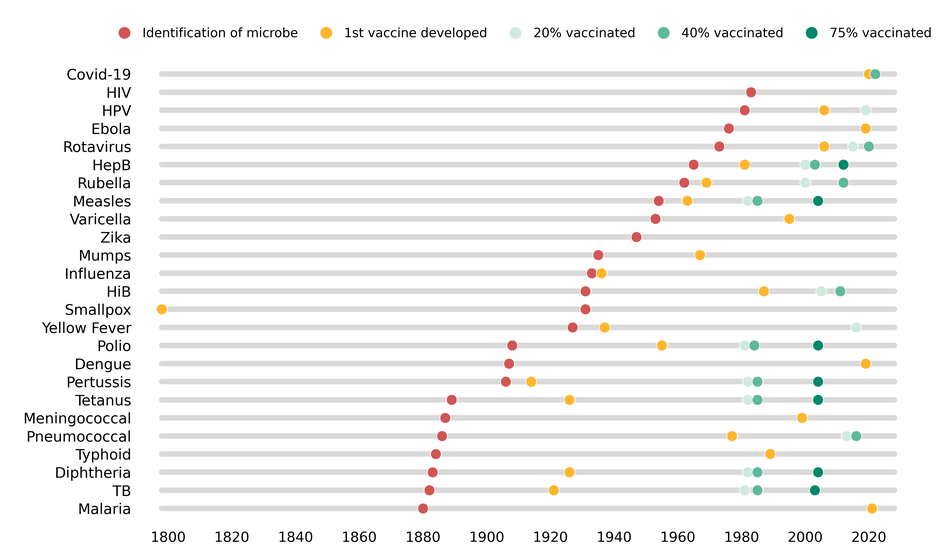
Note: Smallpox was the only disease for which a vaccine was developed prior to identification of the microbe (it was eradicated in 1980, prior to good data on global vaccine coverage).
Source: Glassman, Amanda, Charles Kenny, and George Yang. 2022. COVID-19 Vaccine Development and Rollout in Historical Perspective. Center for Global Development.
The role of additional finance
But we could do far more. The poverty of the potential market means that infectious diseases affecting the world’s poorest people see limited research, development, testing, and rollout of vaccines.
Take malaria: the disease kills about 600,000 people annually, mostly children under the age of five in sub-Saharan Africa. We now have a malaria vaccine, R21, but it is being rolled out slowly. We could save 800,000 additional child lives by 2030 if it were rolled out at speed and scale. Even then, the vaccine is multi-dose and partially effective, and its efficacy fades further over time. While even this vaccine is cost-effective, we also need to develop and roll out a better vaccine. For other mass killers in the world’s poorest countries there is no vaccine available at all, including HIV, Group A streptococcus, Hepatitis C, and Shigella.
A recent World Health Organization (WHO) study named 17 pathogens as top priorities for new vaccine development. The list provides pointers for which diseases need to see more vaccine research and others where the need is for testing, regulatory approval, and then rollout. There is also the need to develop vaccines against pathogens with epidemic potential (we have one Ebola vaccine, but not one that works against the strain that is currently spreading in the Democratic Republic of the Congo), as well as neglected tropical diseases. Table 1, developed with the assistance of Claude using data from the WHO study, lists thirteen of these diseases.
Allowing for failures, development of a vaccine through early clinical safety and efficacy testing (before large-scale vaccine efficacy studies) is estimated to cost an average of $319 million to $469 million. Later stages add considerably more to the cost, with one estimate of bringing a vaccine to the US market approaching $900 million. It is worth noting that research on vaccines against HIV (for example) has already cost many multiples of that.
Additional financing should be targeted according to the likely cost of bringing to market potential vaccines based on the current state of vaccine research, development, and testing for each diseases, alongside likely vaccine efficacy and the potential disease burden avoided in the poorest countries. Maximizing impact would also involve understanding financing gaps given the range of existing funders, researchers, pharmaceutical firms, and global institutions that have already made considerable progress in increasing the number of vaccines available. Major vaccine research funders include the Gates Foundation, Coefficient Giving, and CEPI, for example.
Delivering the vaccine to market is of course only the first step to impact. Once new vaccines are available, existing and new funders have to ensure they are rolled out at scale in low-income countries, likely through Gavi, the Vaccine Alliance. The average per disease cost of vaccinating a child in the poorest countries is under $7. While new vaccines tend to be more expensive to buy, their marginal cost to deliver is lower. But assume a cost of $20, and about 72 million children immunized with Gavi support, this comes to $1.4 billion.
And we need to ensure that as many children as possible benefit from old and new vaccines alike: that points to the need to add proven vaccines to a country’s routine immunization schedule and getting vaccines to those who don’t get them currently, as Rachel and Leah discussed in their blog. Filling Gavi’s financing shortfall, alongside speeding up deployment of the malaria vaccine, could involve $460 million a year for malaria and $580 million for other vaccines. GiveWell suggests cash transfers to incentivize caregivers to bring babies to clinics for routine childhood vaccinations in Northern Nigeria costs about $146 per vaccinated infant, or about $4,500 per life saved, for example. Expansion to new areas outside of Nigeria might rapidly scale to tens of millions a year.
Finance for a maximum vaccination effort initially focused on research, development, and testing could be concentrated on particular diseases or scaled toward rollout, depending on resources and most cost-effective opportunities, but could certainly involve billions a year. And the impact on global health and development would be immense: many millions of lives could be saved.
Table 1. Vaccine status of 13 priority diseases listed by WHO
| Pathogen | Disease/condition | WHO R&D tier | Current vaccine status (2024–25) | Primary burden |
|---|---|---|---|---|
| Group A streptococcus | Rheumatic heart disease, invasive strep, pharyngitis | Research needed | No licensed vaccine; candidates at early/preclinical stage | ~300k deaths/yr (mostly rheumatic heart disease) in LMICs; children |
| Hepatitis C virus | Chronic hepatitis, cirrhosis, liver cancer | Research needed | No licensed vaccine; lead T-cell candidate failed to prevent chronic infection in trial | ~290k deaths/yr; people who inject drugs, LMIC populations |
| HIV-1 | AIDS | Research needed | No licensed vaccine after 40 years; major trials (e.g., Mosaico and Imbokodo) ended without efficacy | ~630k deaths/yr; sub-Saharan Africa heavily affected |
| Klebsiella pneumoniae | Sepsis, pneumonia, neonatal infections | Research needed | No licensed vaccine; early development | Leading cause of drug-resistant neonatal sepsis deaths in LMICs |
| Leishmania species | Visceral and cutaneous leishmaniasis | Further development | No licensed human vaccine; candidates in early clinical development | Poorest communities in East Africa, South Asia, Brazil |
| Non-typhoidal Salmonella | Invasive non-typhoidal salmonella disease, sepsis | Further development | No licensed vaccine; conjugate candidates in early trials | Major cause of bloodstream infection in sub-Saharan African children |
| Norovirus | Acute Gastroenteritis | Further development | No licensed vaccine; candidates in clinical trials | Diarrheal disease burden; severe in young children and elderly |
| Plasmodium falciparum (malaria) | Malaria | Further development | RTS,S/AS01 (Mosquirix) and R21/Matrix-M licensed and WHO-recommended, but modest efficacy | ~600k deaths/yr, ~80% young children in sub-Saharan Africa |
| Shigella species | Dysentery/diarrheal disease | Further development | No licensed vaccine; several candidates in trials | Major cause of childhood diarrheal deaths in LMICs; AMR concern |
| Dengue virus | Dengue fever/severe dengue | Approaching approval/intro | Two licensed vaccines (Dengvaxia, Qdenga and TAK-003); WHO prequalified a dengue vaccine in 2024 | ~half the world's population at risk; tropical/subtropical LMICs |
| Group B streptococcus | Neonatal sepsis and meningitis, stillbirth | Approaching approval/intro | No licensed vaccine yet; maternal candidates in late-stage development | Major cause of neonatal death and stillbirth, esp. in LMICs |
| Mycobacterium tuberculosis | Tuberculosis | Approaching approval/intro | Only BCG (weak vs adult pulmonary TB); M72/AS01E candidate in phase 3 | ~1.25m deaths/yr |
| Respiratory syncytial virus (RSV) | Lower respiratory tract infection | Approaching approval/intro | Licensed vaccines now exist (older adults and maternal); LMIC access limited | Leading cause of infant LRTI hospitalization worldwide |
Source: developed by Claude (AI) from Hasso-Agopsowicz M et al. Identifying WHO global priority endemic pathogens for vaccine research and development (R&D) using multi-criteria decision analysis (MCDA): an objective of the Immunization Agenda 2030. EBioMedicine. 2024;110:105424.
Topics
DISCLAIMER & PERMISSIONS
CGD's publications reflect the views of the authors, drawing on prior research and experience in their areas of expertise. CGD is a nonpartisan, independent organization and does not take institutional positions. You may use and disseminate CGD's publications under these conditions.