As the USAID cuts shutter projects worldwide, Chinese officials are certainly making the most of the opportunity. The country has stepped in to fund child literacy, nutrition, and landmine clearance programs in Cambodia previously backed by the US and has made overtures to Nepal and Colombia about filling gaps. Alongside South Korea, it sent $4 million to the Africa CDC in response to the US exit. So far, these efforts have been largely cosmetic, but that shouldn’t reassure anyone worried about America’s global standing.
In both the Cambodia and Africa CDC cases, where China has “stepped in,” it has done so with a fraction of the resources that the US was providing. And that’s an indication of China’s (lack of) financing heft in the sectors the US is retrenching from. The two countries’ foreign assistance programs simply look very different: China’s finance is dominated by lending and loan guarantees extended to governments alongside loans and equity to the private sector in infrastructure and industry. The US approach relies far more on grants to nonprofits and the private sector to support service provision, particularly for health and humanitarian interventions. China’s finance on a grant-equivalent basis was worth between $5–8 billion, compared to the United States’ roughly $63 billion (see this great AidData report for more details).
That doesn’t mean there isn’t a diplomatic problem. The fact that China won’t fill the gap suggests that, without reversals, the health, education, and other services previously financed by USAID are far more likely to simply stop. The consequences of abruptly ending US support could include hundreds of thousands of deaths that will hammer home the costs of America’s unreliable partnership.
Also, while aggregate numbers can be misleading, they matter—they are what get reported. And the aggregate financing numbers suggest the US is abandoning global leadership to China. As the US is retrenching, China has promised $50 billion in finance to Africa, for example. The Lowry Institute suggests that China may regain its leadership over the US in terms of total volumes of bilateral development finance, and become the larger financier in the majority of developing countries. Already in 2021–22, officials in developing countries tended to think China was as active in supporting development in their country as was the United States—with 52 percent selecting “very active” for both countries in a survey. It’s easy to imagine that the (well-advertised) USAID cuts alongside US tariff warfare will shift that perception to China’s advantage.
Figure. Some real headlines from the past few weeks.
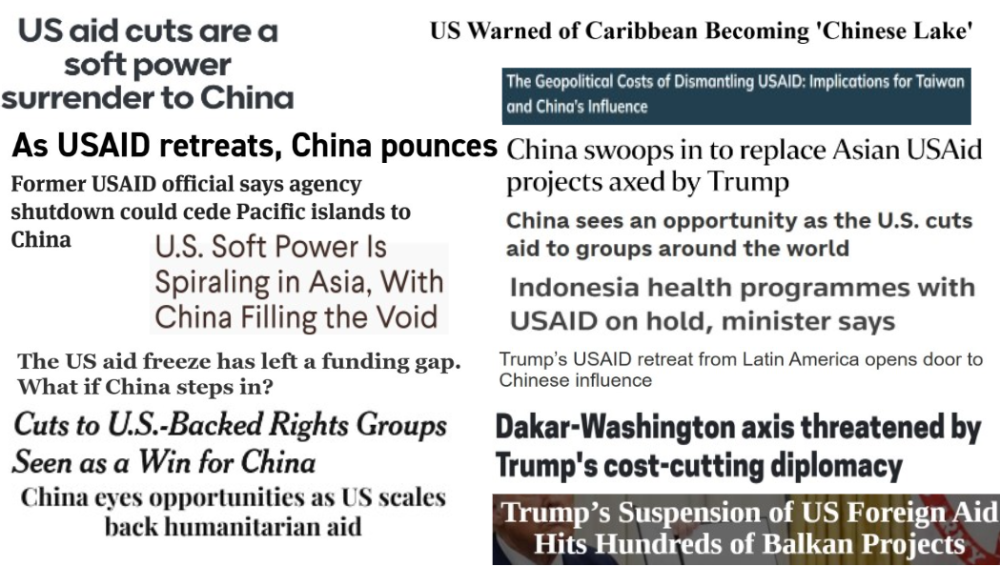
Sources: NYT, Reuters, BNE, African Intelligence, Devex, CFR, Newsweek, Global Taiwan, Lowry, NPR, Fox, Politico, CS Monitor.
The best and most urgent way to fix this problem would be to resume funding. But Congress and the administration could go further and try to regain dominance in soft power. Not least, they could expand the US sovereign loan guarantee program, offering an alternative to China’s financing of public infrastructure.
The US assistance cuts should be reversed because for a fraction of a percent of the US federal budget that assistance delivers amazing results, including millions of lives saved. But if that is not reason enough, the cost to US global standing is another argument to resume aid flows.
Topics
DISCLAIMER & PERMISSIONS
CGD's publications reflect the views of the authors, drawing on prior research and experience in their areas of expertise. CGD is a nonpartisan, independent organization and does not take institutional positions. You may use and disseminate CGD's publications under these conditions.
Thumbnail image by: EA09 Studio/ Adobe Stock