Recommended
In 2019, Germany and the Philippines established the world’s first nursing Global Skill Partnership (GSP). In a GSP, the destination country pays for the training of much-needed workers within the country of origin. Some migrate (those on the “abroad” track) while others stay (those on the “home” track). This blog explores the implementation of this partnership, lessons learned, and next steps.
Why the partnership was established
By the end of the century, Germany’s elderly population will be nearly equal in size to its working-age population. This is already resulting in acute labor shortages. In 2023 there were 35,000 nursing vacancies, and only four applicants for every 10 jobs.
At the same time, the Philippines is deploying more nurses internationally than any other country. In 2021, the Philippine Department of Health estimated that out of the nearly 620,000 licensed nurses, 316,000 worked abroad. A recent study found that the availability of nursing migration pathways encouraged more Filipinos to pursue nursing as a career, helping to grow the total number of nurses: for every one migrant, nine new nurses were licensed.
To help recruit nurses from abroad, the Deutsche Gesellschaft für Internationale Zusammenarbeit (GIZ) GmbH and the Federal Employment Agency (BA-ZAV) launched the “Triple Win” program. Since 2013, the program has placed over 6,000 nurses and trainees from the Philippines and other countries. While this has been beneficial for the migrants themselves, there’s a growing need to also strengthen health workforce development in origin countries, especially as demand for nurses rises both locally and globally. To that end, CGD has recommended Germany pilot the Global Skill Partnership (GSP) model.
We were therefore extremely excited to see a new nursing GSP announced in 2019 between GIZ; three nursing schools in the Philippines (Baliuag University, Northwestern University, and University of Baguio); German hospital partners (University Hospital Bonn and Klinikum Frankfurt Oder); long-term nursing care facilities (Milagros Elderly Home Care Services and Rippling River); and German language service providers (Berlitz and Tandem).
There is often a worry about “brain drain”; how the emigration of highly qualified doctors and nurses will affect the ability of origin countries to deliver healthcare. GSPs were specifically designed to mitigate against “brain drain”, by expanding the global supply of workers. This partnership is no exception. As of April 2025, over 300 nurses were or are being trained. Nearly 200 nurses have or plan to work in the Philippines through the “home” track. Meanwhile, 44 are already working in Germany, with nearly 100 more preparing to migrate via the “abroad” track.
So, what is the partnership learning and where does it go from here?
Skill recognition reduces “brain waste”
The figure below shows what was provided to trainee nurses on the “home” and “abroad” tracks. In the Philippines, a trainee nurse needs to undertake four years of formal studies and a professional licensure examination. In the third year, students could choose which track they went down. Those on the “abroad” track were provided with two and a half months of additional theoretical and skills training, as well as intensive German language training (up to level B2, which would enable them to work as a qualified nurse in Germany).
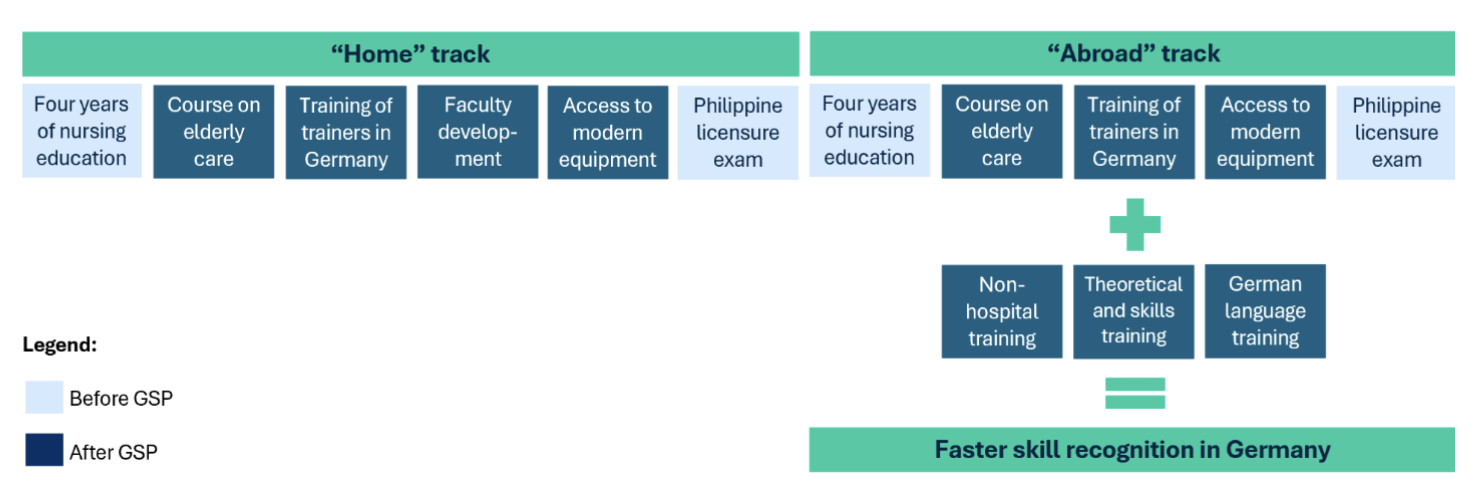
Note: Training of trainers and faculty development are part of capacity development of university clinical instructors at partner nursing schools.
Completing such training before migration ensured that nursing migrants were able to easily achieve full skill recognition in Germany. This has enabled higher salary potential; further career opportunities; and access to family reunification, residency, and citizenship pathways. Foreign nurses often struggle to have their credentials recognized and end up working as nursing assistants with lower pay; the GSP model aims to avoid this “brain waste”.
“Home” track mitigates “brain drain”
The figure below shows the number of nurses working in the Philippines compared with Germany. The number of nurses on both tracks is increasing over time, but the stock of those on the “home” track remains higher.
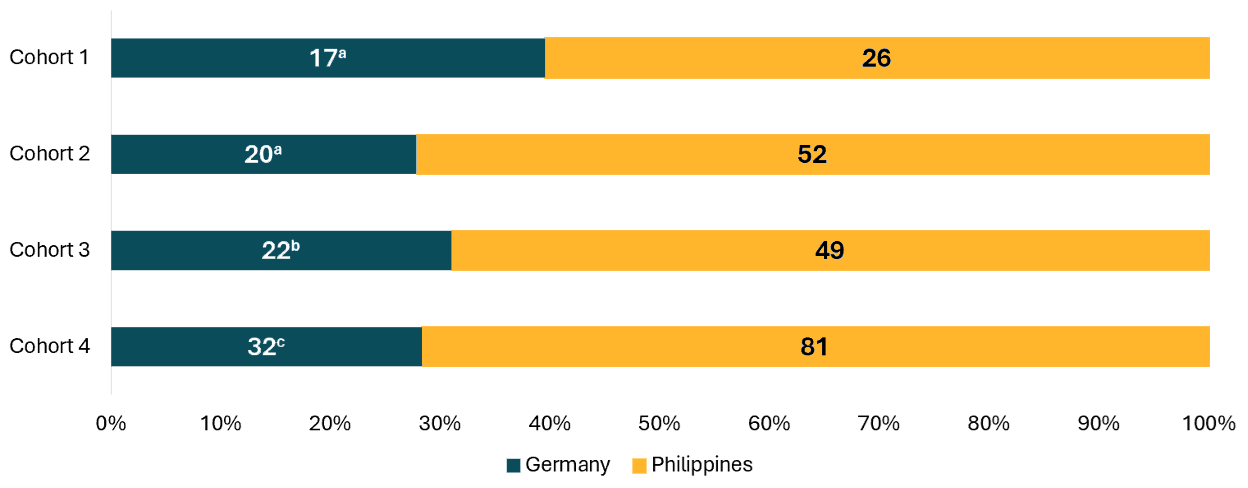
Legend: a Deployed in Germany; b Training for German language proficiency for Common European Framework of Reference for Languages (CEFR) B1 and B2 levels; c Training for German language proficiency for CEFR A2, B1, and B2 levels.
Source: Authors’ calculations based on interview with Baliuag University.
Note: Data as of March 2025. The first cohort does not include seven nurses from Northwestern University who are working in Germany.
This is essential. As destination countries look to develop healthcare migration agreements with origin countries, they are required to provide some form of “mutual benefit”. Expanding the stock of healthcare workers in the country of origin is one way in which destination countries can meet their international obligations and receive a flow of qualified workers at the same time.
Employer financing fosters sustainability
In a GSP, the training in the origin country is financed by the destination country. This benefits the destination country (as the cost is normally lower) and the origin country (as they receive investments to strengthen their domestic training capacity). In this partnership, the German Ministry of Health (BMG), the Bertelsmann Stiftung, and German hospital partners paid for the skills and language training, modern training equipment, and flights to Germany.
Other partnerships have struggled to get employers to financially support such investments due to a lack of trust in the skills of the trainees. To overcome this, three key actions were taken. Firstly, as part of an interview panel—composed of the partner nursing school, BA-ZAV, and GIZ—hospital employers had a say on who was selected. Secondly, academic performance was included as important selection criterion. Thirdly, selected participants had to complete additional trainings (such as in a non-hospital elderly care facility) to ensure smoother work integration in partner hospitals thereby increasing benefits for them.
Timing (and language) matters
For the first cohort, the GSP training had to take place online due to COVID-19, contributing to challenges in passing the B2 German language level and in accessing the practical work exposure required for their recognition. Nurses who migrated to Germany were having to work as nursing assistants while undergoing further training. Juggling this was a struggle. Of the 17 nurses who migrated in the first cohort, only one passed the qualification. The remaining 16 are still studying for the B2 qualification.
Recognizing this, the partnership pivoted. Nursing trainees on the “abroad” track are now aiming to achieve B2 qualification before migrating. Partner hospitals are providing monetary incentives for every qualification level passed, boosting motivation to continue learning. Of the 20 nurses on the “abroad” track in the second cohort, 11 have already passed the B2 level. Those in the third and fourth cohorts are currently training at A2 and B1 levels.
Moving to scale
This partnership has already laid the foundation for scale. Starting from scratch, the partnership has now trained four cohorts and a third partner nursing school (University of Baguio) is training for a new hospital employer in Germany (Klinikum Frankfurt Oder). GIZ is also planning to explore other healthcare professions (such as physiotherapists and nursing assistants) and other sectors, as well as to replicate the GSP in other countries including India and Uzbekistan.
To scale the partnership in the Philippines, however, three things will be needed:
- Stronger political commitment from both the Filipino and German governments. They should reach a consensus on the volume of nurses to be trained; the intended shares of those on the “home” and “abroad” tracks; and the expanded number of partner Philippine nursing schools and German hospital employers.
- Improved inter-agency cooperation within the Filipino government. The Department of Migrant Workers, Department of Foreign Affairs, Department of Health, and Commission on Higher Education, need to come together to negotiate labor migration agreements and manage their implementation.
- Greater financial commitments to support the expansion of training within Philippine nursing schools (especially outside of Manila to improve access to healthcare in rural areas), as well as technical assistance to the Filipino migration authorities. Such technical assistance should support the creation of foreign labor market assessments and labor demand forecasting, development of integrated migration information systems, as well as the digitalization and cybersecurity of migrant worker services.
In doing so, this partnership can redefine how countries approach demographic challenges, health systems strengthening, and the future of ethical healthcare migration.
The authors would like to acknowledge Björn Gruber, Pablo Acosta, Judith Heepe, Margarete Post, Elizabeth Roxas, and Emily Pollack for their valuable feedback. The opinions and conclusions expressed here are those of the authors and do not imply any commitment on the part of the Deutsche Gesellschaft für Internationale Zusammenarbeit (GIZ) GmbH, Center for Global Development, and International Bank for Reconstruction and Development / World Bank and its affiliated organizations, or those of the Executive Directors of the World Bank or the governments they represent.
Topics
DISCLAIMER & PERMISSIONS
CGD's publications reflect the views of the authors, drawing on prior research and experience in their areas of expertise. CGD is a nonpartisan, independent organization and does not take institutional positions. You may use and disseminate CGD's publications under these conditions.
Thumbnail image by: Adobe Stock Images