Recommended
Blog Post
Breaking Down Prime Minister Starmer’s Aid Cut
Blog Post
Don’t Give Up On Aid Just Yet
BRIEF
Aid for Asylum Hosting: Time to Act
The UK’s Foreign, Commonwealth and Development Office (FCDO) must make nearly £3 billion in cuts to its programming by 2027. The Prime Minister has voiced his support for tackling poverty, and the Labour manifesto committed to greater multilateral action. The Foreign Secretary and Development Minister will now take some key decisions about how and where to implement these priorities, while navigating these cuts. These are choices that will have profound implications for the value and impact of UK aid.
In this blog, we review recent trends in UK aid and set out three high-level tests—on greater multilateral action, tackling extreme poverty and reducing aid to better-off countries. These will help ministers ensure they deliver the change they have committed to, generate public support, and achieve impact.
The aid cut challenge
Following the publication of the Spending Review in June, there is now clarity over the FCDO’s budget for the next three years. Despite reducing FCDO spending on refugee hosting costs by at least £1 billion (they stood at £2.8 billion in 2024), the FCDO’s programme official development assistance (ODA) budget (excluding admin costs and the Integrated Security Fund) will fall from £9 billion in 2024-25 to £6.2 billion in 2027-28 (before rising to £6.9 billion in 2028-29).
Test 1: Greater multilateral action
The Spending Review confirmed that the government will prioritise multilateral investment. This approach is backed by the public, who see international organisations as more effective than government or NGOs, and by our Quality of ODA assessment.
There is a risk this doesn’t happen though. Since 2019, the UK has saved around £1.5 billion per year (almost a third of the then multilateral total) by ending contributions to the EU development budget. That should have freed up headroom for other multilaterals—but only if the funding is proactively redirected.
Over the last decade, the UK allocated 42 percent of programmable aid (excluding refugee hosting costs and other domestic spend; it would be 35 percent of all ODA).
In order to meet our first test, the UK must increase the share of ODA allocated multilaterally to more than 45 percent of programmable aid (just below the high-income country average of 46 percent); and move toward a 50:50 split between bilateral and multilateral aid by 2028/29.
We therefore urge the government to maintain commitment levels to the strongest multilaterals—including but not limited to GAVI, the Global Fund and IDA—where its money goes further. By prioritising these organisations, it also gives the UK a clear mandate to fulfil its plans to make the international system work better.
How should the Minister prioritise bilateral spend?
Baroness Chapman, the Minister for Development, was admirably clear when speaking to Parliament in May. Asked about her principles, she said that “international development is about alleviating poverty globally”. Here we consider the overall parameters to guide the country allocations, which the Minister intends to publish in the Autumn.
Among the top five largest providers of aid, the UK and US have been the most focused on the poorest countries. This role is respected and widely appreciated by the UK’s partners. Playing this role is also consistent with the public’s views—support is greatest for providing the basic services that the world’s poorest countries lack.
Test 2: Tackling extreme poverty concentrated in Africa
The UK’s focus on Africa has fallen, just as extreme poverty is increasingly concentrated there. The World Bank calculate that in 2023, over two thirds (69 percent) of the extreme poor were in Sub-Saharan Africa and the Bank projects that figure to rise to over three quarters (78 percent) by 2030.
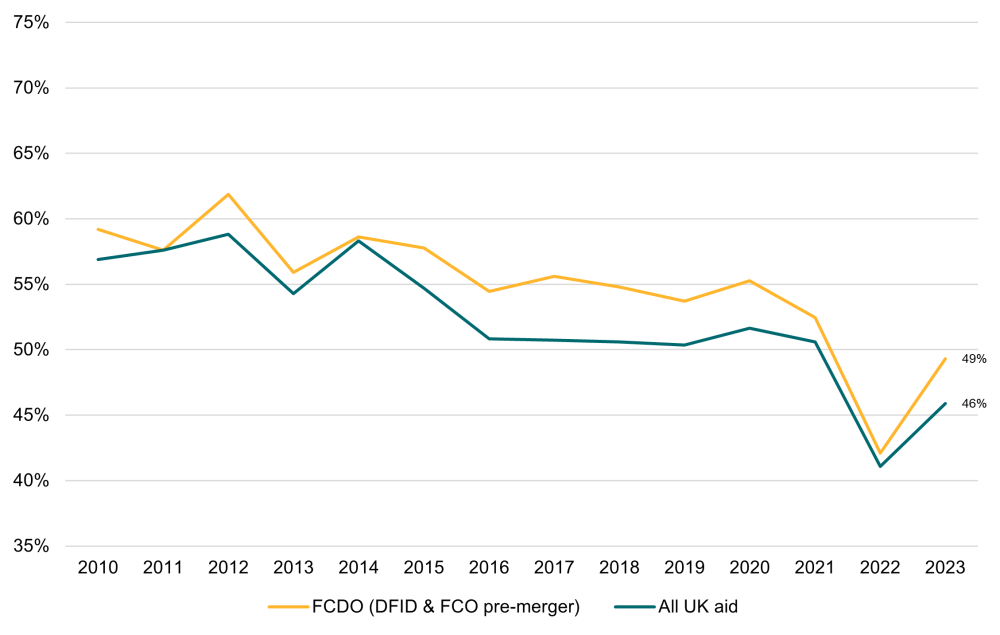
The UK’s aid allocation has been moving in the opposite direction; with Africa receiving under half of our aid in consecutive years for the first time in at least a generation under the previous government and significantly lower than the 55 per cent of UK bilateral aid allocated to Africa a decade ago.
Figure 1. Africa share of UK region-allocable bilateral ODA
Source: OECD CRS database
Notes: Outside of FCDO, Africa’s share of ODA spend has been much lower - around 25 percent over the last five years
In plans for the FCDO’s 24-25 budget (shared with Parliament in early February) Africa’s share remained just below 50 percent; and the FCDO will shortly release its 2025-26 plans.
The share of aid going to Africa is clearly reported by the government, and provides an intuitive guide to the poverty-focus of its allocations (though we acknowledge that this includes some relatively better-off middle-income countries, like Egypt). We propose that the FCDO should allocate 55 percent of its country-allocable bilateral budget to African countries in 2026/27 and lift that share to 60 percent by 2028/29.
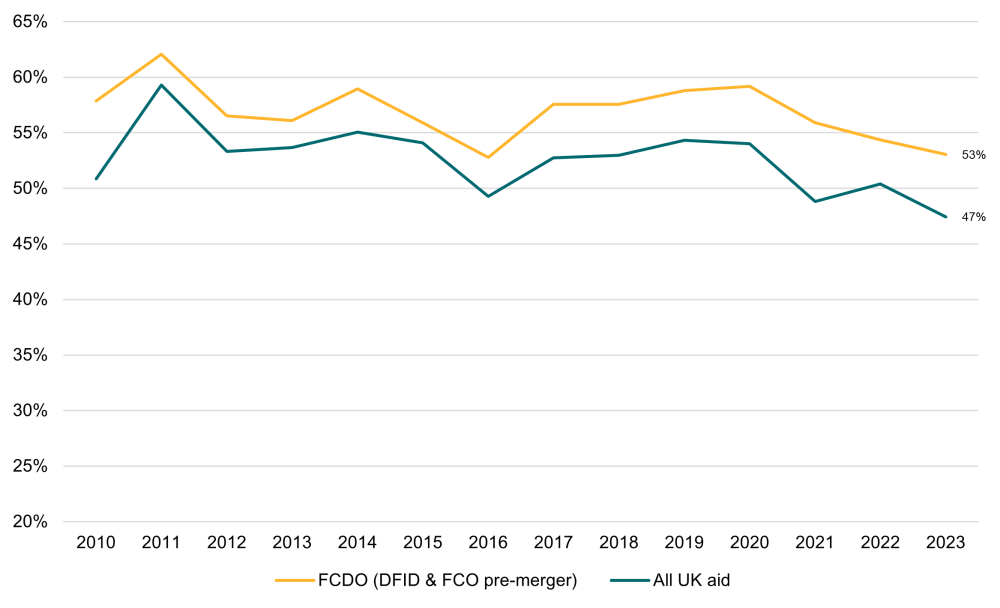
A measure with a similar but broader focus is the share of aid to the currently 46 Least Developed Countries (LDCs). By this measure too, the prior government lost focus on the poorest. In 2023, the share of aid to LDCs fell to a 15-year low. The previous government’s White Paper (Nov 2023) committed to allocate half of bilateral aid to LDCs, and provisional OECD data suggests that threshold was exceeded in 2024.
Figure 2. LDC share of UK country-allocable bilateral ODA
Source: OECD CRS database
Note: Historical classifications of LDCs are used, not the current classification: i.e. the 2010 LDC share reflects the share going to countries classified as LDCs in 2010, some of which may no longer be LDCs.
The government has made helpful strides in the right direction in the last two years but given the cuts to foreign assistance made by the US, needs are even more acute in the poorest countries.
These measures are a start but they overlook how allocations are made within the group. The FCDO should therefore also calculate the “weighted average income” of its recipients. In our recent analysis of development finance quality, the UK ranked 4th on finance quality, largely due to this, and its fragility focus. We’ll return to this in subsequent blogs but a good rule of thumb is that the government should prioritise countries whose income per head is under $4000 per head (in 2023 GNI per capita, at purchasing power parity).
Test 3: Reducing grant-aid to upper middle income countries
Ministers have also been admirably clear about the need to reduce the number of country partnerships the UK has; and our colleagues have also argued for a radical simplification with larger, simpler programs in fewer countries. While the lack of public support for development has been overstated (45 percent thought the aid budget should remain or increase, even at 0.5 percent of Gross National Income); there is significant and long-standing public scepticism about giving aid to countries that are, or are quickly becoming, successful economies. Despite this, in 2023, the UK provided grant-aid to 38 different upper middle-income countries (those with GNI per head between $4,500-$14,000; with average incomes ranging from roughly $8,000 to $42,000 after adjusting for lower price levels).
While assistance for Ukraine (an upper-middle-income country) is rightly a priority; grant aid is unnecessary for countries in this group, and should be removed. The amounts of ODA spent in upper-middle-income countries (excluding Ukraine) appears to have decreased, with FCDO reporting some £80 million in provision 2024 data, down from some £300 million in 2023.
The UK has prioritised support and reform at the multilateral banks; and these institutions can provide the finance at scale and concessionality that better-off developing countries need. We propose then, that, beyond Ukraine, the government’s starting point should be there is no grant-aid support to upper-middle-income countries. If the remaining projects are indispensable purely on UK interest grounds, the Minister should consider declassifying them as ODA. This would also enable the Minister to declare the end of aid for at least 30 countries to focus on those most in need; a move that could please aid skeptics as well as its champions.
Conclusions
The government’s development mission is to end poverty; and it has committed to do more multilaterally. Extreme poverty is increasingly focused in sub-Saharan Africa; but the prior government allowed the UK’s aid budget to drift in the opposite direction. To tackle poverty, the aid budget must be focused where extreme poverty is. Similarly, to achieve its goals of international reform, and ensure aid has maximum impact, the government will need to be proactive in ensuring it supports multilateral organizations.
As a short-hand guide as to whether the UK is being effective in its allocation decisions, we therefore suggest three tests for the focus of UK ODA:
- The share of programmable ODA allocated multilaterally to be at least 45 percent, rising to 50 percent by 2028/29;
- The share of bilateral (country-allocable) aid going to Africa restored above 50 percent; and rising to 60 percent by 2028/29;
- Eliminate grant aid to at least 30 upper-middle-income countries (outside of Ukraine).
We hope these tests are a helpful guide to policymakers, as well as to those with an interest in ensuring impact and value for money.
In the coming weeks, we’ll be looking in more detail at the UK’s aid partners, and which are under-supported by others or exposed to US and other cuts.
Topics
DISCLAIMER & PERMISSIONS
CGD's publications reflect the views of the authors, drawing on prior research and experience in their areas of expertise. CGD is a nonpartisan, independent organization and does not take institutional positions. You may use and disseminate CGD's publications under these conditions.
Thumbnail image by: FCDO/ Flickr