
This brief examines how the 40 most important development finance providers perform in terms of both the quantity and quality of their contributions. Although several major providers recently announced significant cuts to their finance that are not yet reflected in the data, our analysis establishes the baseline for those reductions. We draw on a set of key indicators to identify shortcomings in how development finance is provided, and which providers could improve.
Key findings:
- Even before cuts announced this year, the true volume of cross-border finance for international development fell in 2024. Despite hopes that newer providers might step up, in the latest available data the fall was slightly more pronounced in non-traditional providers, who made up 9.5 percent of the reduced total, down from 11.5 percent in our 2023 assessment and from 16.2 percent in 2020.
- Seven countries are providing less than half of their fair share of development finance—a much smaller share of their economy than one would expect given their income level. This includes Argentina, Australia, Chile, Hungary, Israel, Russia, and the US.[1] In addition, Austria, Czechia, Ireland, and Switzerland provide much less than expected: 0.1 percent of GNI below the average of countries with similar income-levels.
- Regardless of the quantity of contributions, there is significant scope to improve the quality of development finance. Our analysis shows, for example, a sustained trend away from providing finance to the poorest countries over recent years—the income of the average recipient country is now more than twice that of the low-income country average.
- Providing finance multilaterally offers scale and facilitates international cooperation, and many multilaterals are assessed as highly effective. Still, 12 countries provide under a quarter of their finance multilaterally, leaving others to support multilateralism. These countries include Norway, Japan, and New Zealand among OECD providers; and Saudi Arabia, Türkiye, and the United Arab Emirates in the broader group.
- In one bright spot, new analysis of recipient survey data suggests that recipients are expressing greater ownership of assistance programs.
- In our combined ranking of quantity and quality, we find Luxembourg has overtaken Sweden as the top performer on development finance while Norway, Denmark, and the Netherlands complete the top five. Five countries with significant room for improvement in quality are New Zealand, Japan, South Korea, Poland, and Türkiye—these countries are in the middle in terms of volume but all rank in the bottom third on quality.
Development finance quantity and quality
Development finance can have a major impact, potentially saving lives or altering a country’s growth path and ability to cope with climate change. But, despite this potential, the effectiveness and focus of finance is often not designed to achieve the greatest impact. Furthermore, the traditional measure of official development assistance (ODA) has expanded to include items that are largely irrelevant to international development, meaning the true value and fiscal effort of provider countries is difficult to discern. In addition, ODA statistics are not produced for several countries that are major providers of finance.
This brief lays out a clearer picture of countries’ efforts in terms of the quantity and the quality of development finance. For quantity, it focuses only on cross-border finance provided relative to each country’s gross national income (GNI) using our measure of finance for international development (FID). For quality, it analyses six indicators of focus and effectiveness that are likely to imply high impact, including the degree to which a country channels its finance through the multilateral system, and how recipients view providers. These indicators provide only a partial picture, but together they can allow officials and advocates to consider their countries’ relative performance and encourage ministers to implement improvements.
Table 1. Development finance performance: How we assess finance quantity and quality
| Quantity | Quality | |||||
|---|---|---|---|---|---|---|
Finance for International Development (FID) The grant-equivalent value of cross-border finance a country provides as a proportion of its GNI. | Multilateral support | Poverty and fragility focus | Effective practice | |||
The proportion of FID provided through multilateral institutions, not including earmarked funding. | Poverty focus The weighted average of the inverse of each recipient country's GNI (PPP) per capita. | Fragility focus The weighted average of the inverse of each recipient country's fragility score. | Transparency Assessment of the timeliness, openness, and comprehensiveness of development finance reporting. | Tied status Percentage of development finance without condition of procurement from donor service providers. | Ownership Share of donor projects aligning with recipient objectives frameworks | |
Notes: a full explanation of FID, as well as the method and weights of these indicators, is given here. GNI data for poverty focus is based on purchasing power parity (PPP), which adjusts for price differences between countries.
Overall performance
Luxembourg is the top-performing country for development finance—it provides the greatest quantity of finance relative to its GNI, and its finance quality is very high according to our indicators: it has a strong focus on countries most in need, and the projects it supports align reasonably well with recipient objectives (ownership). Other top performers include Sweden, Norway, Denmark, and the Netherlands, who are transparent, do not “tie” their finance to goods and services provided by organizations from their own countries, and focus on the poorest and most fragile countries.
Among G7 countries, Germany provided the highest share of its income in finance, but the UK has the highest quality in our assessment. Still, the picture on quantity is complicated by the US, the UK, and France announcing major cuts in recent weeks, with Germany and others also planning to reduce aid. The US is already ungenerous in its aid volumes and its quality is in the bottom third of countries but the cuts—estimated at 38 percent for fiscal year 24/25 by our colleagues—will likely put it in the bottom 10 countries (with FID equivalent to just 0.11 percent of GNI). France and the UK each plan cuts of around 40 percent of their aid budgets which, if proportionally applied to their cross-border finance portfolios, would reduce FID to just over 0.22 percent in each case, similar to Türkiye. Germany and others, such as Belgium and the Netherlands, have also announced cuts for the coming years.
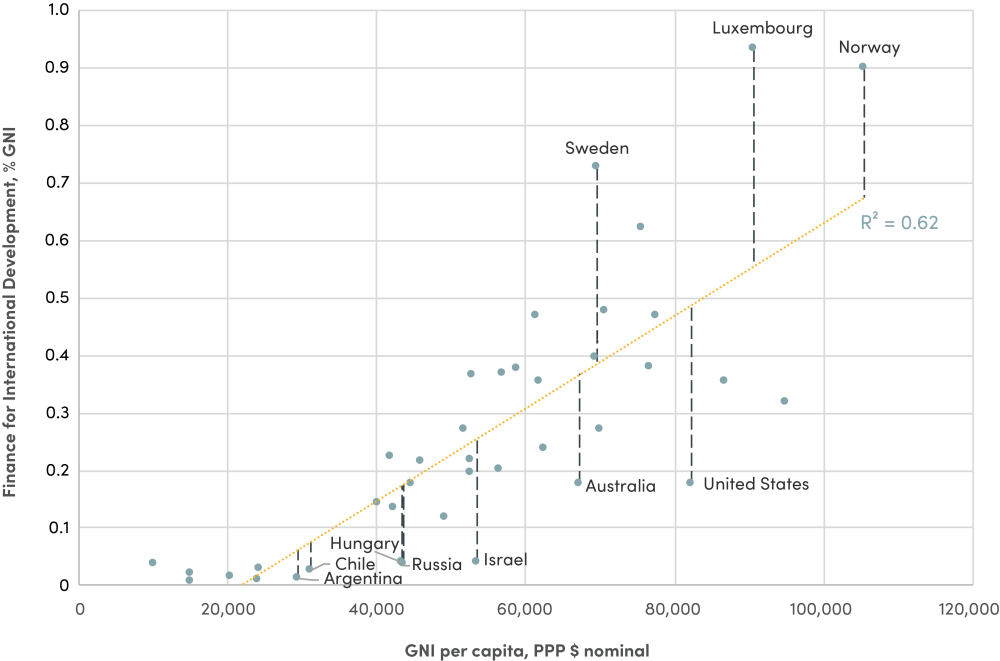
Our assessment places Israel last. Figure 1 shows it provides far less development finance than we’d expect given its income per head, and the finance that is given is ill-targeted towards poorer and more fragile countries. India provides almost the same share of its national income as Israel, even though its per head income is less than a fifth as high. Even so, along with Argentina, China, and Indonesia, India could do more on the transparency of its efforts.
China’s performance on our assessment is notable—it provides a substantial face value of development loans—but these have limited concessionality, so on a grant-equivalent basis they amount to a relatively small share of its economy. Still, a bigger factor in China’s score is its lack of transparency and tying of contracts to Chinese providers.
How much finance do countries really provide, and what should we expect?
In 2024, the 40 countries we assess provided $185bn in finance (FID), or 0.19 percent of their combined GNI, down from $198bn (0.21 percent of GNI) in 2023. For the 27 members of the OECD Development Assistance Committee (DAC) included in this assessment, the 2024 total was $168bn—90 percent of the total, and 0.27 percent of GNI. The most generous providers were generally small, wealthy Northern European economies, namely Luxembourg (0.93% GNI), Norway (0.90%), and Sweden (0.73%). Denmark (0.62%) is the only other provider that provided more than 0.5 percent of GNI as FID.
In addition to Luxembourg, there were other providers who saw significant changes since our last CDI update. Though still providing relatively small volumes in absolute terms, Chile more than tripled the amount of finance it provided from 0.01 percent to 0.03 percent of GNI. Other countries saw reductions, with Saudi Arabia providing almost $2 billion less, and both Hungary and South Africa providing under a quarter of their previous levels relative to GNI.
Looking at these contributions relative to income-levels paints a clear picture of how contributions increase with income. It also highlights a number of countries that we would expect to provide significantly more. In particular, seven countries are providing less than half of what we would expect given their income level: Argentina, Australia, Chile, Hungary, Israel, Russia, and the US. We also see less provision than we would expect from Austria, Czechia, Ireland, and Switzerland; other countries with similar income levels provided an additional 0.1 percent of GNI on average.
Figure 1. Higher income countries tend to allocate a larger share of their income to international development
Vertical dashed lines show the difference to the average or expected FID (as a percentage of GNI) based on the country’s GNI per head.
One important dimension of support for international effort is the channel through which finance is provided: either bilaterally or alongside other countries through multilateral institutions. The fragmentation of aid has long been recognised as a problem, and we see very different approaches from countries. Chile and Greece, for example, both gave almost all (98 percent) of their finance through multilaterals, and at the other end of the spectrum, the UAE, Saudi Arabia, and Türkiye each gave less than 10 percent of their finance through multilaterals. Furthermore, as capital contributions to the New Development Bank and AIIB have fallen in the latest data, most BRICS countries have reduced the share of finance provided multilaterally—Brazil’s proportion fell from 95 percent to 58 percent, India’s halved to 20 percent, and South Africa’s dropped by 26 percentage points to 62 percent.
Finance quality: Poverty and fragility focus
Finance makes the biggest difference to lives and welfare when it is targeted at the countries in greatest need. We calculate two indicators that look at countries’ bilateral portfolios and the degree to which it is focused on two constituencies: the lowest income countries and the most fragile.
Belgium is the most effective provider at channelling its finance for international development to poorer countries—the average GNI per capita of the recipients of its FID is under $3,000. Ireland, South Africa, and Sweden are each also highly effective at targeting their development finance towards poorer countries. In terms of fragility, Türkiye’s efforts in Syria mean that all its finance goes to fragile and conflict affected states. Saudi Arabia is second best on this indicator with large amounts of finance directed to relatively more fragile countries including Yemen, Pakistan, and Sudan.
Focus on the poorest in long-term decline
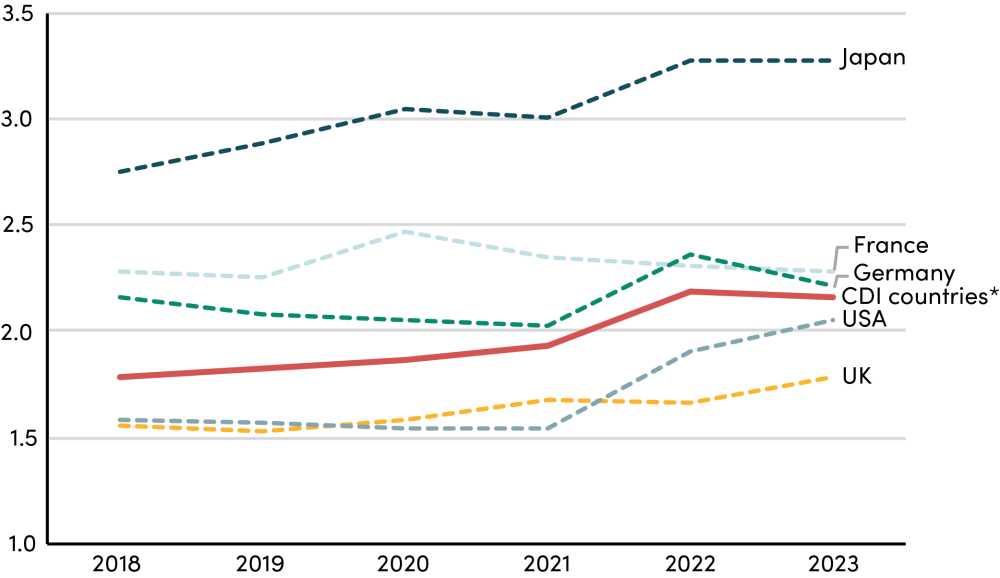
The aid allocations of CDI countries have become less poverty-focused over recent years. Between 2018 and 2023, the aid-weighted average GNI per capita of their recipients rose relative to the average for low-income countries (LICs).[2] Average recipient income was 1.8 times the LIC average in 2018, rising to 2.2 times in 2023. A particularly large increase happened in 2022 when significant aid volumes were directed towards relatively higher-income Ukraine, though an upward movement can also be seen before this.
Although this average masks significant variation across countries, a rise in average recipient income is the norm across CDI countries. The average recipient income of bilateral FID rose for 28 of 31 CDI countries between 2018 and 2023 (falling only for small providers like Finland, Greece, and Türkiye.
Figure 2. Aid allocations are becoming less focused on the poorest countries
Average recipient income of bilateral finance (multiples of LIC average)
*Reporting to OECD (i.e. excluding Argentina, Brazil, Chile, China, India, Indonesia, Mexico, and South Africa).
Notes: the number of low-income countries has reduced over this period from 31 to 26.
Source: CGD analysis of World Bank and OECD CRS data sources.
The number of countries with an average recipient income less than double the LIC average fell from 16 to 13 between 2018 and 2023; and the number with an average recipient income more than triple the LIC average rose from four to eight.
Among the largest providers, average recipient income has risen most for Japan, followed by the United States. For Japan, the rise has been steady over the 2018–23 period and started from a relatively high level, whereas for the United States the rise occurred more recently in 2022 and 2023, starting from a relatively low level. Meanwhile, average recipient income held relatively steady for France and Germany. Despite these trends, the UK and United States remained more focused on the poorest countries in the latest data.
Finance quality: Ownership, transparency, and tying
The three indicators we assess on effective practice are important to the success and impact of development projects.
The trend on ownership is fairly positive. The indicator is based on the only survey of finance recipients’ views of providers. The latest data is still partial, as survey results from the Global Partnership for Effective Development Cooperation’s (GPEDC) 4th monitoring round are published between 2023 and 2026. But data from 18 recipient countries covers 27 of the 40 CDI provider countries (versus 84 recipient countries covering 29 CDI countries in the 3rd round), and our analysis thus far shows a substantial improvement in scores.
Figure 3. Aid objectives are becoming more aligned with partner countries
Share of projects with country-owned objectives
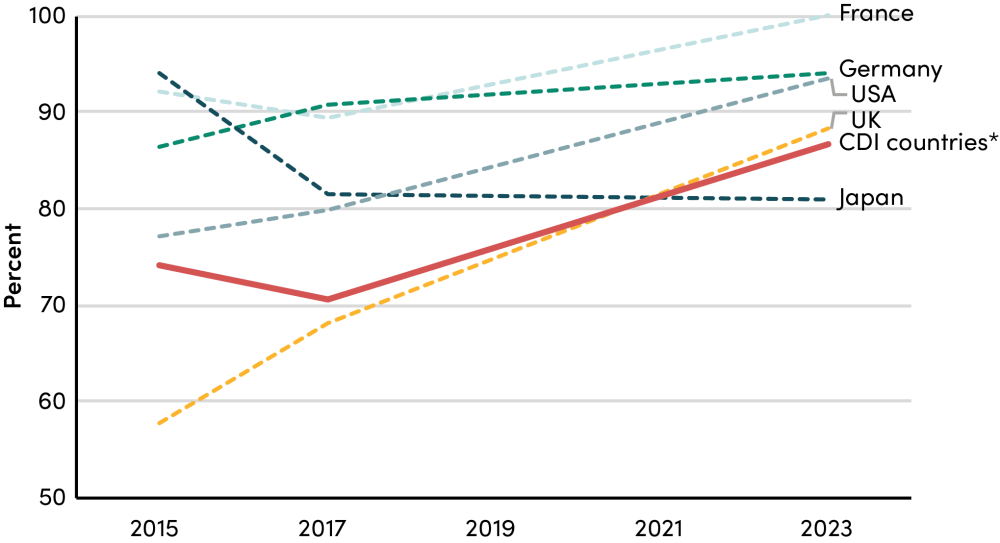
In 2017, the average CDI country had 70 percent of projects drawing their objectives from country-owned results frameworks (down from 74 percent in 2015). By 2023, this had risen to 87 percent. Out of the 23 CDI countries with data in both 2015 and 2023, 13 have improved their share of projects with aligned objectives, 7 have deteriorated, and 3 remained unchanged. Among major providers, the largest improvements have been for the United Kingdom, rising from 58 percent in 2015 to 88 percent in 2023, and the United States, rising from 77 to 94 percent.
Some countries take recipient objectives very seriously. Seven countries—Italy, Germany, Czechia, South Korea, Spain, France, and Portugal—saw recipients agree that over 90 percent of projects were aligned with their objectives.
Several countries are missing data on this indicator; but of those with responses from recipient countries we see that Chile, Hungary, and China have the most room for improvement—these countries, along with India and Belgium, fail to ensure even 50 percent alignment with recipient objectives. However, even here results are based on a low number of responses (just one for Chile and India across both the 3rd and 4th monitoring rounds, and two for Hungary).
On transparency, we use an 8-point scale which assesses whether data is timely, open and comparable, and comprehensive. By reporting fully to the OECD in timely fashion, countries fulfil all the criteria for full points. Countries can still achieve top marks by publishing key information elsewhere, though currently no non-OECD countries do so. Across other countries, transparency arrangements align less well to those principles outlined in the Busan Agreement, with Argentina and China having the least transparent data on development finance—neither makes publicly available even basic information such as breakdowns by recipient or project-specific data that recipients and observers would find extremely valuable.
Mexico has made the most progress on this front, publishing data that is much more timely compared to 2023, while Indonesia has regressed, having published no more data on bilateral operations since our last update two years ago.
Tied aid refers to where a provider requires support to be delivered by an organisation from the provider’s own country. Although official reporting does not tell the full story—many openly procured contracts end up in the hands of national providers—we do know that tying reduces the effectiveness of projects. Among DAC countries, Japan, South Korea, and the US stand out as they each tie over 30 percent of their finance, while Australia emerges with significant credit, reporting completely untied finance. Seven countries appear to tie more than half of their aid—evidence suggests so for China, India, and Russia, and in the absence of evidence to the contrary we assume aid is largely tied for the remaining four countries.
Figure 4. Development finance: Key performance indicators
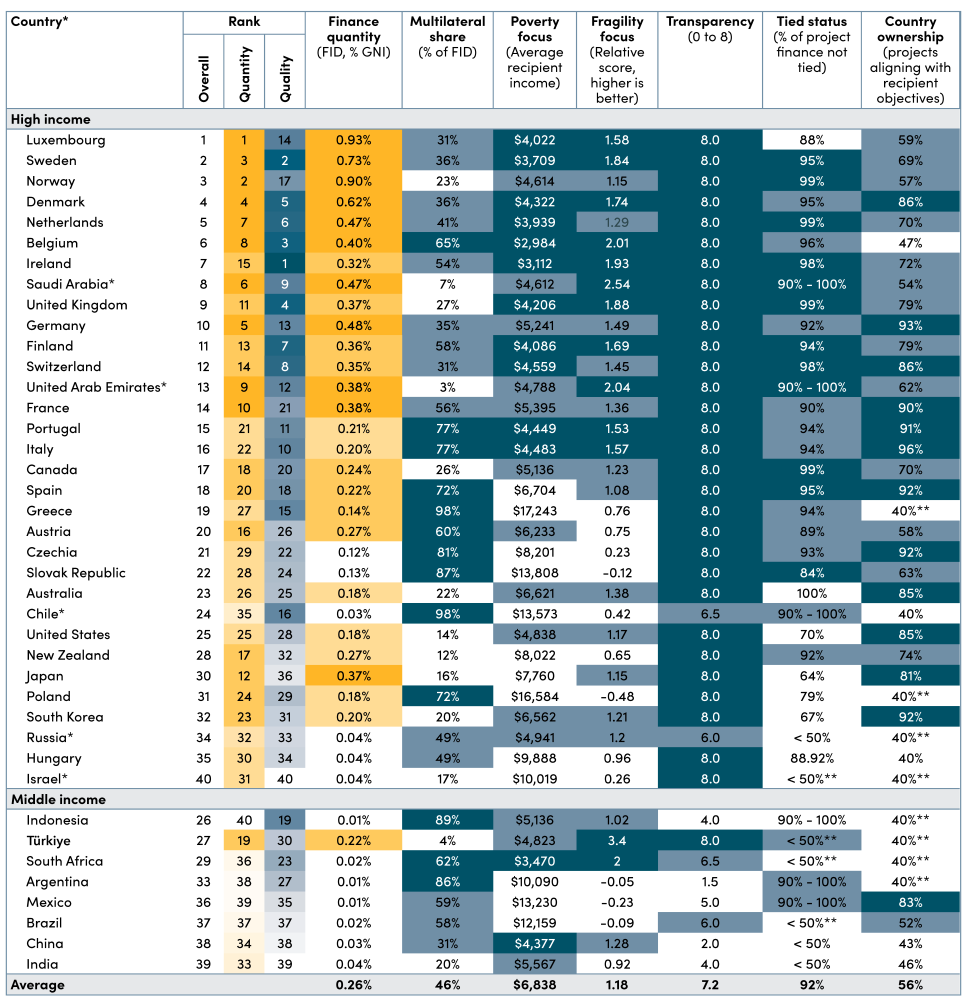
(Click to see larger image)
*Indicates a high-income country that is not a member of the OECD Development Assistance Committee.
**Indicates missing data. Where this is the case, we score countries with the lowest reported value (rather than zero).
Method, data, and sources
This publication is based on the development finance component of the Commitment to Development Index (CDI) and Finance for International Development (FID) measure. The full CDI method is described here, and FID here. We use the latest available data for each country, which is mainly 2024 on quantity and 2023 on quality. The full CDI results will be launched later in 2025 and will be available at www.cgdev.org/cdi.
Center for Global Development and CDI
The Center for Global Development has compiled the CDI since 2003. CGD works to reduce global poverty and improve lives through innovative economic research that drives better policy and practice by the world’s top decision makers. CGD Europe’s work on development effectiveness has benefitted from funding from the Gates Foundation, as well as several governments including those of Canada, Luxembourg, and Sweden. You can find a full list of CGD’s funders here. This work does not reflect the official opinion of funders. The authors are responsible for all methodological decisions and for the information and views expressed here.
[1] In the Commitment to Development Index, of which development finance is one component, we assess how a wide range of policies affect development. For Russia, we make several adjustments to the CDI to take account of the broader development implications of the war in Ukraine. In the forthcoming CDI, we will adjust measures of Israel’s commitment to development where that is affected by the war in Gaza. For the development finance results reported in this brief, we have not made any adjustments to either country's scores.
[2] We use this ratio to provide an intuitive measure that accounts for the entire distribution of finance, rather than just the share provided to countries below a threshold. Although the number of countries in the low-income group fell over the period (from 31 to 26), the average income of the group increased—and it did so at a faster rate than for middle-income countries. As such, the rise in the ratio we observe points to a relative deprioritizing of lower income countries in finance allocations.
Topics
CITATION
Hughes, Sam, Ian Mitchell, and Edward Wickstead. 2025. How Much, How Well: Development Finance Performance 2025. Center for Global Development.DISCLAIMER & PERMISSIONS
CGD's publications reflect the views of the authors, drawing on prior research and experience in their areas of expertise. CGD is a nonpartisan, independent organization and does not take institutional positions. You may use and disseminate CGD's publications under these conditions.