Recommended
The European Commission has released its initial proposals for the EU’s external action budget under the next Multiannual Financial Framework (MFF) for 2028–2034. The budget lays the groundwork for its future engagement with candidate countries and with countries in its neighbourhood, its humanitarian assistance, and development cooperation. With geopolitical tensions high and development needs growing, we ask whether the proposals deliver on the promise of a more strategic Europe while fostering mutually beneficial partnerships beyond its borders to address local and global challenges.
The European Commission’s proposed amounts are big and bold, signalling a recognition of the required scale of investment to foster stability and prosperity in the EU’s neighbourhood and beyond. External funding is set to increase significantly, from EUR 110 billion to EUR 200 billion—not including support set aside for Ukraine. However, while the proposals attempt to strike a balance between EU values and strategic interests, they reflect a clear move away from traditional development principles to a model in which direct European interests and the promotion of the European private sector is prioritised. The European Commission’s intention is to explicitly use the EU’s external funding instruments to pursue a more strategic agenda. Flexibility is the name of the game, but the balance with predictability and accountability is precarious. The proposed Global Europe instrument rationalises and dramatically simplifies EU external action. But it also raises concerns about development effectiveness, migration cooperation as leverage, and transparency and accountability.
What’s changing?
The European Commission has proposed a steep increase in the EU’s external action budget, from EUR 110 billion for the period 2021–2027 to EUR 200.3 billion for the period 2028–2034. The big change is the merging of the separate financial instruments for development cooperation, humanitarian aid, and pre-accession support into a mega-instrument for the whole world.
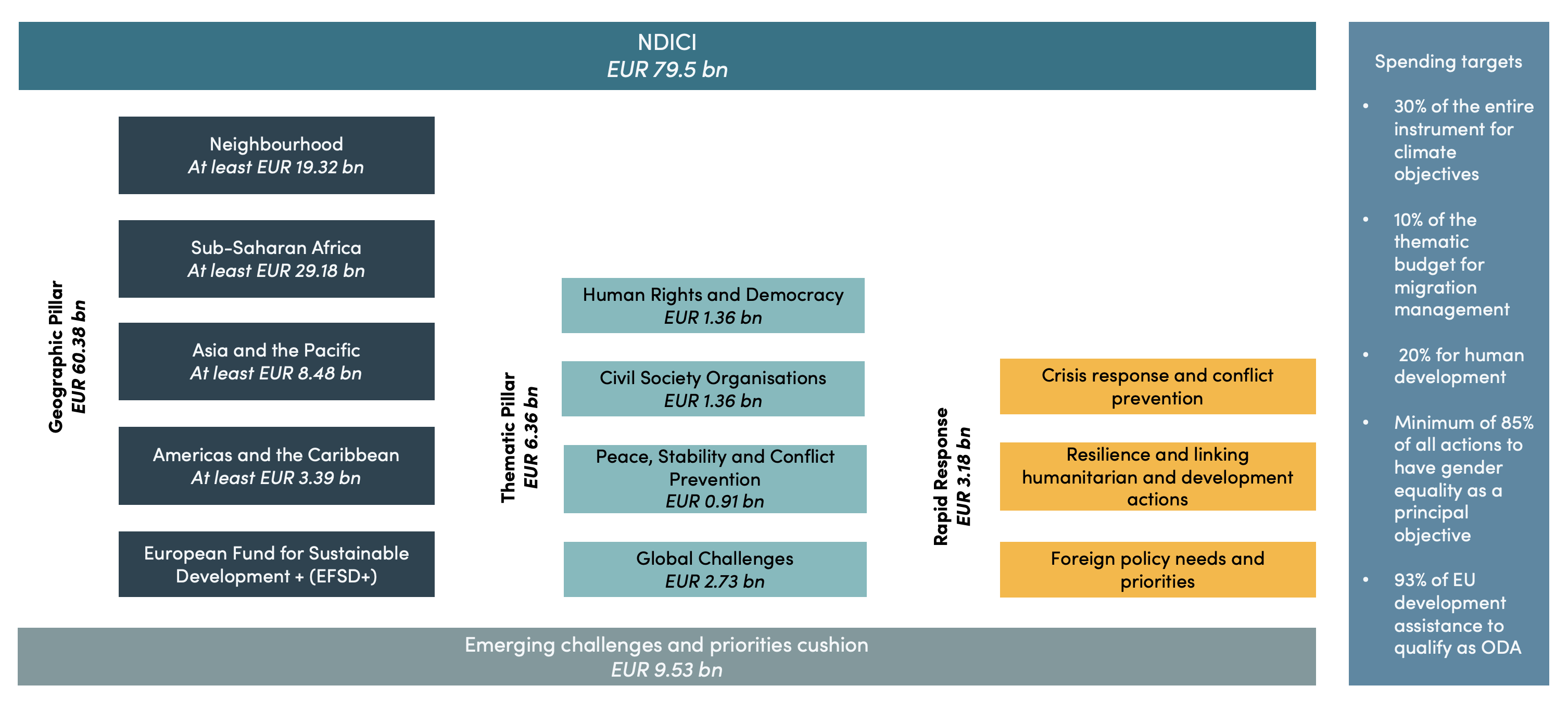
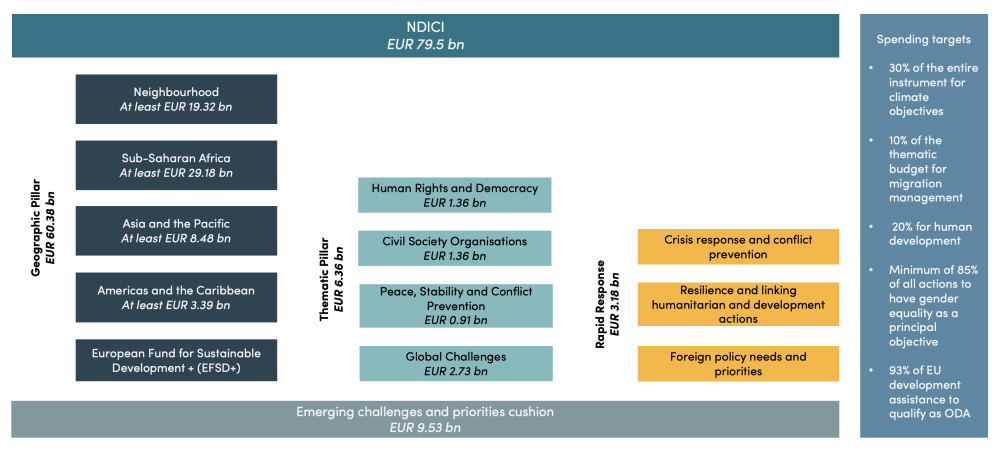
Figure 1. MFF 2021-2027: Heading 6 “Neighbourhood, Development and International Cooperation instrument” (2021 current prices)
To enlarge the image, click here.
Source: European Commission NDICI 2021-2027.
The EU’s current development cooperation instrument—the Neighbourhood, Development and International Cooperation Instrument (NDICI)—is structured around three pillars: a geographic pillar (divided across the Neighbourhood, sub-Saharan Africa, Asia and the Pacific, and the Americas and the Caribbean); a thematic pillar denoting the EU’s priorities (including human rights and democracy, support for civil society organisations, peace, stability and conflict prevention, and global challenges); and a rapid response pillar, including a ‘cushion’ for urgent challenges and emerging priorities (Figure 1). A key feature is the plethora of spending targets, including 30 percent of the total budget for climate-related projects, 10 percent of the thematic budget for migration management, and 20 percent for human development. On top of that, at least 85 percent of all spending is required to prioritise gender equality, and 93 percent to meet the criteria for official development assistance (ODA).
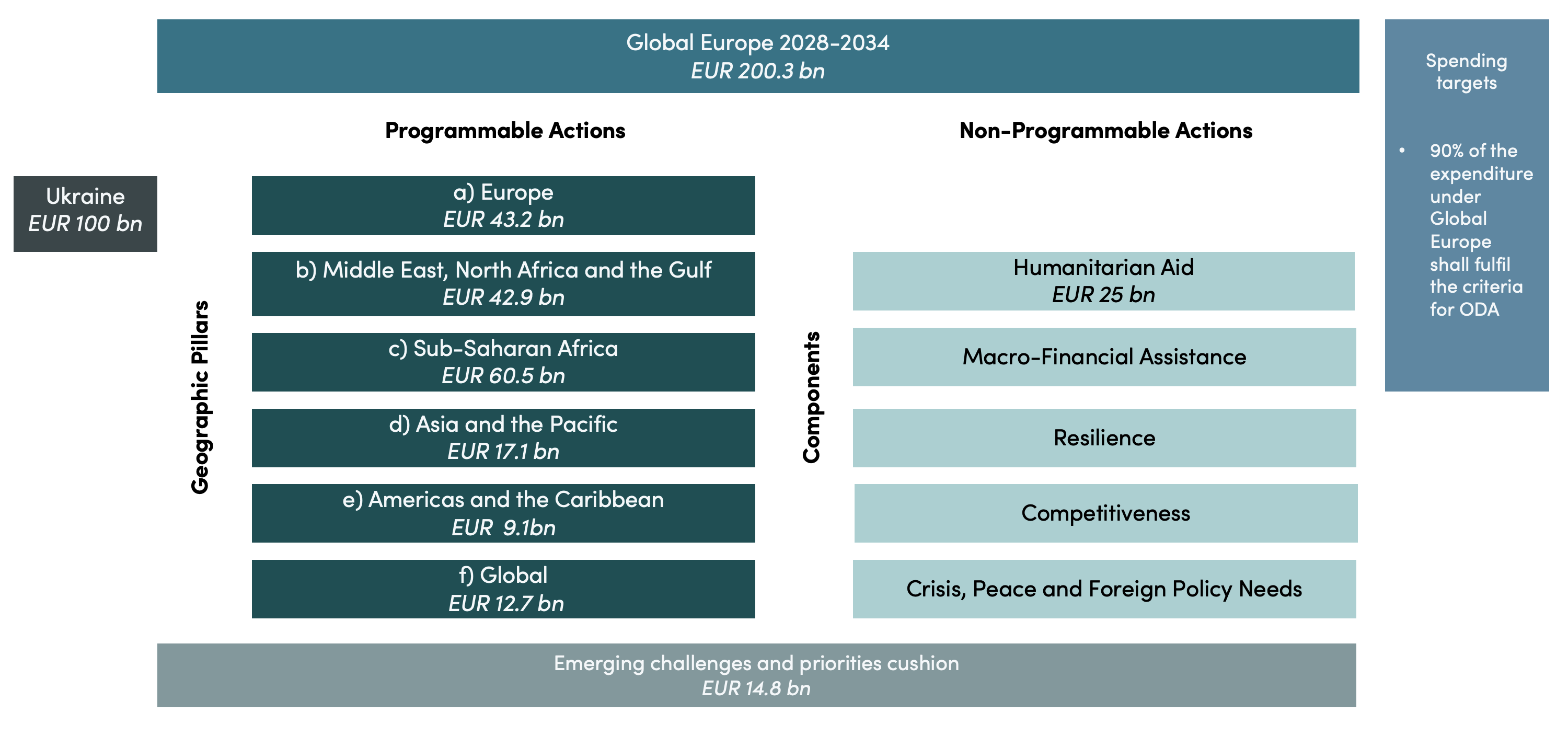
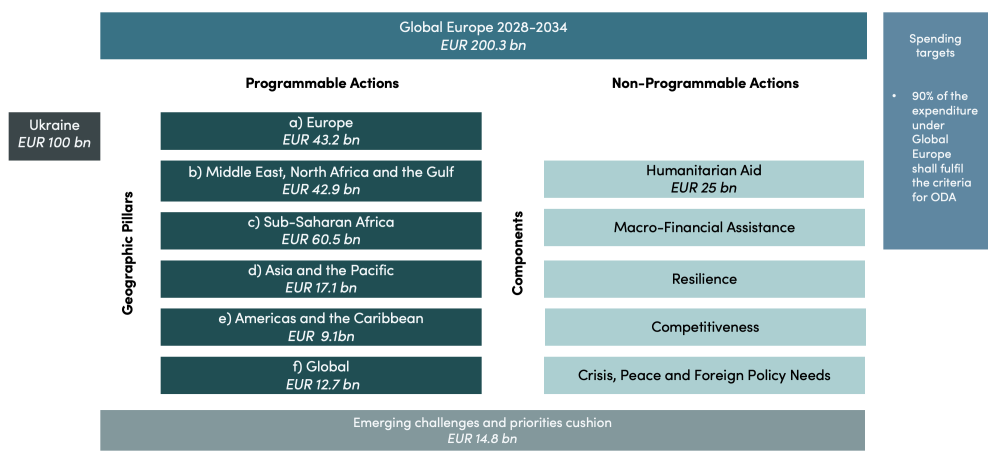
Figure 2. MFF 2028–2034: Heading 3 “Global Europe” (2025 current prices)
To enlarge the image, click here.
Source: European Commission Proposal Global Europe 2028-2034.
Notes: Each pillar will have an unallocated reserve corresponding to a share of the total amount per pillar. MFA only applies to Pillars (a) to (e).
The new Global Europe instrument will consolidate the three largest instruments—NDICI, humanitarian aid, and pre-accession assistance—into a single unified financial instrument driven exclusively by a geographic focus. The thematic programmes under NDICI-Global Europe have vanished. Instead, there will be six geographic pillars with programmable and non-programmable actions (Figure 2).
The non-programmable actions will be used for humanitarian aid—up to EUR 25 billion and implemented in accordance with the existing rules based on the fundamental principles of humanity, neutrality, impartiality, and independence, macro-financial support for countries experiencing balance of payment crises, resilience, competitiveness (linked to the EU’s new Competitive Fund), and crisis stabilisation, peace and foreign policy. At least 90% of all spending will have to fulfil the criteria for ODA—a slight reduction than the target set for current EU external action. Like in NDICI-Global Europe, there is an unallocated emergency cushion for urgent crises and emerging priorities that has been increased by 55 percent. Ukraine—due to its exceptional needs—will be supported through additional resources of up to EUR 100 billion.
The excessive number of spending targets set in NDICI has been removed to enable flexibility and rapid reallocation of funds. Spending targets are a double-edged sword: on the one hand, they demonstrate a commitment to an issue and increase the predictability of resources in the medium- and long-term, as well as accountability; on the other, an excessive number of targets can incentivise a reduction in quality to achieve quantity-driven goals. With the NDICI, they helped mitigate severe cuts in crucial sectors like health and education, but at the same time, they incentivised a box-ticking exercise to achieve the targets. Without any safeguards, however, there is a very real risk that social sector and human capital support could fall through the cracks.
An explicit focus on European interests
The overarching objectives put the EU’s strategic interests at the forefront of the new instrument, supplemented by its values. These objectives include advancing and protecting the EU’s interests; fostering mutually beneficial partnerships with third countries; and supporting global commitments such as the Sustainable Development Goals (SDGs), multilateral cooperation, and the Paris Agreement. Bound by the EU Treaties, the EU commits to poverty reduction but with a strong assertion of its interests, including the ambition to strengthen the export potential and opportunities of European companies by building on synergies with the Competitiveness Fund, although how this will be implemented remains to be seen. A proposal in the draft regulation goes as far as to leave open the possibility of direct grant awards to European companies (without a competitive tender) to spur European investments abroad that serve “the strategic interest of the Union.”
The procurement rules are a further indication of the broader shift towards an investment-driven approach to external action shaped by geopolitics. While the NDICI regulation maintains untied aid in principle, Article 20 of the Global Europe proposal introduces explicit restrictions on who can participate in procurement to protect EU companies from Chinese and other emerging country competitors, particularly when financing large-scale Global Gateway infrastructure projects. This would severely undermine both the effectiveness of aid and the credibility of the EU. European companies must be able to compete on equal terms, while partner countries should have the freedom to choose the best value-for-money services.
Funding Ukraine’s recovery and reconstruction
Ukraine is currently the largest recipient of EU aid by far. In 2023, Ukraine was the EU’s top recipient of ODA at USD 20.7 billion, squeezing available funding for the poorest countries. The EU’s existing external action instruments were not designed to support countries at war. Hence, the creation of the Ukraine Facility for recovery and to pave the way for Ukraine’s accession to the EU. While Ukraine is included in the Global Europe proposal, the European Commission has proposed funding it separately through the Ukraine Reserve and not counting it as part of EU ODA. This is a positive development and unique among other OECD development cooperation providers.
Migration cooperation as leverage
Compared to the NDICI-Global Europe, in which migration was one of several thematic priorities, the references to migration mark an expected shift in tone, mirroring the overall debate on migration in Europe and the political priorities at the EU and member state levels. The proposals suggest stepping up cooperation on migration with partner countries and framing migration as an area of strategic leverage. This suggests the readiness to use cooperation on migration as a bargaining tool, potentially linking EU funding more explicitly to cooperation on returns, readmission, and border control. While the proposals stop short of formally tying aid to migration control, the door is open to such conditionality.
Transparency and accountability
The question of accountability and transparency of EU external spending lingers. While micro-management by the member states and the European Parliament is to be avoided at all costs, getting the balance right between flexibility and accountability has been a challenge. The European Commission has significant control over how funds are spent under the Europe pillar (for EU candidate countries), as well as over flexible pots like the emergency cushion and non-programmable funds, as well as year-on-year carryovers. Member states have only a limited role in overseeing these decisions. The mid-term review of NDICI–Global Europe, for instance, was widely seen as lacking transparency and partner consultation, a worrying precedent as the EU enters a new round of MFF negotiations.
What happens next?
The first shot has been fired in what will be a protracted and complex negotiation process. The EU Council (i.e. the member states) will now develop its position, typically by trimming down the Commission’s proposed figures, while the European Parliament will seek to protect and expand funding for its priority areas. Undoubtedly, as with previous MFF cycles, the budget for external action is likely to face significant pressure, and final allocations may well fall below the Commission’s ambitions. Key battles lie ahead over how much funding will be earmarked for the EU’s strategic interests, what conditions will apply, and whether a careful balance can be struck between flexibility and accountability. Stay tuned for further analysis as the negotiations unfold and the direction of the EU’s external engagement for 2028–2034 takes shape.
The authors are grateful to Laura Granito for her comments and contributions.
Topics
DISCLAIMER & PERMISSIONS
CGD's publications reflect the views of the authors, drawing on prior research and experience in their areas of expertise. CGD is a nonpartisan, independent organization and does not take institutional positions. You may use and disseminate CGD's publications under these conditions.