As aid budgets shrink and development needs surge, we face a critical question: how can we mobilise more private capital for global development, quickly, at scale, and without breaking the public purse?
We believe there are sizeable pools of untapped capital, particularly among high-net-worth individuals (HNWI) and family offices, which could be nudged into financing impactful investments in developing countries if the government offered one simple, proven incentive: tax relief on impact bonds.
Just consider that single-family offices in the UK manage an estimated $340 billion. And compared to institutional investors, they can be more flexible in how they allocate capital, including for social and environmental priorities they care about, which makes them a natural partner for policy innovation.
Not a new idea, but the right time
Tax relief for bonds is not a novel concept, and it has been proven to work elsewhere.
In the United States, tax-exempt bonds are a cornerstone of public finance, used by local government to fund everything from roads and schools to water systems and social housing. A specific class, Private Activity Bonds (PABs), channels private capital into projects with public benefit, with annual issuance ranging from $18–25 billion. Their appeal? Investors accept lower interest rates in exchange for tax-free returns. A high-income investor earning 4 percent on a tax-exempt PAB would need a return above 6 percent on a taxable bond to match it. That’s a powerful nudge.
Brazil has taken a similar approach, offering tax-free interest on infrastructure debentures to individual investors, which has helped unlock significant domestic capital for energy, transport, and sanitation projects. India, too, has used tax-free infrastructure bonds to successfully channel household and high-net-worth savings into public development initiatives. These examples show that with the right design and guardrails, tax exemptions can be a powerful tool to steer private finance toward public good while building deeper, more resilient capital markets in the process.
A UK opportunity: building on what already exists
The UK doesn’t need to start from scratch. A ready-made model already exists in the Community Investment Tax Relief (CITR) scheme, which has channelled capital into accredited social lenders serving disadvantaged communities across the UK. CITR offers a 25 percent tax credit on the principal invested, spread evenly over five years, meaning the benefit is the same for both individuals and corporate entities, regardless of their marginal tax rate.
We propose a new initiative, the Investing for Development Scheme (IFDS), which could follow a similar structure, extending this proven approach to impact investments in developing countries. Once accredited, impact managers - such as AgDevCo, Cygnum Capital, and TLG Capital - could issue bonds to finance sustainable infrastructure, agriculture, and enterprise growth in underserved markets. Oversight from the Foreign, Commonwealth & Development Office (FCDO) would ensure investments were aligned with UK development priorities and delivered measurable impact.
A full 25 percent tax credit, as in CITR, may not be necessary. We estimate that an incentive set at half that level could be enough to attract HNWIs and family offices, boosting the effective return on a 5-year bond by 250 basis points (2.5 percent) annually. The tax credit would compensate investors for accepting low returns on impact bonds, and allow impact bond issuers to pass on the benefit of a lower cost of capital to their portfolio companies.
And it would be cost-effective. Let’s say we target £500 million of private capital raised for global development projects in bonds over five years, which we believe to be an ambitious but achievable goal. The total value of tax credits would be £62.5 million, or just £12.5 million per year, which could be covered by the UK’s official development assistance (ODA) budget.
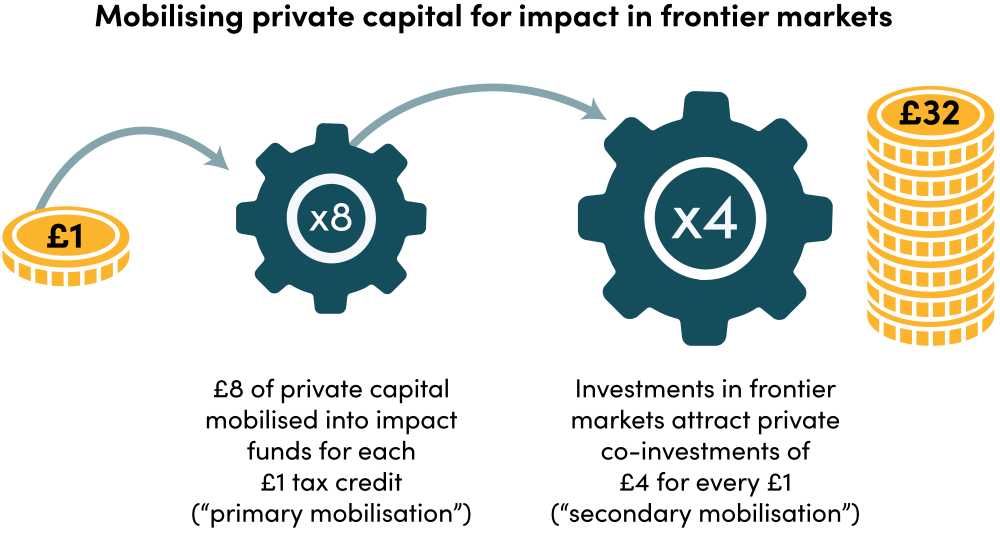
Once invested, the capital raised under IFDS would be expected to mobilise further private investment, including from domestic capital markets. The Private Infrastructure Development Group (PIDG), which invests in infrastructure projects in developing economies, says it leverages over $10 of private capital for every $1 it invests. AgDevCo’s and Cygnum’s investees are mobilising funding from domestic capital markets in sub-Saharan Africa, including from local banks and pension funds, with an expectation of $4 of private capital mobilised for every $1 of their capital.
So, in summary: for a cost of £62.5m, the tax incentive scheme could attract up to £500 million in new investment into impact investment funds and subsequently mobilise a further £2 billion or more in private capital in developing economies. That’s a ratio of 32:1.
The UK is already exploring this space
There is a real policy window of opportunity. The UK government has launched a new investor taskforce aimed at mobilising institutional investment into emerging markets and developing economies (EMDEs). One of its core pillars is product innovation, exploring new vehicles to direct capital where it’s most needed.
This proposal fits squarely within that agenda: a simple, scalable financial product that leverages public policy to crowd in private capital. It also aligns with the Sevilla Commitment from the Fourth International Conference on Financing for Development, which calls for additional private resources to be mobilised at scale and speed for developing countries.
Why this makes sense
1. Cost-effective way of mobilising billions for impactful investments
The proposal would help developing countries move beyond aid to self-reliance. Unlike many complex, bespoke blended-finance structures, tax relief on bonds is simple, scalable, and easy for investors to understand.
2. Lower cost of capital for borrowers
Tax relief on bonds allows impact bond issuers to offer lower interest rates while still attracting capital, making life-changing finance more accessible for businesses and infrastructure projects in developing economies.
3. Strong value for investors
High-net-worth individuals, family offices, and foundations increasingly want impact with returns. Tax credits boost the effective net yield, making these bonds attractive even at lower coupon rates.
4. Growing appetite
We’re seeing a shift in the ecosystem, from closed-end General Partner/Limited Partner funds to permanent capital vehicles using private debt with built-in exit pathways. These investors want income, capital preservation, and purpose. This fits.
What could it deliver?
With impact investment firms telling us they have a strong pipeline of investable projects, our early estimates suggest this market could grow to hundreds of millions per year, with multiplier effects into the billions. As the asset class develops, and with the right credit structures, even pension funds could be persuaded to enter the fold. Most importantly, it gives UK investors—individuals and institutions alike—a tangible stake in building shared global prosperity.
Targeted tax incentives could be a game-changer, unlocking billions in private capital for development at a fraction of the cost of traditional aid. By adapting proven tools like CITR, we can create a simple, scalable mechanism to finance impact, efficiently and at scale.
It’s time to put smart tax policy to work for the global good.
Disclosure: Chris Isaac is employed by AgDevCo, an impact investor that could benefit from the proposed policy change. The views expressed here are his personal opinions, and do not necessarily represent those of AgDevCo or its affiliates
Topics
DISCLAIMER & PERMISSIONS
CGD's publications reflect the views of the authors, drawing on prior research and experience in their areas of expertise. CGD is a nonpartisan, independent organization and does not take institutional positions. You may use and disseminate CGD's publications under these conditions.