Recommended
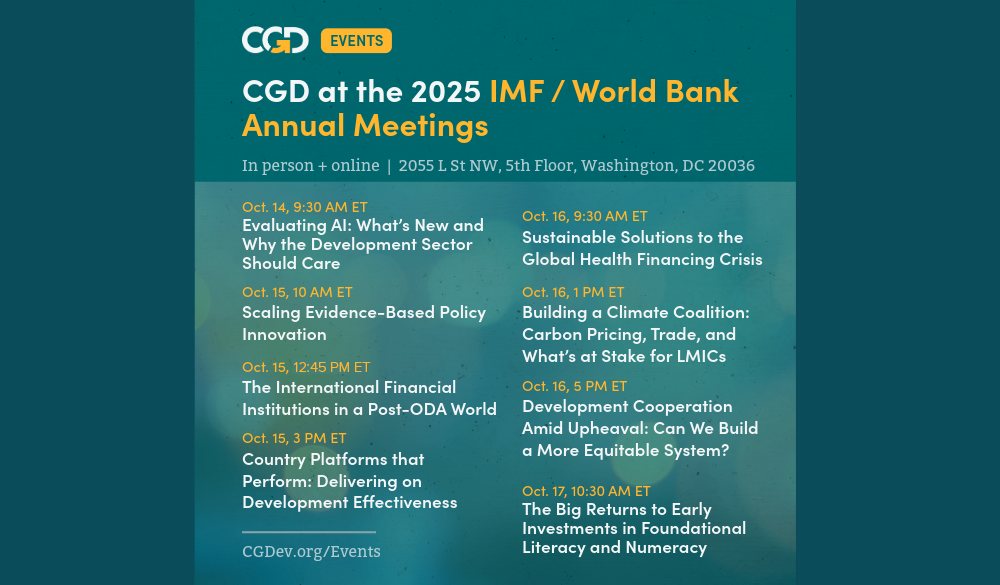
CGD at the 2025 IMF / World Bank Annual Meetings
The IMF-World Bank Annual Meetings kick off next week, bringing together finance ministers, central bankers, and other top officials from around the world to discuss the state of the global economy and the direction of the multilateral institutions—at a time when both are unsettled.
To help orient you as the meetings get underway, five CGD experts lay out what they’re paying attention to.
And join us next week, in person or online, as we convene eight events, featuring conversations on everything from country platforms to evaluations of AI interventions. Find the full lineup and registration details here.
At this year’s IMF-World Bank Spring Meetings, US Treasury Secretary Scott Bessent accused the IMF of “mission creep,” arguing it has strayed from its core mandate—macroeconomic and financial stability—into areas such as climate, gender, and social policy. He urged the IMF to refocus on exchange rates, fiscal and monetary policy, financial sector health, and surveillance.
It will be worth watching how these views shape policy debates at the Annual Meetings. On October 6, Daniel Katz, currently chief of staff at the US Treasury, took over as IMF first deputy managing director. Katz is known as a China hawk, and his arrival may influence how sharply the IMF addresses China’s role in global imbalances. A recent IMF paper estimated the fiscal cost of China’s industrial policies at over 4 percent of GDP annually, raising the question of whether the IMF will adopt a tougher line on subsidies and trade distortions.
I suspect four questions will dominate development discussions during these meetings.
1. Will countries form new coalitions on issues like climate finance that advance progress even if the US does not participate?
2. To what degree will the US take up the broader multilateral development bank (MDB) reform agenda—beyond its drive to finance fossil fuels and oppose “diversity, equity, and inclusion (DEI)” finance?
3. Are we finally seeing MDBs shift to whole-of-bank approaches that set clear results targets and bring all their tools to bear in pursuit of those targets?
4. Does mobilization of private finance now demonstrably play a central role in driving MDB institutional strategies and operations?
We anticipate important announcements from the Circle of Finance Ministers organized by Brazil in advance of COP30 and from borrowing countries forming coalitions to engage with creditors. These are important initiatives that help sustain multilateral progress even as Cold-War-like east-west divides threaten other fora.
On MDB reform, Secretary Bessent has a chance to build on areas of agreement like energy access and take up issues that should appeal to this Administration: more efficient use of capital and better reporting and accountability on impact.
The World Bank, the African Development Bank, and the Rockefeller Foundation are pursuing a very different model through Mission 300. That model sets a clear electricity access target, builds a partnership around it, and supports energy compacts owned by recipient countries. One hopes that MDBs will take up that model in other sectors. But the trick is to set the right evidence-based targets for maximum development and climate-related gains.
On private finance, the World Bank just securitized a portfolio of International Finance Corporation (IFC) assets. Its target for more than 50 percent local currency finance by 2030 is ambitious. It is ramping up guarantee and equity operations—among the most catalytic instruments. And its internal reorganization is breaking down silos between its public and private sector operations. That means it is advancing on the three fronts that are the best tests of whether an MDB is serious about mobilization: a whole-of-bank approach, portfolio transfers to the private sector, and a shift in financial instruments that actually fill gaps in capital markets rather than compete with the private sector.
Will sovereign debt swaps gain momentum as a stopgap for development finance? There has been a marked resurgence of interest in sovereign debt swaps as an instrument for development financing. In the absence of large-scale debt relief initiatives, debt-for-development swaps are increasingly seen as a pragmatic bridge solution to redirect part of countries’ debt-servicing obligations toward investments in climate, health, and education.
This renewed attention reflects both necessity and opportunity. With aid budgets tightening across major donors, debt swaps offer a politically feasible way to unlock resources for social sectors that have suffered setbacks since the pandemic. Recent examples show the potential for scaling this mechanism if coordination improves among creditors, multilateral institutions, and recipient governments.
Given the World Bank’s emerging role in structuring and validating such arrangements, I will be watching the Annual Meetings to see whether the conversation moves beyond isolated cases toward a broader framework that could bring in new actors, standardize terms, and expand coverage to sectors like health and education.
Current levels of debt repayment in many of the poorest countries make it hard for governments to invest enough in basic health and education. I’m not optimistic about seeing much progress announced this week, but one can always hope. At the last Spring Meetings, the G24 group of developing countries “welcome[d] the planned reviews of the joint World Bank-IMF Low-Income Countries Debt Sustainability Framework.” That review isn’t due until 2026, but I’ll be looking out for any hints on timing and substance.
I’m watching to see how many longstanding World Bank principles management is willing to compromise to stay on the right side of the US administration.
We’ve already seen pandering in terms of de-emphasizing climate, and the Bank has introduced considerable sludge into its civil works procurement rules at the US Treasury’s request (remember the happy days when the Bank’s president was focused on reducing unnecessary bureaucracy?).
Now Ajay Banga is downplaying the impact of US trade policy and the benefits of global trade in general. Asked if the new US tariffs were a problem for the world’s poorest countries, he replied, “Not really. First of all, the poorest countries in the world are very low exporters to the United States.” This might come as news to Lesotho, where exports to the US are worth about 6 percent of GDP and those exports have crashed by two-thirds between March and June. Other IDA-eligible countries might be similarly taken aback, including Haiti (83 percent of the country’s exports are to the US), Liberia (42 percent), Cambodia (38 percent), Nicaragua (37 percent), and Honduras (36 percent). For Honduras, exports to the US are worth about 13 percent of the country’s GDP.
What comes next? Work on gender must be a likely target given it has already been de-emphasized across the street at the IMF, by the very same managing director who earlier declared it macro-critical. Of course, however unedifying it is to watch, continued US participation and a decent IDA contribution are worth some level of obeisance by Bank management, but at what point (if any) will other shareholders declare enough is enough?
Topics
DISCLAIMER & PERMISSIONS
CGD's publications reflect the views of the authors, drawing on prior research and experience in their areas of expertise. CGD is a nonpartisan, independent organization and does not take institutional positions. You may use and disseminate CGD's publications under these conditions.