Recommended
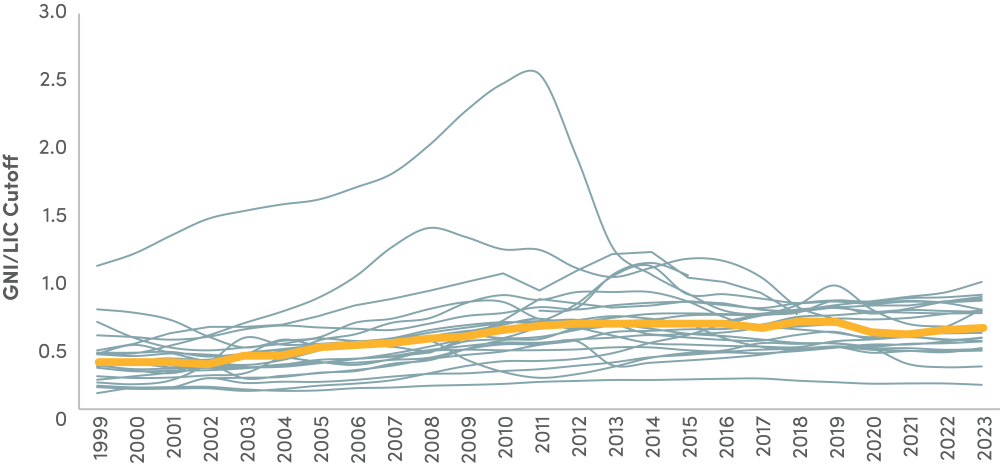
Between 2000 and 2023, the number of low-income countries (LICs) worldwide, with GNI per capita below $1,145, declined from 63 to 26. Graduates included G20 member India (China graduated in 1998). If the same rate of graduation continued, there would be no LICs by 2040. But that outcome is extremely unlikely absent considerable national and global policy change. Graduation rates have slowed over the past 10 years, and annual per capita growth has averaged less than 0.1 percent since 2010 in current LICs. That more recent performance suggests as few as three additional graduations by 2035 and three more in the 15 years 2035 to 2050.[1]
G20 countries should be concerned by this outcome. LICs are not only home to the world’s poorest and most vulnerable people, they are also fragile states at high risk of conflict, with limited capacity to provide global public goods from security to biodiversity and pandemic control. Providing coordinated support in areas from finance through market access and migration opportunities, the G20 could accelerate LIC progress towards comparative prosperity, self-reliance and stability to considerable global benefit.
Current LICs: GNI per capita as a proportion of LIC cutoff GNI/capita
Why care?
The LIC cutoff is an arbitrary one—using an unconventional income measure (Atlas GNI per capita) and it is not based on any discontinuity in living standards or other outcomes. That said, LICs are undoubtedly extremely poor. They have a GNI per capita below 1.5 percent of the US level, or 9 percent of China’s per capita GNI. They are home to 9 percent of the world’s population, but 40 percent of the world’s extreme poor ($2.15/day) and the majority of the ultra-poor, living considerably below $2.15 a day. The under-five mortality rate in LICs is 13 times that in high-income countries. About a third of the population in the average LIC has access to electricity, and only 20 percent to clean water. The average secondary school enrollment rate is just 39 percent.[2]
Two-thirds of LICs are in fragile and conflict situations. Total battle-related deaths in LICs averaged nearly 1,400 per million people in 2000–22, 20 times the level in other developing economies. Half of LICs were in or at high risk of debt distress in 2024. Climate change is disproportionately impacting LICs (an injustice compounded by the fact that they are responsible for just 4 percent of current emissions). Agricultural yields in some LICs may already be 40 percent lower than they might have been absent climate impacts. The World Bank estimates a median labor productivity loss due to climate change through 2050 of up to 6 percent in LICs compared to 0.2 percent in high-income countries. [3]
Between 2000–2021, natural resource-related exports from LICs accounted for 76 percent of the total.[4]This reliance is associated with significant governance challenges. At the same time, LICs are extremely externally dependent, not least because they have very limited productive capacity in areas from vaccines and antibiotics through machinery and equipment to vehicles and infrastructure capital goods. In that sense they are the most reliant on a global trading and financial system that works, and yet it works particularly poorly for them. Beyond domestic institutional and infrastructure bottlenecks, international regulations from Financial Action Task Force controls to oversight of pension portfolios discriminate against LIC participation in global investment and exchange.
Low-income countries see particularly volatile growth and that is associated with lower growth overall. As countries exit low-income status, they are more likely to converge toward higher incomes, and have greater resilience to climate shocks. Those who exit are considerably less likely to fall into civil war. As such, exiting low-income status is an indicator of early progress on the journey to self-reliance as well as greater global security. And middle-income countries have greater capacity to contribute to global public goods from pandemic control through conservation of biodiversity.
An initiative to achieve no LICs by 2040 would require a median growth rate of 2.9 percent amongst current LICs. It would take a maximum sustained growth of 10 percent for the poorest country in the world on the Atlas GNI measure—Burundi—and nearly 7 percent for the second poorest, Afghanistan. Moving the goal to 2050 would reduce these to 1.8 percent, 6.3 percent, and 4.1 percent, respectively. For all of the challenges LICs face to future growth, it is possible to see rapid growth accelerations out of LIC status: since 1990, 26 growth accelerations at an average rate of 7 percent a year over 16 years have been achieved by countries in the LIC grouping.
Why the G20?
The G20 nations have an outsized role to play in improving the prospects for rapid LIC graduation. Not least, they are collectively responsible for the considerable majority of world aid, climate finance, trade and investment flows, and dominate global governance institutions. They are also recipient economies for a considerable proportion of the world’s commodity and migration flows and the source of most tourism dollars. Home to most of the world’s population, they also have a considerable interest in greater stability and capacity of LICs and the global public goods that can deliver. G20 agreement on measures to improve outcomes in LICs and bolster development will encourage a race to the top in terms of the global policy environment facing LIC policymakers.
That said, a previous G20 initiative around industrialization and the least developed country grouping appears to have had little impact, perhaps because it was short on specific policy proposals for G20 countries or international institutions to implement. Any initiative to graduate all LICs would have to (continuously) develop and implement new, specific policy actions.
In order to prevent falling back (“reverse graduation”), the policy initiative should focus on a wider group of countries than purely current LICs. A $1,300 threshold would align the LIC graduation effort with existing international agreements favoring least developed countries (LDCs) as well as the aid efforts that use the IDA cutoff as an inclusion measure (LDCs have a graduation income of USD$1,306, very similar to the IDA threshold of $1,335).
It is also worth noting that approaches to support will have to vary considerably between LICs, some of which face widespread sanctions and/or where state- to-state cooperation is extremely limited for groups of G20 countries. Any G20 initiative would have to be flexible enough to deal with this reality.
Potential policy measures
G20 policy proposals should seek to capitalize on exploiting the comparative strengths of LICs, including their demographic advantage, suitability for renewable power (including hydro, solar, and geothermal), access to minerals needed for the green economy, and a growing tourism sector (tourism’s contribution to LIC GDP has increased by 2 percentage points since 2000).[5] To reduce the risk of reversion and support sustainable economic transformation, there should also be a strong focus on conflict prevention, diversification into industry and services, and resilience (including irrigation and electrification).
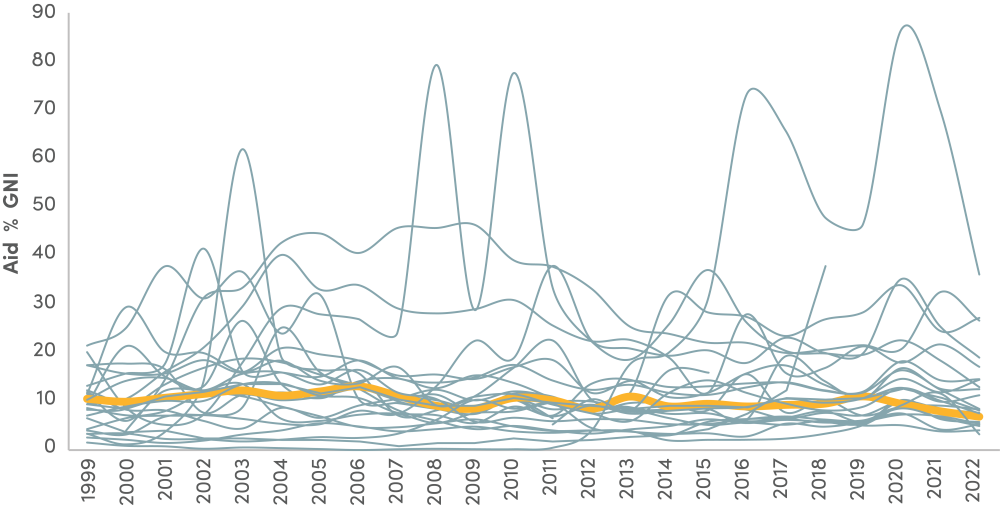
The Doha Programme of Action in LDCs agreed in 2022 to target greater assistance to LDCs. Official development assistance (ODA) as a percentage of GNI has been falling in LDCs since 2000. It declined since 2020 by 5 percentage points to 7 percent of GDP in 2022, the lowest level in decades.[6] Taking one estimate of aid effectiveness, a 1 percentage point increase in the aid-to-GNI ratio raises per capita growth by approximately 0.35 percentage points. Targeting a 3.5 percent growth rate across LICs as a whole, up from 0.1 percent today, would naively imply raising the ratio by 10 percent, or about a 40 percent increase from the 2020 level of ODA to LICs. Stronger commitments to future multilateral development bank concessional lending replenishments as well as income-targeted funds including Gavi would be a suitable goal for the G20 to pursue even in a time of declining overall aid flows.
Current LICs: ODA as a percentage of GNI
G20 countries might also make agreements regarding the quality of assistance financing (around sustainable debt burdens, using multilateral channels rather than transactions-heavy small bilateral country programs, transparency of lending terms, and tying, for example). They could also agree to fast-track debt relief for LDCs in debt distress. Regarding private investment, G20 members could commit to revisit both national regulatory rules, including those governing banks and pension funds, as well as international agreements, including the Financial Action Task Force for unintentional or avoidable restrictions on investment and transactions with LDCs.
Regarding trade, LDCs get preferential market access for goods (such as the EU EBA Initiative) and services, as well as special treatment under World Trade Organization rules. Most of the developed country members and China grant either full or nearly full duty-free and quota-free market access. Other G20 members might volunteer similar treatment and might agree zero tariffs particularly on potential diversification exports including textiles.
All G20 members could follow the Doha Programme of Action in LDCs’ call for meaningful preferences for LDC services and service suppliers. Related to that, G20 members might commit to waiving visa requirements and visa fees and to otherwise lowering the costs of travel both to and from LDCs. To support legal and safe mutually beneficial movement of people, G20 countries might commit to plurilateral skills partnerships, where countries come together to support training and migration opportunities in skills that are in short supply in G20 member states.
The G20 could demand adherence to extractives industry transparency standards for firms based in member countries working in LDCs. Member states might also commit to fully funding and supporting peacekeeping and conflict prevention in LDCs in particular, as well as agree to controls on weapons transfers to LICs.
The last year has seen the United States step backwards in trade access and terms, visa requirements and the ability to travel, foreign assistance, and support for peacekeeping. At the same time, a number of other OECD countries have cut development assistance. The G20 as a whole has functioned with less efficacy in recent years, not least due to rising tensions between China, the US, Europe, and Russia, and the recent success of G20 initiatives including Just Energy Transition Partnerships has been limited. This is likely the wrong moment to expect rapid and effective adoption of a strategy to assist LICs. That said, it may be a good time to start building support behind such an idea. Not least, popular support for isolationism is already waning in many G20 countries. Hopefully, the G20 and its member states will regain their momentum toward international cooperation, including in favor of the world’s poorest people.
With thanks to an anonymous reviewer for helpful comments.
[1] World Bank Global Economic Prospects January 2025 Chapter 4
[2] World Bank Global Economic Prospects January 2025 Chapter 4
[3] World Bank Global Economic Prospects January 2025 Chapter 4, https://ourworldindata.org/grapher/total-ghg-emissions?tab=chart, Ortiz-Bobea, A., Ault, T.R., Carrillo, C.M. et al. Anthropogenic climate change has slowed global agricultural productivity growth. Nat. Clim. Chang. 11, 306–312 (2021).
[4] World Bank Global Economic Prospects January 2025 Chapter 4
[5] World Bank Global Economic Prospects January 2025 Chapter 4
[6] World Bank Global Economic Prospects January 2025 Chapter 4
Topics
CITATION
Kenny, Charles. 2025. Zero LICs by 2040: A Call for G20 Action. Center for Global Development.DISCLAIMER & PERMISSIONS
CGD's publications reflect the views of the authors, drawing on prior research and experience in their areas of expertise. CGD is a nonpartisan, independent organization and does not take institutional positions. You may use and disseminate CGD's publications under these conditions.
Thumbnail image by: G20 SA/ Flickr