Recommended
Blog Post
The World Bank’s New Local Labor Procurement Rule

As part of a general revival of interest in industrial strategy and job creation, some multilateral development bank (MDB) stakeholders suggest there may be a role for MDB-financed procurement to more strongly favor local suppliers through local content rules. This note discusses local procurement rules in general and the (small) role of MDBs in government procurement, and argues that MDB procurement rules around local content should make preferences flexible, optional, and justified on a case-by-case basis.
Introduction
As part of a general revival of interest in industrial strategy and job creation, some MDB stakeholders are suggesting there may be a role for MDB-financed procurement to more strongly favor local suppliers (including bidders, goods, and employment). There is already some allowance for optional local supplier advantage across MDB procurement rules. World Bank rules have long allowed client countries to add 15 percent to the price of goods manufactured abroad as part of cost-based evaluations of bids and 7.5 percent for construction in low-income countries. The African Development Bank (AfDB) allows 15 percent for manufactured goods and 10 percent for construction, and the Asian Development Bank (ADB) allows 15 percent. AfDB also allows regional preferences.[1] But there are signs of a more aggressive approach to local content. Not least, the World Bank recently mandated that all borrowers ensure that at least 30 percent of the total labor cost under World Bank-financed civil works contracts go to employing local staff and personnel.
This note discusses local procurement rules in general as well as the role of MDBs in government procurement, and suggests what that implies for any MDB procurement rules around local content: that preferences should be flexible, optional, and justified on a case-by-case basis.
Local content requirements: A common tool with variable impact
Looking at procurement preferences by both government and private sector, local provision is already advantaged. Ignoring any trade quotas and tariffs, foreign suppliers often face unfamiliar policy and regulatory environments, language barriers, currency costs, international transport costs, and limited local knowledge regarding suppliers, customers, and logistics. These “border costs” unrelated to trade policy already imposed the equivalent of an estimated 71 percent tariff on goods’ imports, according to a 2004 study.[2] Looking at services, think of the costs of bringing in foreign labor to countries where the price of labor is already low—not least the travel, the additional housing costs, the wage premia demanded as the benefit of being away from home, and the visa requirements. Tariffs and quotas, whether implemented across the board or specifically on government purchases, further raise these costs to yet further increase domestic supplier advantage.
Turning to government procurement specifically, there is a growing interest in using procurement policy as a tool of industrial strategy—to foster infant industries and promote innovation, among other goals.[3] This can involve favoring local contractors or requiring all contractors to hire local construction laborers, or use locally made supplies, for example. And many countries across the world already have specific policies in place designed to foster particular industries, sectors, or regions using procurement preferences.[4]
Perhaps partially as a result of these preferences, governments already heavily discriminate against international suppliers in their own procurement. The share of imports in public purchases is about 60 percent of the share of imports in private purchases in the average country.[5] Multilateral and preferential procurement agreements have failed to reduce governments’ propensity to buy from national suppliers (indeed, home bias is increasing over time).
Local content requirements are a form of import substitution, which has a long and somewhat tarnished history in development economics.[6] That is not to claim universal failure—again, certainly import substitution has been widely used by now-industrialized countries—but the record at least suggests it is a tool to be used with caution.[7]
And evidence regarding specific local content requirements suggests that they can significantly increase the price of goods covered and/or reduce the profitability of affected investments.[8] These costs can be extremely high (and the evidence of driving industrial growth weak) in the largest economies.[9] They are likely to be even higher in smaller economies, especially for industries that require large-scale investment and/or high-skilled employment.
Take the Lao PDR, where in some industries the vast majority of value added is already domestic—for example, construction, with 98 percent domestic value added in demand (Table 1). It appears likely that local contractors would win contracts and/or international firms would source locally without further incentive. In other sectors, like automotive, there is no local industry: 99 percent of final demand is met by foreign value added. Creating a local car industry through government procurement (alone) would likely be a stretch. Again, this is not to say content requirements have no role in fostering innovation, employment, or industrial growth, but they should be designed with care, focus, and local constraints and capacities in mind.
Table 1. Lao PDR foreign value added as a percentage of total value added in final demand 2020
| Total - all activities | 35% |
|---|---|
| Manufacturing | 71% |
| Manufacture of motor vehicles, trailers, semi-trailers and of other transport equipment | 99% |
| Construction | 2% |
Source: OECD TiVA Database[10]
Looking at the record of local procurement in MDB-financed operations in particular, evidence is limited as to whether domestic procurement without preferences is harmful to outcomes in MDB projects. For what it is worth, when domestic consultants win contracts, it is associated with longer project implementation and lower project outcome evaluations.[11] Looking more broadly at the share of all contract values under a project won by local firms, there is (currently) no relationship either way with regard to World Bank project outcomes.[12] That said, there is no evidence that it improves development outcomes, even before preferences.
That is one reason why MDB procurement rules have traditionally sought to encourage global competitive sourcing of goods, works, and services in terms of cost, quality, and economic impact, principles still strongly favored in other areas of MDB operations.[13] It is also worth noting that local procurement rules are incompatible with the original conception of how foreign aid and MDB support spurred economic development: to fill investment gaps that required foreign exchange.[14]
This may also be why, historically, domestic preference rules have been rarely used by MDB clients in practice.[15] Between FY99-09, World Bank-financed procurements valued at a total of $280 million used domestic preference rules out of a total of $63.7 billion of potentially eligible procurements. In the cases where domestic preference was used, it affected the outcome of the procurement in only $4.3 million-worth of contracting.[16]
MDBs are ill placed to impose industrial strategy from the outside
Beyond the mixed record of local preference in general, MDBs in particular are ill-placed to mandate an industrial strategy based on such preference. MDBs as a group invest in excess of $150 billion a year, but much of that finance is private sector or policy-based and does not involve country procurement oversight.[17] Project-based public investment lending in the last few years accounts for about 50 percent of World Bank lending (42 percent of IBRD lending, 67 percent of IDA lending), 63 percent of IDB sovereign lending, 69 percent of AfDB/ADF public lending, and about 80 percent of ADB loans and grants.[18]
Of the investment component, the majority of procurements under investment already go to local suppliers. Across the World Bank, the Inter-American Bank, the African Development Bank, and the Asian Development Bank over a five-year period, about $147 billion out of $208 billion in total procurements under projects were contracted to firms from the borrowing country. This 29 percent share of foreign contractor value compares to a 24 percent share of imports in GDP for low- and middle-income countries, rising to 30 percent in sub-Saharan Africa.[19] Note, however, MDB-financed procurement will look different from the average procurement carried out by client countries: it is likely to be for larger and more complex purchases than that average.
Regardless, Table 2 suggests the annual potential “market” for increased local contracting under MDB-financed investment projects is a little over $10 billion a year in total across these four MDBs. Note that is surely an overestimate of any potential desirable increase in local contracting, but also different from the increased local sourcing potential from these contracts (because international contractors already use local supplies and labor in many cases, while local suppliers frequently buy goods from abroad).
Table 2. Contracts won by non-borrower country firms (count and dollar amount) 2020-5
| MDB | Category | All contracts | Contracts with non-borrower supplier | % |
|---|---|---|---|---|
| African Development Bank | Total dollar amount | $10,803,840,945 | $5,666,017,751 | 52% |
| Total number of contracts | 12983 | 2364 | 18% | |
| Inter-American Development Bank | Total dollar amount | $9,458,700,947 | $1,616,683,718 | 17% |
| Total number of contracts | 27307 | 2246 | 8% | |
| Asian Development Bank | Total dollar amount | $89,037,924,496 | $13,795,475,654 | 15% |
| Total number of contracts | 28999 | 4501 | 16% | |
| World Bank | Total dollar amount | $98,848,295,347 | $39,625,556,872 | 40% |
| Total number of contracts | 217934 | 17426 | 8% | |
| All | Total dollar amount | $208,148,761,736 | $60,703,733,996 | 29% |
| Total number of contracts | 287223 | 26537 | 9% |
Note: source is official datasets of each MDB. Ranges from 2020-2025 except for IADB (2020-2023)
It is worth comparing an annual procurement spend under these four MDBs investment projects of a little more than $50 billion a year to summed developing country GNI of $38,690 billion.[20] Under the circumstances, industrial strategy by development bank fiat is unlikely to have much of a macroeconomic impact across much of the developing world.
Take civil works: over the past few years, the World Bank has financed about $5 billion of internationally bid procurements each year, or about 0.04 percent of global construction spending.[21] It lacks the financial leverage to significantly impact outcomes in the sector through procurement choices. More broadly, public procurement in developing countries represents approximately 15–22 percent of GDP, while the World Bank, ADB, AfDB, and IDB between them oversee about $55 billion in procurements a year, or a little more than 0.1 percent of the total GNI of developing countries.[22]
MDB-financed contracting is only a significant proportion of local markets in the smallest client countries, reaching about 7 percent of GNI in countries with a GNI of below $5 billion (around the size of Fiji or Eswatini). And looking at the share of MDB-financed contracts awarded to local contractors, the share is consistently smaller in smaller economies. Those client countries with a GNI of below $5 billion have an average local contractor share of 38 percent (by value) compared to 72 percent for countries with a market GNI above $100 billion (about the GNI of Oman, Cuba or Bulgaria).[23]
Figure1. Country GNI vs significance of MDB-financed contracting
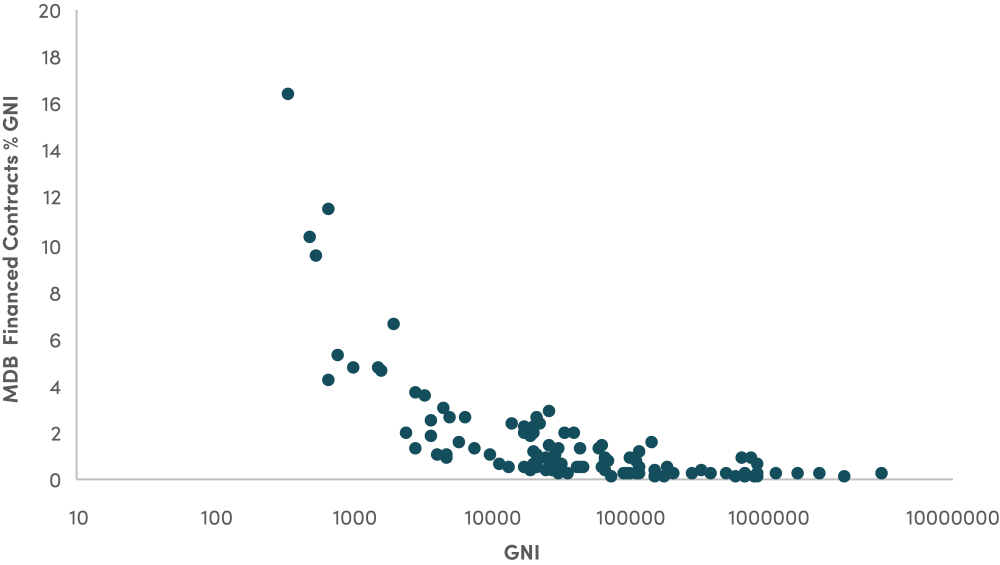
Notes: excludes high-income countries, countries with less than $100m in procurement, Tuvalu. %GNI is based on total 2020-5 MDB-financed procurement (2020-3 for IaDB) divided by five) compared to 2023 market GNI
Figure 2. Country GNI ($m) vs local contractor share
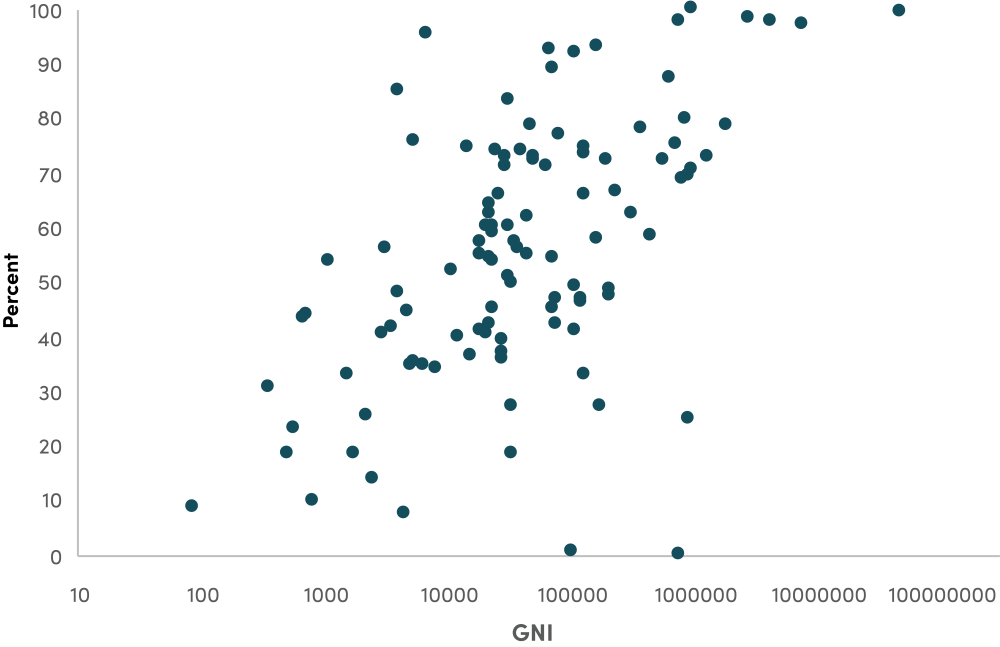
Notes: excludes high-income countries, countries with less than $100m in procurement. Current market GNI 2023
Table 3. MDB contracting characteristics by economy size
| Share of MDB financed contracting local (%) | MDB contracting as a share of GNI (%) | Share of total MDB-financed contracting value (%) | |
|---|---|---|---|
| <5bn | 38 | 6.45 | 3 |
| 5bn-100bn | 56 | 0.87 | 35 |
| >100bn | 72 | 0.20 | 62 |
Notes: excludes high-income countries, countries with less than $100m in procurement. %GNI is based on total 2020-5 MDB-financed procurement (2020-3 for IaDB) divided by five) compared to 2023 market GNI. Figures are unweighted averages.
This is what you would expect—smaller (poorer) economies are more reliant on imports in general because they don’t tend to have as many industries that benefit from considerable scale economies (such as heavy manufacturing or pharmaceuticals) or a full range of specialized production firms.
Put these facts together: especially in the poor small countries, high local content requirements won’t work. In countries with a GNI greater than $100 billion —the MDB’s biggest clients, which accounted for 65 percent of the value of MDB-financed contracts in recent years —these measures aren’t needed. That leaves the countries in the middle, where the macroeconomic relevance of MDB-financed procurement is still limited and where there are still often good reasons for using MDB finance for imported products and skills.
Indeed, the second outlier bottom-right on the graph of local share versus economy size offers an example of the pitfalls of universal local labor or content requirements by MDBs. It is Turkmenistan, with a $58 billion economy and almost no local procurement funded under development bank projects. This is because a large portion of the borrowing was for an ADB electricity project where nearly all of the loan proceeds were used to buy equipment for transmission and substations, while the national power company constructed and installed the equipment using regular budgetary resources.[24]
The country does not appear to have a comparative advantage in heavy electrical equipment production; indeed, its total exports of all types of machinery in 2023 were worth $11 million (less than 0.1 percent of total exports).[25] Add in the fact that the project was defined to exclude the national power company’s supply of labor and construction services, it made absolute sense to see a very low local labor and material content.
Any new local procurement incentives should be designed with such national advantages and constraints as well as project-level peculiarities in mind, not imposed by fiat by MDBs on a very small percentage of procurements.
Policy implications
To recap:
- MDBs are not well-positioned to impose industrial strategy through government procurement import substitution in any but a small handful of their smallest client countries.
- It is likely that local content rules governing MDB-financed procurements are going to be effective and potentially appropriate in a few sectors in those countries.
- In those countries, the costs of poorly designed procurement-based industrial strategy would be very high.
On top of these concerns, there are costs of red tape involved in local preference procurement procedures. Not least, MDBs have their own definition of “domestic” for goods and contractors (local content value added or registration/shareholding/local employment share) and demand justification for the use of preferences.[26] This is a bureaucratic process, but at least a voluntary one. For the new World Bank rule mandating 30 percent of labor costs going to hire locals, by contrast, all borrowers will have to develop a comprehensive assessment of the capacity and availability of the local labor market, bidders will have to outline the roles to be filled by local personnel and their hiring strategy alongside proposals to develop skills, contractors will have to provide monthly reports, and then borrowers quarterly reports, on compliance. And if borrowers want to opt out of the requirement, they will have to explain why.[27]
Because MDB procurement policies are used on such a small percentage of government procurements in the average client country, there is a high learning cost per contract attached to such rules, and the complexities of MDB procurement and lending systems are frequently mentioned by clients as a major disincentive to engage with MDBs.[28] Furthermore, sufficient competition over bids is already a significant issue in MDB-financed procurement, especially in poorer smaller countries, and local preferences will further erode that competition.[29] Any mandate, even with generous exceptions, will add considerable sludge to the process of working with MDBs.
MDBs do have a supporting role to play. They might increase flexibility to adapt to national procurement rules where governments have chosen to adopt local preferences. The record to date of the use of such flexibility is limited: World Bank projects have the potential to use local procurement regulations under certain circumstances, but since that flexibility has been introduced, it has never been used; one reason given is that it is complex for World Bank staff.[30] Fixing the incentive problems related to this challenge would be a productive step.
And while specific content and employment rules should be decided by country governments rather than mandated by MDBs, MDBs should review their use on individual projects that they finance to ensure a solid economic rationale. Clients should have to make the case for local preference (opting in rather than out) in each case—a decision to protect a particular sector or activity based on learning potential and the degree of substitutability, for example.[31] The burden of proof should be higher for policies that demand local content or labor quotas than for policies that adopt scoring strategies through “tariffs” on foreign content, because quotas are more distortionary.
MDBs might also have a policy role in thinking through how to design national local content rules, in sectors where the government is a reasonably significant consumer and where it is plausible that there are economies of scale or other factors that might mean a local preference could have a significant and sustainable impact on industrial development. MDB technical assistance could also help countries ensure no accidental privileging of overseas contractors—providing duty-free access for inputs denied to local contractors, for example.[32]
But MDB-mandated local content rules are a blunt instrument mostly applied at an insignificant scale—banks with tiny hammers seeing every problem as a nail, but the nail is the size of a stake. Local content or labor provisions in MDB-financed contracts should be voluntary, bespoke to the borrower, carefully reviewed, and relatively rare.
Thanks to Dan Honig, Karen Mathiason, and two anonymous reviewers for comments.
[1] See MDB procurement rules available at:https://documents1.worldbank.org/curated/en/099120102072534901/pdf/SECBOS1a43bff50e019609110773aaa8d12.pdfhttps://www.adb.org/sites/default/files/procurement-domestic-preference.pdfhttps://www.afdb.org/fileadmin/uploads/afdb/Documents/Procurement/Project-related-Procurement/Rules%20and%20Procedures%20for%20Procurement%20of%20Goods%20and%20Works%20%28May%202008%20Edition%20Revised%20July%202012%29.pdf
[2] Anderson, J. E., & Van Wincoop, E. (2004). Trade costs. Journal of Economic literature, 42(3), 691-751.
[3] See, for example, Day, C. J., & Merkert, R. (2023). Unlocking public procurement as a tool for place-based industrial strategy. Regional Studies, 57(6), 1029-1042. Kattel, R., & Lember, V. (2010). Public procurement as an industrial policy tool: an option for developing countries?. Journal of public procurement, 10(3), 368-404.
[4] Dawar, K., & Oh, S. C. (2017). The role of public procurement policy in driving industrial development (Version 1). University of Sussex.
[5] Note these estimates look at purchases of potentially tradeable goods. Rickard, S. J., & Kono, D. Y. (2014). Think globally, buy locally: International agreements and government procurement. The Review of International Organizations, 9(3), 333-352. Gourdon, J., & Messent, J. (2019). How government procurement measures can affect trade. Journal of World Trade, 53(5).
[6] Irwin, D. A. (2021). The rise and fall of import substitution. World Development, 139, 105306.
[7] Chang, H. J. (2003). Kicking away the ladder: Infant industry promotion in historical perspective. Oxford Development Studies, 31(1), 21-32.
[8] Hufbauer, G. C., Schott, J. J., & Cimino-Isaacs, C. (2013). Local content requirements: A global problem (Vol. 102). Columbia University Press. See also García-Santana, M., & Santamaria, M. (2024). Governments' Home Bias and Efficiency Losses: Evidence from National and Subnational Governments (No. 19256). CEPR Discussion Papers. Deringer, H., Erixon, F., Lamprecht, P., & Van der Marel, E. (2018). The economic impact of local content requirements: A case study of heavy vehicles (No. 1/2018). ECIPE Occasional Paper.
[9] Bombardini, M., Lira, A. G., Li, B., & Motta, C. (2024). The Increasing Cost of Buying American (No. w32953). National Bureau of Economic Research.
[10] https://data-explorer.oecd.org/vis?pg=0&bp=true&snb=15&tm=TIVA&vw=tb&df%5bds%5d=dsDisseminateFinalCloud&df%5bid%5d=DSD_TIVA_MAINLV%40DF_MAINLV&df%5bag%5d=OECD.STI.PIE&df%5bvs%5d=1.0&dq=FD_VA%2BDFD_FVA.LAO..W..A&pd=2015%2C&to%5bTIME_PERIOD%5d=false
[11] McLean, E. V. (2023). Looking for advice: The politics of consulting services procurement in the World Bank. World Development, 161, 106117.
[12] Kenny, C., Duan, S., & Gehan, Z. (2025). Chinese Contractors and Development Project Quality (CGD Working Paper No. 715).
[13] World Bank. (2018). Stronger open trade policies enable economic growth for all. Results brief. World Bank trade topic page: https://www.worldbank.org/en/topic/trade/overview Washington Post World Bank backs Trump’s gripe over other nations’ higher tariffs on U.S. goods https://www.washingtonpost.com/business/2025/06/10/tariffs-world-bank-trump-trade-war/ World Bank CPIA criteria, available here: https://thedocs.worldbank.org/en/doc/69484a2e6ae5ecc94321f63179bfb837-0290032022/original/CPIA-Criteria-2021.pdf
[14] Chenery, H. B. (1967). Foreign assistance and economic development. In Capital movements and economic development (pp. 268-292). London: Palgrave Macmillan UK.
[15] Williams-Elegbe, S. (2017). Public Procurement and Multilateral Development Banks: Law, Practice and Problems. Bloomsbury Publishing.
[16] Alexander, M., & Fletcher, C. (2012). The Use and Impact of the Bank’s Policy of Domestic Preferences. Background Paper: Review of the World Bank's Procurement Policies and Procedures.
[17] Boosting MDBs’ investing capacity. (2022). An Independent Review of Multilateral Development Banks’ Capital Adequacy Frameworks.
[18] See MDB financial statements available at: https://thedocs.worldbank.org/en/doc/58bd55040cd2ae909ce2173c1ab1a495-0040012025/original/IBRD-Financial-Statements-June-2025.pdfhttps://thedocs.worldbank.org/en/doc/92e198b581900dcde30422c147d1c484-0040012025/original/IDA-Financial-Statements-June-2025.pdfhttps://www.afdb.org/en/documents/annual-report-2024https://www.adb.org/sites/default/files/institutional-document/1059581/qpu-q1-2025.pdf
[19] World Bank Databank: https://data.worldbank.org/indicator/NE.IMP.GNFS.ZS
[20] World Bank databank: https://data.worldbank.org/indicator/NY.GNP.MKTP.CD
[21] World Bank Local Labor Supporting Job Creation Through Operations Procurement https://thedocs.worldbank.org/en/doc/12df134a23770c0a9dd5d76fc69e6b17-0290012025/original/17340-WB-Local-Labor-FS.pdf and Mischke, J., Stokvis, K., Vermeltfoort, K., & Biemans, B. (2024). Delivering on construction productivity is no longer optional. McKinsey & Company, 15.
[22] World Bank Local Labor Supporting Job Creation Through Operations Procurement https://thedocs.worldbank.org/en/doc/12df134a23770c0a9dd5d76fc69e6b17-0290012025/original/17340-WB-Local-Labor-FS.pdf and World Bank databank: https://data.worldbank.org/indicator/NY.GNP.MKTP.CD
[23] For a discussion of other correlates with local/international procurement outcomes in MDBs, see Martínez‐Galán, E., & Proença, I. (2024). Who benefits from the procurement financed by Multilateral Development Banks? Journal of International Development, 36(1), 43-69.
[24] See project document at: https://www.adb.org/sites/default/files/project-documents/49370/49370-002-pp-en.pdf
[25] The bottom-right outlier, with a $394 billion economy, is Iran, and the relevant loan was a World Bank COVID-19 Emergency Response Project, approved in 2020, where the Bank made direct payments to the World Health Organization (WHO) for medical equipment, bypassing payments to the Iranian government which was under sanctions.
[26] https://documents1.worldbank.org/curated/en/099120102072534901/pdf/SECBOS1a43bff50e019609110773aaa8d12.pdfhttps://www.adb.org/sites/default/files/procurement-domestic-preference.pdfhttps://www.afdb.org/fileadmin/uploads/afdb/Documents/Procurement/Project-related-Procurement/Rules%20and%20Procedures%20for%20Procurement%20of%20Goods%20and%20Works%20%28May%202008%20Edition%20Revised%20July%202012%29.pdf
[27] World Bank Local Labor Supporting Job Creation Through Operations Procurement https://thedocs.worldbank.org/en/doc/12df134a23770c0a9dd5d76fc69e6b17-0290012025/original/17340-WB-Local-Labor-FS.pdf
[28] See the ODI survey here: https://cdn.odi.org/media/documents/Country_perspectives_on_MDBs_-_a_survey_analysis.pdf. There is considerable evidence regarding consulting contracts that following MDB rules already takes precedent over getting the best result, most evaluators lack the technical skills to evaluate the quality of bids, the process takes many months, and there is no correlation between price and quality scoring. Casartelli, G., & Wolfstetter, E. (2007). World Bank Policy on the Selection and Employment of Consultants: Study of its Effectiveness. Washington, DC: World Bank.
[29] Kenny, C., & Karver, J. (2012). Publish what you buy: the case for routine publication of government contracts (No. 11). Center for Global Development.
[30] See World Bank IEG report here: https://ieg.worldbankgroup.org/evaluations/making-procurement-work-better
[31] Melitz, M. J. (2005). When and how should infant industries be protected? Journal of International Economics, 66(1), 177-196.
[32] Wells, J., & Hawkins, J. (2008). Increasing local content in the procurement of infrastructure projects in low-income countries. Institution of Civil Engineers, 6-7.
Topics
CITATION
Kenny, Charles. 2025. The Role of MDB Local Content Rules in Industrial Strategy . Center for Global Development.DISCLAIMER & PERMISSIONS
CGD's publications reflect the views of the authors, drawing on prior research and experience in their areas of expertise. CGD is a nonpartisan, independent organization and does not take institutional positions. You may use and disseminate CGD's publications under these conditions.
Thumbnail image by: Yellow Boat/ Adobe Stock