Recommended

DATA VISUALIZATION
Project
Globally, worker shortages crucial to delivering the green transition are growing, with an estimated seven million more workers needed in the next five years. In many countries, the impacts of skills shortages are already being felt through delays to project timelines and stunted growth in key sectors.
Over the past few years, colleagues and I have been researching how training and migration policies could be brought closer together to support the green transition in both countries of origin and destination. As part of this broader research project, we are excited to launch a new map today. It showcases 26 existing projects that have successfully paired training and migration to support the green transition, illustrating the various forms and geographical reach of projects in a relatively nascent field.
Developing the map
We built this map to understand the scope and breadth of green skilled migration projects; to enable information sharing and draw out lessons. Our pool of projects matched the following criteria:
- Include a training component in skills or professions that are relevant to the green transition, e.g., construction, engineering, welding, electrical skills.
- Includes a Global South–North labour migration component: circular, temporary, or permanent.
- Includes the intention to assist project participants in finding employment, either temporary or permanent, in the country of destination.
We have taken an agnostic approach to funding source, and have included a wide spectrum of projects: targeting refugees, public/private partnerships, and wholly private sector-led schemes.
This map is intended to be a living resource and is non-exhaustive. Please do get in touch with us to add to or edit the data!
What we found
Our mapping found 26 projects, ongoing or completed, that met the criteria above. The different projects are difficult to compare; instead we hope this mapping shows the extent of knowledge that already exists from project implementation, and the wide range of countries engaged, demonstrating potential for scale.
That being said, here are three key takeaways from the exercise:
1. 54 countries are currently involved in a green-skilled labour migration pathway, with Germany and North Africa leading the way.
54 countries are involved in a labour migration pathway that involves green skills, with 40 countries of origin. 28 out of the 40 origin countries are in Africa, with North Africa leading the way: Egypt (7), Morocco (5), and Tunisia (4). For countries of destination, Germany is the leader with 13 projects. In the first decade, projects often had multiple origin countries grouped from a region, and in later years we are seeing more projects with just one or two countries of origin.
2. There has been an uptick in projects since 2023.
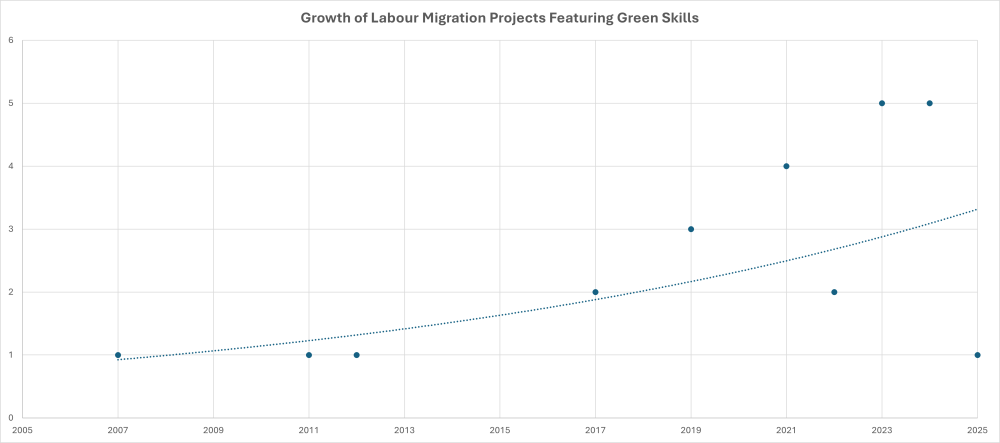
While the oldest project in our mapping began in 2007 there were notably few projects before 2017, and a relative uptick in projects in 2023 and 2024, with continued growth expected. This is perhaps unsurprising given increasing skills shortages in key green skill occupations, as well as green skills being a focus area of the EU’s 2023 launch of five Talent Partnerships. We will make sure to update this map, and track future activity.
Figure 1. Growth of green-skilled labour migration projects by project start date
3. Pilot, publicly funded, projects dominate – with emerging initiatives from the private sector and on displaced talent.
Publicly funded projects (governments, development agencies, or multilateral institution funding) are the most common. Among these, while there are examples of larger programmes such as the Australia-Pacific Training Coalition (APTC), pilot projects dominate, with most projects running for three to four years. Interestingly, we found new private sector led initiatives, such as Eryk and BAUVERBÄNDE NRW e. V., and initiatives placing refugees in skilled worker roles. These new emerging approaches are in their first few years, but it will be interesting to track their evolution.
| Project | About | Size |
|---|---|---|
| BAUVERBÄNDE NRW | BAUVERBÄNDE NRW e. V. (a German trade association for construction companies) uses a talent pool approach to train apprentices from Mozambique and Ethiopia and place them with member companies in Germany. The African partners identify candidates for German language courses based on a jointly developed set of criteria. Once the candidates have been identified, the construction associations offer four information workshops in Ethiopia. The candidates then work on achieving B1 German language skills. Once they have passed the B1 language exam, BAUVERBÄNDE NRW e. V. receives the relevant application documents from the candidates and contacts interested construction companies. Video conferences are then held between the candidates, the potential training company, and BAUVERBÄNDE NRW e. V. If the placement is successful, the candidate and their family pre-finance the German courses and German exam, the visa, and the flight. BAUVERBÄNDE NRW e. V. recommends that the training companies in Germany reimburse these costs in three stages: after the start of training in Germany, after successful completion of training, and after two years of employment as a skilled worker in the former training company. In 2025, BAUVERBÄNDE NRW also took its first steps in Ghana and Senegal with the aim of arranging training placements. | 58 |
| Eryk | Eryk is an International Technical Service Provider, and has run an African Apprenticeship Program since 2018. Since beginning the program with technicians from Ghana and Nigeria to start with, Eryk has signed an MOU with the Nigerian National Board of Technical Education in 2023, agreeing to selecting and screening candidates for the programme. In 2024, cooperation agreements were established with technical schools in Denmark and Poland to support further training of apprentices. The programme is supported by the Consulate General of Denmark. Complementary to the apprenticeship scheme, Eryk has set up an IT hub in Lagos, Nigeria, and aims to create 1000 sustainable jobs. | 50+ |
| Talent Beyond Boundaries | Talent Beyond Boundaries supports displaced people to move from countries of asylum to the UK under an existing skilled migration route. TBB aligns worker placements with the UK's Shortage Occupation List to support the UK's clean energy infrastructure needs. They are currently placing workers across the UK, including in Scotland for an infrastructure project which needs Overhead Power Linesman, and also Source Power Engineers for Substation roles. They are planning on growing the numbers placed in the coming years. | 221 |
Explore the map here, and please get in touch to learn more about our work on green skilled migration or to share a new initiative.
You might be interested in our community of practice, which brings together a broad group of implementers, policy makers, and the private sector to discuss the role that migration can play in supporting the green transition; share ideas, updates, and concrete best practices; and ultimately craft a more integrated long-term vision. The community of practice convenes online every two months for an open discussion focused on a specific theme (e.g., financing, TVET) and features short presentations by members. You can express interest in joining our community of practice here.
In early 2026, we will be publishing a policy paper on lessons learned from six of the projects from this mapping. Sign up to our newsletter to be notified.
The authors would like to thank the project implementers and policymakers who generously gave their time to share and check the data
Topics
DISCLAIMER & PERMISSIONS
CGD's publications reflect the views of the authors, drawing on prior research and experience in their areas of expertise. CGD is a nonpartisan, independent organization and does not take institutional positions. You may use and disseminate CGD's publications under these conditions.