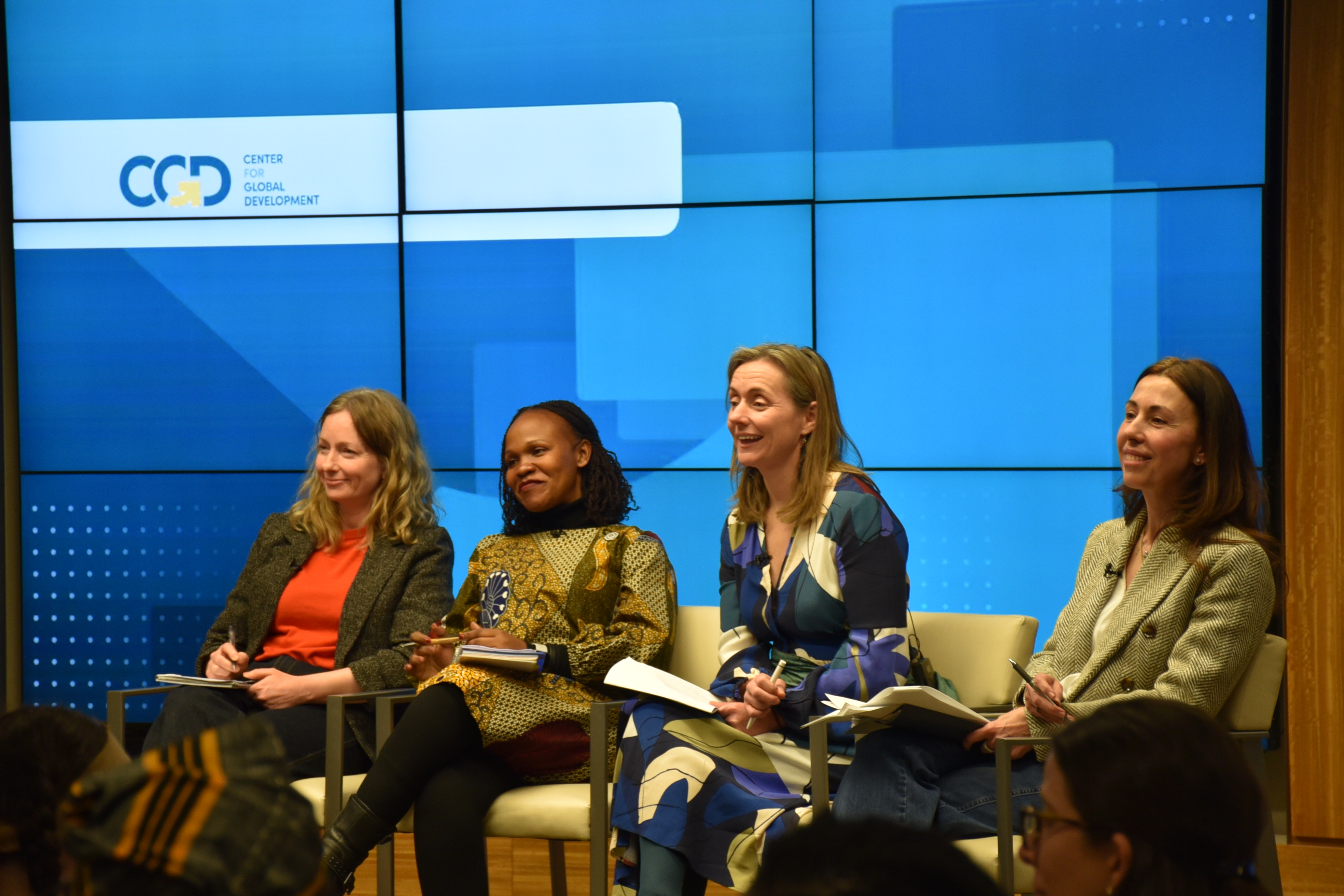
Eliminating school-related violence is a foundational issue. Our best evidence (and more continues to come) shows adverse impacts on all kinds of student outcomes, both in the short term and throughout their lives. As part of the “CGD Research Workshop on School Violence and Response,” we recently organized a panel of experts to explore three questions: what we know about ending violence, how that knowledge can be translated into effective, scalable programs in practice, and why there isn’t more action on this issue from donors and governments. (You can watch the panel here.)
Why we should care
Rachel Glennerster, president of the Center for Global Development, gave three reasons we should be working to eliminate school-related violence and not—as she put it—look away from it, as it’s so tempting to do.
First, school-related violence is massive. Global estimates suggest that 246 million girls and boys are affected by violence in and around schools, but analysis that digs deeper into individual country cases suggests the problem may be even worse.
Second, eliminating school-related violence is important. “The main reason it’s important is that children should not be subjected to violence, in school or anywhere else.” Even though violence affects learning and school attendance (and that matters), the fact that violence is inherently wrong should be enough to motivate action to address it.
Third, norms and practices around school-related violence can change. “In the last generation, we have seen so many countries radically change their perspective on school violence.” She narrated how, in her experience, social norms about the acceptability of school-related violence in the US and the UK have shifted considerably in her lifetime.
What do we know and what do we need to know about eliminating school-related violence
Karen Devries, professor of social epidemiology at the London School of Hygiene and Tropical Medicine, is among the experts who have researched this topic more than anyone else. She laid out five elements that are often present in interventions that have successfully reduced school-related violence:
- Take a whole-school approach. They don’t just work with students or teachers but rather with various actors within the school.
- Support improved relationships. That can be between students or between teachers and students.
- Teach non-violent conflict or dispute resolutions. This can include nonviolent alternatives to corporal punishment or ways for students to resolve conflicts.
- Create social support for change. If people around you are changing as well, it’s more likely you’ll be able to change your behavior.
- Change norms and attitudes toward violence. It’s not just about directly changing behavior.
While we know a lot, Devries highlighted how much we still need to learn. In a recent systematic review that she and collaborators prepared, they found 160 trials of interventions to reduce violence. That might sound like a lot, but in another public health area—smoking cessation—there have been more than 3,000 trials! What do we need to learn more about? Devries highlighted three things. First, scaling: of the 160 trials, only six have subsequently been scaled. Second, costs: few studies document costs or estimate cost-effectiveness. Third, response systems among education systems and research teams: interventions to reduce violence often led to more children reporting violence, and systems must make sure children are protected.
How do you actually implement a program to reduce school-related violence?
Hope Wambi, coordinator of violence against children prevention at Raising Voices, brought practical, deep experience on how to take school violence prevention interventions to scale. Raising Voices developed the Good Schools Toolkit, an intervention that works with teachers, students, and other members of the community linked to schools to try to change school culture around violence. A randomized controlled trial has shown that the Toolkit reduces both violence and acceptance of violence by school staff and students. She shared five principles for practical implementation:
- Use schools as an entry point to prevent violence against children. Most children attend school for at least some of their lives, and it influences their worldview on many aspects of life.
- Pilot for scale. Even though the Good Schools Toolkit began as a pilot, it was designed with scalable aspects in mind. For example, it doesn’t require significant additional time from teachers; instead, it embeds principles into teachers’ existing daily activities.
- Iterate and adapt. The Toolkit began as a primary school approach. Over time, with success, the team built a secondary school version. Then they built a slimmer version to facilitate further scaling.
- Build an opinion infrastructure. Raising Voices met with everyone! They spoke with the media, policymakers, teachers’ unions, and civil society organizations. That way, ideas from the Toolkit could permeate discussions rather than coming only from a single champion.
- Embed in national systems for sustainability. For more than a decade, Raising Voices worked to create formal Memoranda of Understanding with government ministries and to get certification from the National Curriculum Development Center. To achieve this, they held innumerable formal and informal conversations. Often, an informal coffee meeting with a key decisionmaker was even more important than the official meeting that followed.
As a result of these efforts, the Government of Uganda has committed to scaling the Good Schools Toolkit nationwide.
How can we get more action to eliminate school-related violence from governments?
Mercedes Mateo Diaz, chief of the education division at the Inter-American Development Bank, underlined the need to reframe the discussions around school-related violence. She highlighted:
- Do not focus on what we don’t know. Researchers tend to emphasize how much they still don’t know. But ministers of finance and of sectors have many competing demands, and if we come to the table with a “bag of doubts,” they won’t put money towards this crucial issue.
- Do not delay action to address violence. We should use the evidence we do have to take bold action, and then make sure we learn from each experience. There is a cost to making mistakes, but there is also a massive cost to inaction. Focusing on what we don’t know in the policy debate can inadvertently push countries and education systems towards inaction.
- Find the owner of the issue. We need to be very clear on who is the owner of this issue: who is responsible? Ministers of Education often don’t see reducing violence as their primary responsibility. But if we want to see action, we need to find someone in government leadership to take ownership.
How can we get more action to eliminate school-related violence from donors?
Laura Savage, executive director at the International Education Funders Group, reflected on recent research her organization has conducted on how education funders engage with school-related violence. She made three key points:
- More education donors are working on school-related violence than you think. They just don’t call it violence; they call it school safety, good environments, or child well-being.
- Some donors avoid the topic because of how it might be perceived. Those who don’t work on it often avoid it because boards of philanthropies prefer topics that seem or are framed positively rather than negatively (hence the recasting as school safety or well-being).
- Fear of creating tension with government also plays a role. Some funders avoid the topic for fear of damaging the relationship with governments they work with. Will governments be offended that they are being accused of failing to protect children?
If we can be flexible on the framing, then we may be able to bring even more actors to work against school-related violence. Savage also listed four practical things that philanthropists can do: they can raise the profile of the topic by talking about it, they can generate new data and evidence, they can add evidence-based interventions to their existing programs, and they can make sure systems are in place to keep children safe throughout the organizations they support or partner with.
Concluding thoughts
School-related violence is a big problem, it is wrong, and it adversely affects children, but it is possible to change. We have evidence of programs that are effective at reducing violence, and we know more than before about how to integrate those into government programming. With flexibility in how we label this work and a willingness to approach policymakers with a focus on what we do know (even as we keep learning), we can help more children in this generation and those to come to have flourishing childhoods and lay a foundation for them to live their best lives.