Recommended
Blog Post
What We Are Learning About Lead in 2026

Event
Research Grants to Build Evidence on Global Lead Poisoning
VIRTUAL
June 23, 2026 10:00—11:00 AM ET | 3:00—04:00 PM BST
Event
Second Annual Research Conference on Global Lead Exposure
HYBRID
June 03, 2026 5:00—10:45 AM ET | 10:00—3:45 PM BST
WORKING PAPER
Schools in the Shadow of Toxic Sites
This spring in Washington, DC, World Bank president Ajay Banga announced a major new initiative, “Water Forward,” with an ambition to help deliver water security to more than a billion people by 2030. The World Bank lending portfolio currently includes over $3 billion for 81 active water supply projects across low- and middle-income countries (LMICs). We scanned the project paperwork for one word: lead.
The word “lead” appears dozens of times in these documents, but always in the sense of leadership or causation: “the ministry will lead implementation,” or “poor sanitation leads to disease.” Lead the metal—the contaminant and neurotoxin estimated to cause five million deaths per year—is entirely absent.
Not one project includes lead testing in drinking water or plumbing parts. Two projects, one in Ghana and one in Karnataka, southern India, tested for lead in groundwater at baseline but didn’t commit to any follow-up monitoring, and tell us nothing about the potential lead content of actual drinking water provided via World Bank funding.
That is the full extent of drinking-water lead testing across $3 billion of active World Bank water investment in 47 countries.
Why this matters
A recent systematic review found that 25 percent of drinking water samples in LMICs exceeded the WHO guideline for lead. Lead in water looks different in LMICs than in the US or Europe. Rather than legacy lead pipes, the main concerns are industrial contamination of groundwater and lead in new components. These components might include lead-based stabilizers in cheap PVC pipes, lead in solder, lead in brass components such as pipe fittings and faucets, and lead in handpump parts. The Water Institute at the University of North Carolina at Chapel Hill found lead in 82 percent of the rural water systems they tested in Ghana, Mali, and Niger. There is therefore a real risk that new investments might be purchasing poisonous plumbing.
Lead is especially harmful for children—a recent study in Addis Ababa that found contaminated water in kindergartens should raise particular concern. A direct link exists between lead components and human exposure: research from 2023 in Madagascar found that removing lead components from handpumps was followed by statistically significant reductions in measured blood lead in children. The World Bank's own recent Economics of a Livable Planet report cites an estimate of a 35:1 benefit-cost ratio for reducing lead exposure in drinking water.
What we did
We downloaded documentation for all 81 active water supply projects from the World Bank's public portal. This included project appraisal documents, environmental and social impact assessments (ESIAs), management frameworks (ESMFs), commitment plans (ESCPs), and resettlement and stakeholder engagement plans. We then ran an automated scan across the resulting 590 PDFs for mentions of lead (Pb), heavy metals, and specific water-quality testing parameters.
Figure 1. Where the World Bank invests in water: Active water-supply portfolio, share by region and financing type
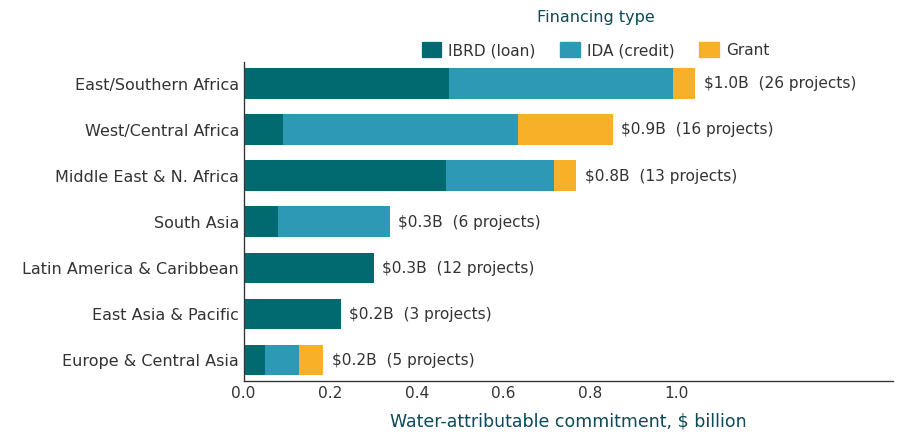
Note: Many projects are multi-sector—this figure includes only the share of projects attributed to water supply. Code to reproduce the figure is available on GitHub here.
Water quality monitoring, where it exists, focuses almost exclusively on microbial contamination (coliform, E. coli) and country-specific geological contaminants (arsenic in Bangladesh, fluoride in Karnataka). Most documents reference “national standards” or “WHO guidelines” without specifying which parameters projects will actually test. Testing protocols are typically deferred to Operations Manuals that are not public.
Where lead appears elsewhere, it never appears in the context of drinking water. Uganda’s ESIA reproduces effluent-discharge standards and separately tests soil for lead and other trace metals, but the drinking water monitoring plan excludes lead entirely. Malawi lists a lead limit, again in an effluent table. Burkina Faso is acquiring metal-testing lab equipment without specifying which metals.
What the World Bank is doing
The Bank knows about lead. It joined the Partnership for a Lead-Free Future in 2024, published a major report, A World Without Lead, in 2025, and is spending a combined $500 million in Bangladesh and Pakistan on lab equipment and lead monitoring. Its Water Department has developed a Lead-Free Drinking Water Initiative, proposing action on procurement reform (specifying lead-free components), regulatory support, monitoring, and surveillance. These are the right options; the question is whether projects actually use them.
The Bank’s corporate scorecard includes a target and measure for water supply and quality, but the definition of quality covers only the avoidance of E. coli, arsenic, and fluoride. The Bank’s “Environmental and Social Framework” lays out standards that borrowers must meet regarding pollution management but does not explicitly refer to lead (Pb). Borrowers must follow whichever standard is stricter: national law or international guidance. The relevant international guidance is the WHO Drinking Water Quality Guidelines. These guidelines call for testing at the consumer’s tap, but whether this actually happens in practice remains unknown.
Most of these projects are loans, not grants. Ninety-three percent of the active water portfolio consists of IBRD loans and IDA credits—debt the borrower government repays. Once a project has been signed off, the Bank can’t retrofit monitoring requirements; the borrower owns the project. The World Bank's leverage lies at the design stage—in what goes into the safeguards documents that future projects must satisfy. For the roughly 7 percent of the portfolio that flows as grants, the World Bank retains more discretion.
What’s needed
We must be careful not to throw the baby out with the bathwater. In the 1990s, when arsenic was discovered in water in Bangladesh, a public health campaign led people to switch to even less safe water sources. Avoiding arsenic while drinking water with fecal contamination increased child mortality. The World Bank is right to lend to expand cleaner water supply; doing so will almost certainly save lives.
But at the same time, a scandal is brewing and a problem is stored up for the future if the Bank is paying for new lead-contaminated infrastructure. The cost of testing a sample of components and ensuring that only lead-free parts are procured is negligible and feasible. The World Bank should amend its Environmental and Social Framework to mandate that in procurement pipes, fittings, brass valves, and solder are certified as lead-free against the International Plumbing Code limit. Former USAID Administrator Samantha Power shares this sentiment—that World Bank projects should ensure water infrastructure is lead-free before installation.
Adding ongoing testing for lead in water is more complicated, but hardly impossible, and if remediation means only swapping brass fittings rather than replacing entire lead pipes, the cost need not be prohibitive either.
Perhaps before investing in a wholesale testing regime, the World Bank should at least invest in research. Better data could help us understand exactly how large the health risks are from different types of contaminated components.
The WHO/UNICEF Joint Monitoring Programme (JMP) should also expand its efforts to include lead. The JMP is the official mechanism for monitoring Sustainable Development Goal (SDG) #6 on access to safe water. It currently tracks E. coli, arsenic, and fluoride as priority drinking-water contaminants. Lead is absent, despite a WHO guideline value since 1993, and a 2022 WHO brief explicitly recommending lead surveillance. Adding lead to the JMP indicator set would generate country-level prevalence data that we currently lack and would create a default reporting expectation that World Bank-funded utilities would, in turn, need to satisfy.
The marginal cost of adding some form of lead testing to a water supply programme is negligible. The marginal cost of not adding it—paid in exposed children, reduced IQ and productivity, and cardiovascular-related mortality decades later—could be enormous. As Richard Damania, the World Bank's chief economic adviser for planet, said at CGD last month: "water quality is the neglected sibling in the world of water… underfunded, under-researched." Lead is the most neglected sibling of the most neglected sibling.
Code to reproduce the analysis in this blog is available on GitHub here.
Topics
DISCLAIMER & PERMISSIONS
CGD's publications reflect the views of the authors, drawing on prior research and experience in their areas of expertise. CGD is a nonpartisan, independent organization and does not take institutional positions. You may use and disseminate CGD's publications under these conditions.
Thumbnail image by: USAID/Flickr