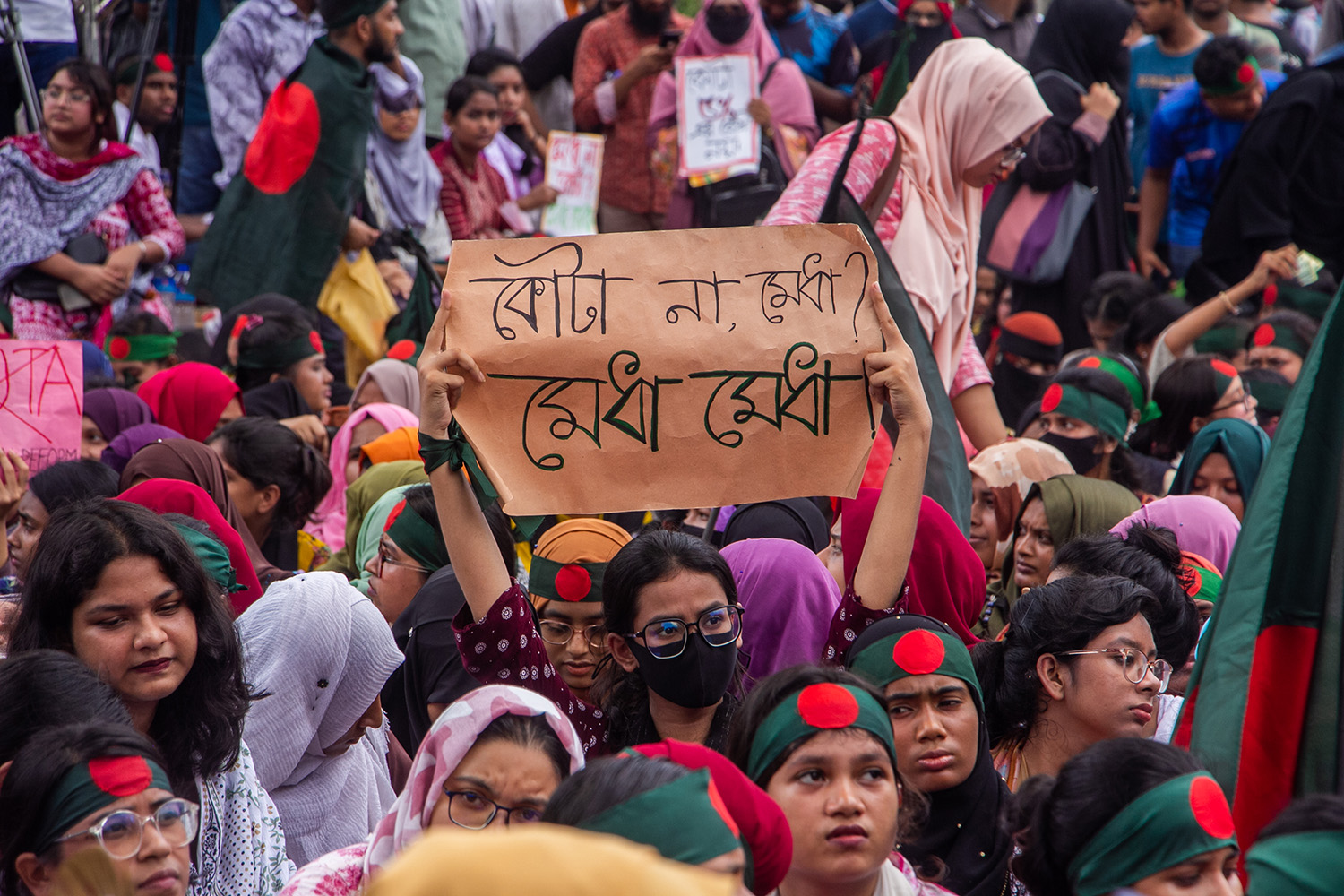
For about six weeks now, thousands of young Indians have camped out in nonviolent protest and hunger strikes in New Delhi. This situation has now hardened into a serious political challenge for the government of Prime Minister Narendra Modi. So far, the government’s response has been violent: on July 20, police used tear gas and batons to stop a nonviolent student-led march on Parliament, injuring more than a hundred students.
The demand at the center of it all can seem a bit curious from the outside: the students are asking for the resignation of the national education minister. Tear gas over an education minister was likely not on many bingo cards for 2026. But really what the students are asking for is accountability over a leaked standardized medical-entrance exam (the National Eligibility Entrance Test, or NEET) and compensation for the families of students who died by suicide after the irregularities came to light.
To understand why leaked examination questionnaires would lead to student suicides, let’s step back and ask what the education system is actually supposed to deliver. India's macroeconomic story has looked reasonable for years, with respectable growth and rising GDP per capita; some would even have us believe ambitions of high-income status by 2047. But there have also been troubling signs that decent average growth is hiding unequal growth. The IMF has documented that India's Gini coefficient (a common measure of economic inequality) rose from 0.45 in 1990 to 0.51 in 2013, while India's top 1 percent now captures 22–23 percent of national income—higher than at any point since income tax records began in 1922, including under British colonial rule, and higher than the top 1 percent share in South Africa, Brazil, or the United States today. (The government's own recent consumption-survey data tells a rosier story, with the official Gini falling from 28.8 in 2011 to 25.5 in 2022. But consumption surveys are known to undersample and undercount the very rich, which is why economists studying top incomes turn to tax records instead.) And, over a third of Indian children remain chronically malnourished.
But, in addition to not lifting all boats, India’s economic growth has also done little to change who gets ahead. Research deploying new methods to measure mobility under the typical data constraints in low- and middle-income countries finds very limited intergenerational mobility in India—since well before the economic liberalization of the economy. Since the 1950s birth cohort, a child born to poorly educated parents has had roughly the same (low) odds of climbing the education ladder as her parents did. The odds are somewhat better for Scheduled Castes and Tribes (SC/ST), thanks in part to affirmative action, but it has actually fallen among Muslims. Daughters consistently do worse than sons regardless of group or era.
A World Bank database using income data, rather than education as a proxy, corroborates this finding: India records the lowest level of income mobility of any country in South Asia, in the same low-mobility tier as Egypt, Tunisia, and Guatemala—where a father earning twice as much as another can expect his son to out-earn the other son by more than 80 percent. In places with the highest intergenerational mobility, that number is under 25 percent.
But what little intergenerational mobility existed worked, disproportionately, through the national education system. The lynchpins of this system have long been competitive exams that determine college entry, choice of subject, college rank, and other factors.
These exams are based on a standardized national curriculum, and administered under standardized and largely equal conditions. For students from poor or middle-class families, these examinations have long represented one of the few channels into medicine, engineering, the civil service—a ticket to a better life than their parents had. (I recently wrote about Indian social change, including a snapshot through my family’s lens. In it, I wrote of my mother joining the Indian Administrative Service. To do so, she traveled over a thousand miles from home and lived with her grandparents for several months to study for and take the standardized entrance exams and interview. Countless Indian families have stories of resources being poured into an exceptionally bright child or two, often including their being sent away to a city center, to prepare for one of these exams.)
How much families are willing to spend for that ticket to intergenerational mobility is in itself a measure of how consequential these exams are. Various estimates put the size of the tutoring/private coaching industry that prepares students for these standardized exams at anywhere from roughly $3.5 billion to $6.5 billion depending on the year and methodology. (Precise figures are hard to come by and these are private market-sizing exercises conducted by consultancies, not academic estimates.) By way of comparison, the National Testing Agency, the body that actually administers these exams, is largely self-funded through exam fees and spends only about $50–60 million a year running them. Families are collectively spending on the order of a hundred times more preparing for these tests than the government spends administering them.
But even before the scandals at the heart of the student protests, the returns to education were shrinking. Indian returns to schooling were estimated at roughly 7–10 percent per year of education through the 1990s. A new study of India's rapid higher-education expansion found that the wage premium for a college degree has been eroding since 2004 in the districts with the most new capacity: non-SC/ST graduates now earn roughly 9 percent less than comparable graduates elsewhere, and SC/ST graduates face a combined shortfall near 43 percent—a penalty that didn't exist before expansion and is likely a question of credential signaling rather than a skills gap. Separately, income gains for Indian graduates overall have been slowing since 2017, and fewer than 7 percent land a permanent salaried job within a year of finishing.
That decline still assumed one thing: that however much the credential was worth, at least earning it depended on merit rather than connections.
Along comes corruption
These various standardized examinations were also, until now, one of the few parts of Indian public life that had stayed relatively insulated from the corruption documented everywhere else, from the sale of the broadband spectrum to bias in the judiciary to village-level redistributive politics. The sociologist Patrick Heller has documented a related shift: welfare as rights-based entitlement under the previous government (2004–2014) has since been converted under the current government into discretionary patronage—recipients recast as grateful subjects of the leader's largesse rather than citizens exercising a right. Exams were rules-based and standardized in a way that resisted this kind of reframing. Every candidate taking one of these exams faced the same standard. This year's scandals are the first real evidence that the exams, too, have been corrupted—a concrete example of the gap between populist rhetoric and the elite capture reality of its policies.
Dissent is an act of care
Across South Asia, Gen Z movements have toppled governments in Sri Lanka, Bangladesh, and Nepal: when unmet promises, weak institutions, and rampant corruption accumulate past a threshold, mass youth-led mobilization can go from rhetorical grievance to regime-shaking protest almost overnight. (This said, I find it hard to imagine these protests challenging a coalition that is very popular.)
The Modi government has cast the protests—and protestors—in a negative light, meriting a violent crackdown. The Minister of Education initially called the students “terrorists” and then suggested that they should act within the system rather than taking to the streets, thereby fomenting instability and chaos. Perhaps the government has a point. After all, a citizen accountability newspaper campaign in Uganda that publicized school grant disbursements dramatically reduced graft in public education disbursements. But a study in India giving citizens information, testing tools, and training to hold local schools accountable found that none of it moved teacher effort or learning outcomes. The only thing that worked was volunteers bypassing the system entirely to teach remedial camps themselves. It is hard not to conclude that India’s institutions are unresponsive.
Where things go from here depends on whether the state can recognize that nonviolent dissent is not the opposite of loyalty, but one of its more demanding forms–and a quintessentially Indian one at that. It is, after all, what shaped Mahatma Gandhi’s leadership of the Indian independence movement and went on to influence Martin Luther King Jr. as well as the African National Congress and Nelson Mandela.
With sincere thanks to Justin Sandefur, Charles Kenny, and Dave Evans for helpful discussions and feedback.