Recommended
Global estimates suggest that one billion children have experienced physical, emotional, or sexual violence—and this number is likely an undercount. Most estimates rely on survey data in which respondents are asked about their experiences of violence. Questions may include: “Over the last month, how frequently have you been kicked, pushed, or hit by your peers?” “Has a teacher physically punished you by hitting you with a stick?” or “Has a member of school staff ever touched your private parts or made you have sex?” Yet many children may choose not to disclose these experiences due to fears of retaliation, social exclusion, judgment, and shame. As a result, the data we collect may systematically underestimate the true prevalence of violence.
Addressing misreporting is crucial, and many researchers have long investigated ways to obtain better and more reliable data on sensitive issues. Misreporting distorts estimates of how common violence is and can bias conclusions about whether prevention programmes are working. Misreporting (particularly underreporting) can also be a missed opportunity to identify and refer cases to the appropriate authorities and support services needed to protect children.
Most of the evidence has focused on adults, with just a handful of studies exploring children’s disclosure of school-related violence. In this blog, we share findings from a survey experiment examining which methods lead to more reliable disclosure of school-related violence among children aged 8 to 12 years old. Three key findings emerge.
- How surveys are administered matters. We find that disclosure of all forms of violence is higher when children respond privately using audio computer-assisted self-interviewing (ACASI) relative to being interviewed face-to-face (F2F).
- Where surveys are conducted matters too, particularly for sexual violence. Children report higher levels of sexual violence when surveyed at school than when surveyed at home.
- Privacy-enhancing methods are especially important for older children and boys, who face the strongest social barriers to disclosing violence F2F.
We discuss other important findings below.
What did we study?
The study included nearly 6,000 children aged 8 to 12 in 251 primary schools across eight districts in northern, central, and southern Malawi. Children answered questions in one of three local languages about emotional, physical, and sexual violence perpetrated by peers and school staff. To test how survey mode and location affected disclosure, they were randomly assigned to one of four survey approaches: F2F interviews or ACASI, administered either at the child’s home or at school (Table 1).
We chose these combinations to vary the level of privacy children had when answering questions about violence. ACASI was expected to offer more privacy than F2F because children entered their responses on a tablet without directly interacting with an enumerator. Survey location was also expected to matter if children perceived different levels of privacy at home and at school.
Throughout the study, comprehensive safeguarding protocols were in place, including post-survey counselling for all children and referral pathways through YouthNet and Counselling (YONECO), a nongovernmental organization that manages Malawi’s National Child Helpline.
Table 1. Survey mode and location
| Survey mode | Location |
|---|---|

F2F An enumerator asked the child directly about their experiences of school-related violence and recorded responses on a tablet. Female enumerators interviewed girls, and male enumerators interviewed boys. | 
At home The survey was administered at the child’s home—the most common setting for large-scale surveys such as the Violence Against Children Surveys (VACS) focused on children aged 13–24, and Demographic and Health Surveys (DHS), focused on women 15 or older. |

ACASI The enumerator provided the child with a tablet and headphones. The child listened to recorded questions and entered responses on a touchscreen. Girls heard a female voice; boys heard a male voice. | 
At school The survey was administered at the child’s school—the most common setting for school-based surveys such as the Programme for International Student Assessment (PISA), focused on children aged 15, and Global School-based Student Health Survey (GSHS), focused on children age 13–17. |
What did we find?
Privacy drives disclosure. The control group consisted of children who completed the survey F2F at home, as this is a common approach for collecting data on violence against children and women, including in surveys such as the VACS and the DHS. We found that ACASI substantially increases disclosure across all forms of violence. Regardless of survey location, reported physical bullying and corporal punishment each increased by around 20 percent; emotional bullying increased by 10 percent; and emotional violence by school staff nearly doubled (Figure 1).
Figure 1. Disclosure of emotional and physical violence is higher under ACASI than F2F
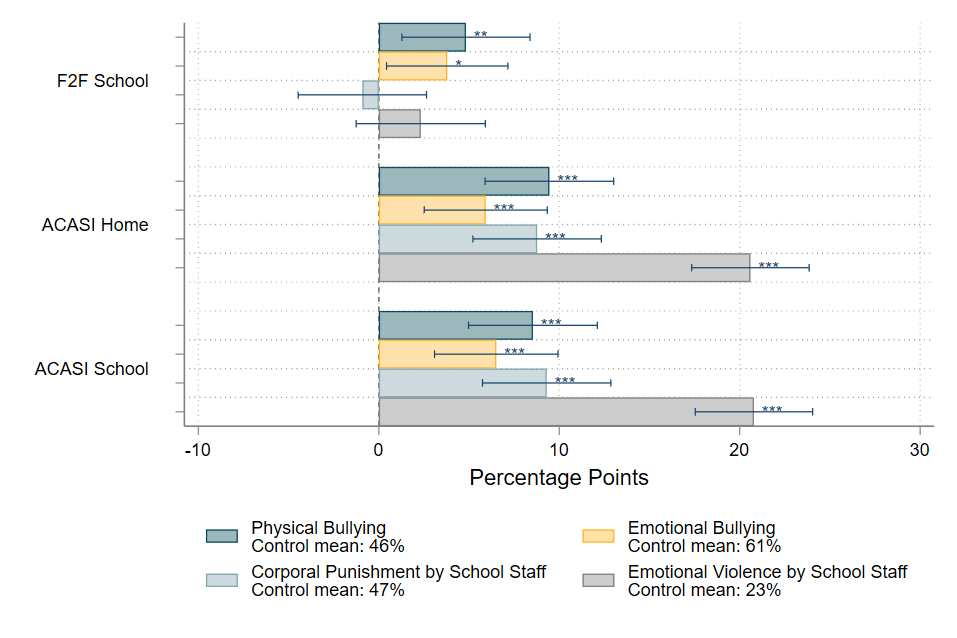
Note: The graph shows the mean difference in disclosure between F2F school, ACASI home, and ACASI school survey treatment arms relative to the control group. The lines represent the confidence intervals, and the stars indicate the statistical significance: * p < 0.10, ** p < 0.05, *** p < 0.01.
The effect is largest for sexual violence, which includes sexual comments about the child’s body, to forcing, persuading, or pressuring a child to take part in sexual activities. In the control group (F2F at home), 14 percent of children reported experiencing any form of sexual violence perpetrated by peers or school staff. Under ACASI, that figure more than doubled, rising to nearly 27 percent and 31 percent when surveyed at children’s homes and schools, respectively. As shown in Figure 2, the increase is driven by reports of sexual violence perpetrated by members of the school staff.
Figure 2. Disclosure of sexual violence is higher under ACASI than F2F, particularly for violence perpetrated by school staff
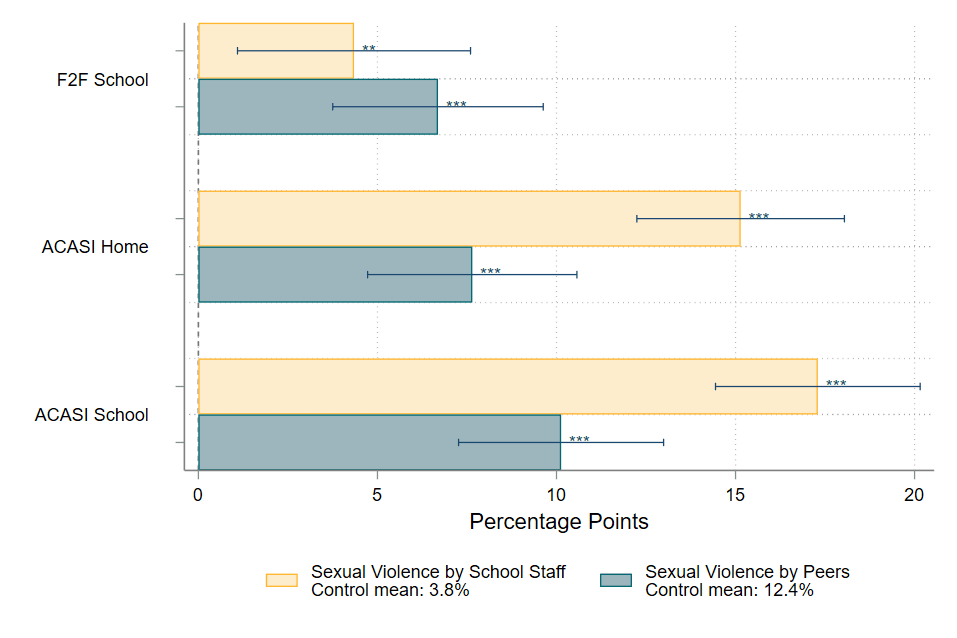
Note: The graph shows the mean difference in disclosure between F2F school, ACASI home, and ACASI school survey treatment arms relative to the control group. The lines represent the confidence intervals, and the stars indicate the statistical significance: * p < 0.10, ** p < 0.05, *** p < 0.01.
These findings echo evidence from Uganda, where ACASI also led to higher disclosure of violence against children in schools. Other survey methods, such as those that use sealed envelope approaches, also suggest that increasing privacy consistently leads to higher reporting of school-related sexual violence.
Location matters too, especially for sexual violence. Children surveyed at school disclose significantly more sexual violence than those surveyed at home, even when the survey method is the same. This pattern does not appear to be driven by children's proximity to perpetrators. Since our questions focused on violence perpetrated by peers or the school staff, we might have expected disclosure to be higher at home if physical distance from the perpetrator was the main factor. Instead, our qualitative and quantitative data suggest that what appears to matter most is whether the interview setting clearly signalled privacy. Schools offered more varied spaces to conduct the survey relative to the child’s home, giving enumerators more options for ensuring the interview was visibly out of the listening range of others.
Disclosure of violence differs by age and sex. Older children age 10–12 years are more likely to underreport physical violence during F2F interviews, consistent with research showing that internalised norms of shame grow stronger with age. Moreover, boys are eight percentage points more likely than girls to report sexual violence under ACASI compared to F2F, likely reflecting stigma around male victimhood and harmful masculinity norms that silence reporting. The additional privacy of ACASI appears to lower these barriers. More qualitative and mixed-methods research would help unpack why these effects vary across groups of children and across different forms of violence.
Our results are robust to multiple checks. Some might worry that the results reflect higher overreporting (false positives) in the ACASI arm. Though this is a valid concern, research suggests that in the context of violence higher disclosure is more likely to reflect the truth rather than systematic overreporting. We find that children in the ACASI arm were less likely to give socially desirable responses, suggesting a lower incentive to conceal experiences of violence. A small fraction of children in the ACASI arm also failed attention-check questions (which could result in either overreporting or underreporting) or misunderstood some questions on sexual violence (potentially leading to overreporting). However, we find suggestive evidence that these errors are more likely random than systematic misreporting. Most importantly, even after correcting for these errors, our results remain similar, providing reassuring evidence that false positives do not drive our findings.
ACASI is cost-effective. ACASI is around $1 more per child than F2F due to additional costs for equipment and audio recording. However, ACASI is more effective in improving disclosure. As a result, we find that the cost of increasing the probability of a child reporting sexual violence by one percentage point is roughly halved when using ACASI in schools. Specifically, we find that the cost is $3.67 with ACASI at school, $5.10 with ACASI at home, and $7.69 with F2F at school.
Why does this matter for future data collection?
Without better data, we risk misunderstanding both the scale of violence against children and the effectiveness of interventions designed to prevent it. Our findings show that how—and where—we ask children about violence shapes what they tell us. Privacy-enhancing approaches such as ACASI play a critical role in reducing underreporting and generating more reliable estimates of violence. As governments, donors, and researchers invest in measuring progress toward ending violence against children, choosing methods that minimise systematic underreporting while protecting children's safety is essential for both effective policy and ethical data collection.
For more details on our survey instruments, we invite you to review our supplementary materials. Please also stay tuned for our forthcoming paper on the safeguarding processes used in this study!
Topics
DISCLAIMER & PERMISSIONS
CGD's publications reflect the views of the authors, drawing on prior research and experience in their areas of expertise. CGD is a nonpartisan, independent organization and does not take institutional positions. You may use and disseminate CGD's publications under these conditions.
Thumbnail image by: GPE/Mbuto Machili