

Millions more children are now in school, and new teaching approaches have been shown to sharply increase learning. Yet most children have yet to benefit from these improved pedagogies, despite many examples of large learning gains even in challenging circumstances. The challenge now is to systematically apply this evidence to transform education within tight government and donor budgets. The Global Education Evidence Advisory Panel (GEEAP) of experts from around the world and across disciplines (convened by the FCDO, World Bank, and UNICEF, with CGD as its research partner) aims to do just that. It draws on cost and impact data from thousands of studies plus government experiences in scaling into a consensus list of Smart Buys recommendations. Since 2020, GEEAP’s Smart Buys have been adopted in national education plans for 247 million children and now inform most World Bank and FCDO education investments.
The challenge
We know that children around the world are able to achieve substantially more learning than they currently do—among 10-year-olds in LMICs, seven out of ten can’t read a simple sentence even though the vast majority are in school. Education budgets are tight, and aid funding for education is falling. There are many studies showing large gains in learning even with relatively limited additional funding, but sifting through the thousands of new education studies every year is an impossible task for a policymaker, let alone standardizing them on common metrics, calculating relative cost-effectiveness, and knowing which have scaled elsewhere. Decision makers need practical advice based on boiling this vast literature into common lessons, comparative cost-effectiveness, and an understanding of the constraints and opportunities they face. They need a ranked, priced shortlist of the most cost-effective ways to solve the specific challenges they face—whether improving enrollment, teaching literacy, or helping children who have fallen behind—compiled and curated by a trusted body that knows the research and the practicalities of implementing education at scale. They also benefit from some consensus among the many different bodies giving them advice.
What we did
The Global Education Evidence Advisory Panel (GEEAP) brings together education experts from around the world to turn decades of research into a clear answer to the question every ministry and donor face: where will each dollar buy the most learning given the challenges I face?
GEEAP borrowed a proven model: the World Health Organization's "Best Buys" for noncommunicable diseases, now incorporated into national strategies and donor financing in roughly 120 countries. Education had nothing comparable until 2020, when the UK's FCDO and the World Bank (later joined by UNICEF and, formerly, USAID) convened GEEAP. Each organization brought a strong track record of generating rigorous evidence and using it in policy. GEEAP knits this dispersed expertise into a single global body with one set of recommendations and builds credible consensus around them, giving low- and middle-income countries practical, scalable recommendations and advice on where they work best.
The panel does three things most research bodies won't:
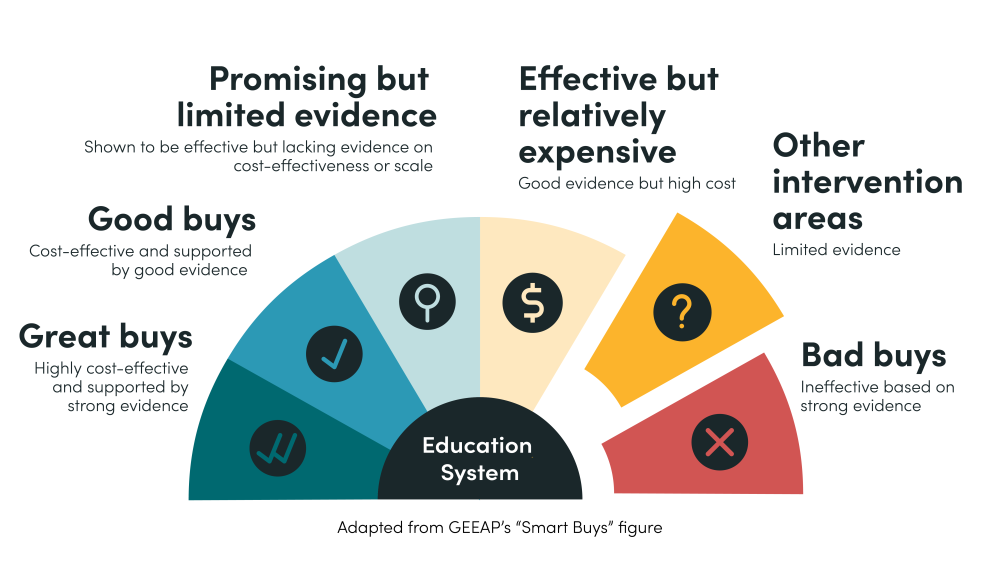
1. It distills a sprawling evidence base into usable Smart Buys categories that reflect cost, strength of impact evidence, and scalability—"Great Buys," "Good Buys," "Promising but Limited Evidence," "Effective but Expensive," and, crucially, "Bad Buys.” Guiding governments on what to invest in at scale cost-effectively and what not to fund sets GEEAP apart.
2. It advises on when and where to use different approaches—each recommendation has a discussion on the appropriate context and conditions where it is most likely to be effective, and alternative implementation approaches that would suit different local constraints.
3. It engages with policymakers, donors, and implementers—with an average of 20+ engagements a year, real-world needs shape recommendations, and recommendations shape budgets, working through its conveners, the World Bank, FCDO, and UNICEF, to turn engagement into investment on the ground.
CGD serves as GEEAP’s research engine. CGD experts oversee the evidence synthesis and research curation behind the forthcoming GEEAP products, led by GEEAP panel member and CGD President Rachel Glennerster with a team of CGD researchers. The GEEAP Secretariat leads dissemination, supported by the co-conveners (FCDO, the World Bank Group, and UNICEF) and MannionDaniels.
What we helped achieve
GEEAP has become a reference point for the education sector. Its Smart Buys recommendations are reflected in the plans of governments that educate hundreds of millions of children; its guidance features prominently in the strategy of the World Bank, which finances over $4 billion in education investments annually; and its model is being replicated across sectors. Flagship products include the Smart Buys reports (2020, 2023), a post-COVID recovery report (2022), and the first GEEAP-endorsed report on effective reading instruction (2025). It aims to reach 660–700 million primary-school-aged children across 130 low- and middle-income countries, who stand to learn more and realize more of their potential for every dollar spent.
The Smart Buys recommendations are reaching decision-makers and influencing how they allocate money. GEEAP reports have been presented at more than 70 events across 30-plus countries. The 2023 Smart Buys report has been downloaded 79,000 times in over 110 countries; the 2025 literacy report reached 159 countries with 24,000 downloads since its launch in November 2025. More importantly, GEEAP recommendations are shaping decisions. A 2026 CGD analysis found two GEEAP Great Buys—targeted instruction and structured pedagogy—cited in 68 percent of World Bank decisions and 38 percent of FCDO decisions in 2025.
GEEAP recommendations are also reaching national policy. CGD analysis in 2026 finds that since 2020, 17 countries have included GEEAP Great Buys—structured pedagogy or targeted instruction—in their plans, covering 247 million children. India—home to some of the world's largest school systems—Ghana, Senegal, and South Africa are strengthening instruction in local languages in line with the GEEAP-endorsed literacy report. GEEAP recommendations now shape the sector's largest funding channels, such as World Bank lending, FCDO investment decisions, and the foundational learning and early childhood pillars of the World Bank's new Implementation Strategy on Education and Skills. Media coverage, podcasts, and regional engagement—such as the CGD co-hosted policy panel in Pakistan in January 2026—continue to widen the circle.
GEEAP has also become a model for evidence-based policymaking initiatives in other sectors. CGD and the World Bank recently launched the Global Advisory Panel on Skills, applying the same approach to youth and adult skills. The new Smart Buys Alliance is building smart buys lists beyond education, and an independent nutrition evidence panel is in development. UNICEF-Hempel's foundational learning framework and the Foundational Literacy and Numeracy Impact Review by former USAID staff both build directly on GEEAP's work.
What’s next
The next Smart Buys report launches in 2027, and, for the first time, the review will incorporate non-English-language databases. GEEAP is candid about the limits of the evidence: cost-effectiveness estimates in one context may not translate to another. The next phase will therefore expand upon the topical deep dives (such as the 2025 literacy report), asking not just what works, but how to adapt it to specific education systems. A related workstream with J-PAL is building a validated global item bank in literacy and numeracy to standardize learning measurement, laying out the groundwork to compare across any program or country how much real learning $100 buys.
GEEAP is an independent evidence advisory panel convened by FCDO, the World Bank, and UNICEF. CGD leads GEEAP’s research and evidence synthesis efforts. All efforts described in this story are attributed to GEEAP as a whole. To learn more, visit the GEEAP website; to get involved, email [email protected].
Support More Work Like This.
Your contribution makes it possible for the Center’s researchers to devise practical, evidence-based solutions for today’s most pressing development challenges.