Recommended

In a recent blog post, we outlined the extent to which two major donors (FCDO and the World Bank) mention the “smart buys” from the Global Education Evidence Advisory Panel (GEEAP) report in their project documentation. But what about national governments themselves?
Here we present a new analysis of national government education sector plans from 134 countries spanning nearly three decades (2000–2025), which we refer to throughout as “education plans”. We see clear evidence of a growth in mentions of structured pedagogy and targeted instruction, the two classroom-based interventions classified as “great buys” in the latest smart buys report. Since 2020, 17 countries have published education plans that mention structured pedagogy or targeted instruction, collectively serving a population of 247 million children.
To do this, we scraped UNESCO’s Planipolis website and found 820 education-planning documents. We analysed the 743 available in English, French, or Spanish. Of these, 179 were broad national sector plans, with the remaining 564 being more specific and focused on topics such as higher education, emergencies, teacher development, and other sub-sectors.
We look at adoption of the eight best buys from the GEEAP reports (three highly cost-effective interventions flagged as “great buys” and five as “good buys”). These include:
- structured pedagogy
- targeted instruction
- specific information about the costs, benefits, and quality of education
- early child stimulation
- preschool
- reducing travel time
- merit scholarships
- mass deworming
We use a retrieval-augmented generation (RAG) approach: first applying a broad semantic search to identify potentially relevant passages, and then using a large language model (LLM) to review the surrounding context and determine whether the content corresponds to a GEEAP smart buy, even when different terminology is used (see our full methodology here).
Example Quotes
"students, parents and counselors are provided with the results of those studies, including information about specializations that are in high-demand by the labor market. this too will help develop awareness of parents and students to guide them towards future choices in this field."
Country: Jordan; Year: 2018; Document: Education strategic plan 2018-2022; Page: 93
"the ministry will publicly disseminate information on school/student standards in order to inform parents and other decision makers"
Country: Cambodia; Year: 2005; Document: Education Strategic Plan 2006-2010 ESP; Page: 32
"participate in continuous professional development activities ... prepare and use of lesson plans ... use of teacher’s guide and other teaching learning materials"
Country: Bangladesh; Year: 2011; Document: Third Primary Education Development Programme PEDP3. 1: Main Document. 2: Implementation Guide. 3: Detailed Costings. 4: Annexes; Page: 169
"provide year 1-3 students, primary schools and teachers with appropriate classroom resources (lesson plans, workbooks, textbooks, posters, reading books, mathematics kits etc.); this will include the development of syllabuses plus teacher guides for k-13."
Country: Vanuatu; Year: 2012; Document: Vanuatu Education Sector Program: design document; Page: 26
"a Grade 5 student performing at Grade 3 level attended an accelerated Grade 3 class for two months before progressing to a condensed Grade 4"
Country: Zimbabwe; Year: 2013; Document: Education medium term plan operational plan + Annexes; Page: 31
"the real plan will roll out interventions to improve basic literacy and numeracy using a Teach at the Right Level (TaRL) approach that assesses students’ needs and provides targeted support"
Country: Nepal; Year: 2022; Document: School education sector plan 2022/23-2031/32; Page: 129
"moevt and csos to develop parenting education materials and guides to provide knowledge and skills to parents to enable them inculcate verbal communication, language acquisition skills and competence to babies (0-3 years old)"
Country: Tanzania UR; Year: 2012; Document: Adult and non-formal education development plan (ANFEDP) 2012/13 - 2016/17; Page: 32
"a handbook of practical activities on early stimulation, based on the new curriculum and parenting manual, which parents can implement with ecce-age children"
Country: Kiribati; Year: 2020; Document: Education sector contingency plan for Covid-19 in Kiribati; Page: 21
"effective ecce programmes require good curriculum resources, tools for assessment and strong instructional practice. ecce teachers should have a minimum standard of qualification and engage in yearly professional development"
Country: Vanuatu; Year: 2021; Document: Vanuatu Education and Training Sector Strategic Plan 2021-2030; Page: 23
"moeys will take important steps towards improving the quality of ecce/pre-primary education through professional preparation of facilitators, development of safe and inclusive learning environment ... distribution of good quality learning materials"
Country: Cambodia; Year: 2019; Document: Cambodia's Education 2030 Roadmap; Page: 30
"free transportation for the pupils with a permanent residence at least 2 kilometres away from the nearest school"
Country: North Macedonia; Year: 2018; Document: Education strategy 2018-2025 and action plan; Page: 31
"every primary age pupil should be within 3 km of a school to ensure that all children have easy access without incurring transport costs"
Country: Cambodia; Year: 2005; Document: Education Sector Support Program 2006-2010 (ESSP); Page: 34
"the government has promised merit based scholarships for the 55,000 students with the highest marks"
Country: Bangladesh; Year: 2011; Document: Third Primary Education Development Programme PEDP3. 1: Main Document. 2: Implementation Guide. 3: Detailed Costings. 4: Annexes; Page: 66
"scholarship awards are well and transparently managed based solely on merit as well as considering the priority needs for the country"
Country: Vanuatu; Year: 2017; Document: Interim Vanuatu Education and Training Sector Strategy (VETSS) 2017-2018; Page: 24
"support to school based de-worming twice yearly"
Country: Cambodia; Year: 2005; Document: Expanded Basic Education Programme EBEP Phase II 2006-2010; Page: 59
"under the school based de-worming programme, 6 million school going children were de-wormed in 2015/2016"
Country: Kenya; Year: 2016; Document: Education sector report 2017/18-2019/20; Page: 19
The most commonly mentioned smart buys in low- and middle-income country (LMIC) documents are preschool (33 percent) and merit scholarships (27 percent). These are somewhat intuitive policy ideas, and not necessarily a sign that the countries have been engaging directly with the recent evidence.
Figure 1. Cost-effective education concepts are being considered by both LMIC and high-income governments
Note: Bars show the share of national education sector plans in each income group that mention each smart buy at least once. Mentions are based on a RAG approach, which aims to capture substantive references to the intervention idea rather than only exact phrase matches. Data from 2000–2025.
Have governments been responding to the smart buys research?
Two of the smart buys stand out: targeted instruction and structured pedagogy. They are less obvious and intuitive interventions, and more driven by recent research. Mentioning them is thus a clearer signal of engagement with the evidence.
For both interventions, mentions in education plans increase over the long run, broadly coinciding with the growing evidence of their effectiveness in the last two decades. The pattern after the GEEAP reports is less clear, but with the smaller sample size in 2024–2025, and the fact that plans are only released every five years on average, we should expect some lag before we can see if the reports are impacting policy language. Only one document explicitly references a GEEAP report: Rwanda’s 2024–28 Foundational Learning Strategy.
Figure 2. Great buys are appearing more in education plans
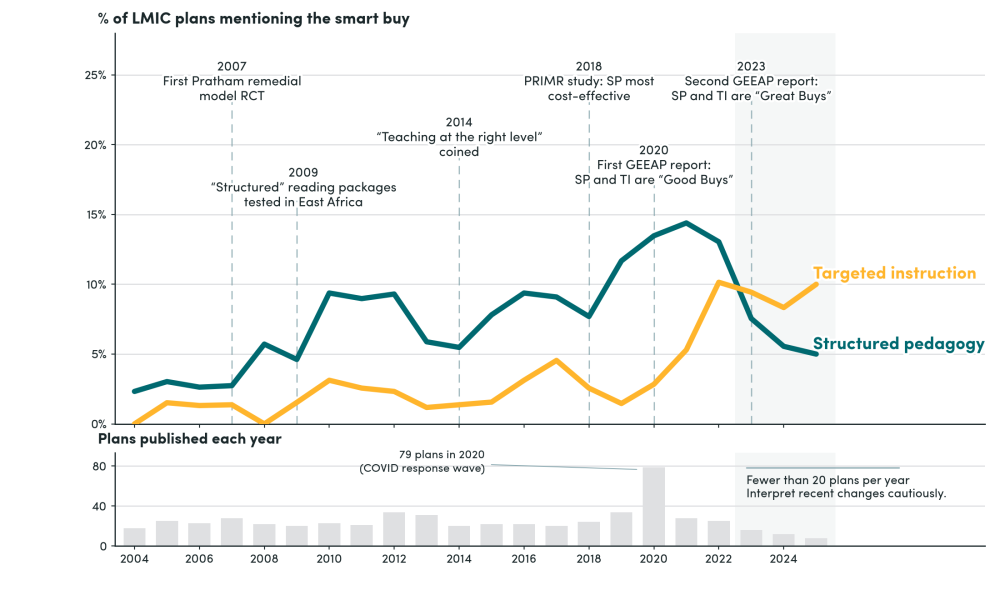
Note: These figures show a three-year moving average of the percentage of education plans that mention targeted instruction/TaRL (TI) or structured pedagogy (SP), based on our RAG method. LMIC plans only.
Two more caveats are worth mentioning here. First, education plans are often more about high-level goals and priorities than specific interventions. Programmes can therefore exist in practice without appearing in the plans. We know of three national targeted instruction programmes supported by TaRL Africa that do not show up in our results, even when we allow for different ways of describing the approach. In some cases, the programme may not be mentioned; in others, our method may have missed broader terminology. We do not know how large either problem is. This means our results likely represent a lower bound of engagement with the smart buys. Even against this conservative benchmark, the upward trend in mentions is still revealing.
Second, the smart buys reports are clear that interventions should be adopted only where appropriate and needed. Deworming is the clearest illustration of a policy that only makes sense in certain contexts—where there is a large worm problem! Not all recommendations will be relevant everywhere.
Have they responded to other research on global education?
Despite the increase in school enrolment in LMICs in the last few decades, there has been a surprising lack of learning happening in schools. The flagship World Development Report in 2018 drew global attention to the learning crisis, and “foundational literacy and numeracy” (the basics learnt in early primary school) has emerged as a growing priority on the global agenda. Do these terms show up in national policies? Here, instead of the RAG LLM method, we searched explicitly for the exact terms “learning crisis” and “foundational learning” (and their French and Spanish translations). Education plans have discussed similar concepts with different terminology before, but the take-up of the new terms could be a sign that governments are increasingly prioritising foundational skills. We see a sudden increase in both of these terms in education plans, as well as in major research and policy publications.
Figure 3. Governments are starting to pay attention to the learning crisis
Note: This figure shows the percentage of LMIC plans that mention either foundational literacy and numeracy (FLN) or the learning crisis; the lines represent a three-year moving average. The dashed vertical line marks the release of the World Bank’s World Development Report 2018: Learning to Realize Education’s Promise. Exact phrase rules are documented here.
The rising mentions of structured pedagogy, targeted instruction, and foundational learning are a meaningful, if partial, signal that international evidence is reaching national planning discussions. Compared with the donor documents we looked at previously, national plans move more slowly and cite research documents less. Whether policy plans translate into programming on the ground and, eventually, into learning outcomes is the question the next decade will answer.
Graph data and metadata for the reports are available to download here.
Topics
DISCLAIMER & PERMISSIONS
CGD's publications reflect the views of the authors, drawing on prior research and experience in their areas of expertise. CGD is a nonpartisan, independent organization and does not take institutional positions. You may use and disseminate CGD's publications under these conditions.
Thumbnail image by: World Bank / Flickr