Recommended



Launched in 2021, the Global Gateway is the EU's flagship external investment strategy. In Central Asia alone, the EU has committed €22 billion, including a €12 billion package announced at the April 2025 Samarkand Summit. Building, operating, and maintaining these infrastructure investments will stimulate economic development in Central Asia. Yet there is an opportunity to unlock even greater development gains, through linking these investments with skills development and labor mobility. This logic is not specific to Central Asia: it applies across Global Gateway partner regions, such as Africa, where large infrastructure investments coincide with young, fast-growing workforces. In countries that are also sources of migration to the EU, skills partnerships could complement efforts to create skilled jobs at home.
The skill levels of Central Asian workers
In Central Asia, job creation has lagged behind labor supply growth. For example, in Uzbekistan, the most populous country in the region, between 2004 and 2023, the working-age population grew about 1.8 percent a year while employment grew about 1.0 percent a year.[i] The recently published Poverty and Equity Assessment finds that job creation has picked up since 2022, with the employment rate rising from 51 to 57 percent, implying nearly two million additional jobs. Wage employment growth was the main contributor to the national poverty rate falling from 17.0 percent in 2021 to 5.8 percent in 2025. However, 84 percent of new jobs in construction, trade, and manufacturing are informal, and firms across the region consistently rate inadequate workforce skills as one of their most significant obstacles to growth (Figure 1).
Figure 1. The lack of skilled workers in Eastern and Central Asia (ECA)
Source: World Bank (2025)
Technical and vocational education and training (TVET) providers are only partially filling this gap. Enrollment levels are high—around 22 percent of upper secondary students in Kyrgyzstan are in vocational programs, and Uzbekistan has historically had among the highest vocational enrollment rates in the world—but the skills trained for are not always relevant to the local labor market. In Uzbekistan, only one third of employed TVET graduates work in fields closely related to their training; in Tajikistan, 45 percent of employers identify technical skills as their most significant gap.
Global Gateway investments in hydropower, logistics, and digital infrastructure—part of broader national investment drive in these sectors—could thus face implementation challenges because of a lack of engineers, technicians, and ICT specialists. But, as we argue in this blog, they could also become a catalyst that complements local efforts to build a skilled workforce for the future.
Strengthening the supply side: Results-based financing for TVET
One way to build the required skills would be to strengthen existing TVET providers using results-based financing (RBF) instruments. These instruments tie payments to verified results (such as graduate employment rates, employer satisfaction scores, and wage levels) rather than inputs (such as enrollment numbers or classroom hours). This shift in incentive structure directly addresses the relevance gap: providers paid on the basis of placement rates have a strong reason to align curricula with what employers actually need.
The World Bank's Nepal Employment Fund offers an illustration of what this can achieve. By tying 60 percent of payments to verified job retention, the Fund placed 90,000 beneficiaries in employment within six months (53 percent of them women, 80 percent from disadvantaged groups), with an independent evaluation confirming significant positive impacts on earnings one year after training.
The Global Gateway could embed RBF instruments directly into its investment architecture, linking financing to verified skills and employment outcomes rather than inputs alone. Co-financing from employers and development partners could further strengthen this approach. Existing procurement frameworks that encourage local labor participation and on-the-job skills development in civil works contracts offer complementary models worth considering.
Strengthening the demand side: Global Skill Partnerships
Investments in the supply of skilled workers are rarely sustainable without a corresponding increase in demand. But infrastructure-linked demand alone is not enough to sustain a transformed TVET system over time: projects are finite, labor absorption remains constrained by slow job creation, and informal employment dominates. Creating more skilled jobs at home for a rapidly growing urban population should thus remain the priority.
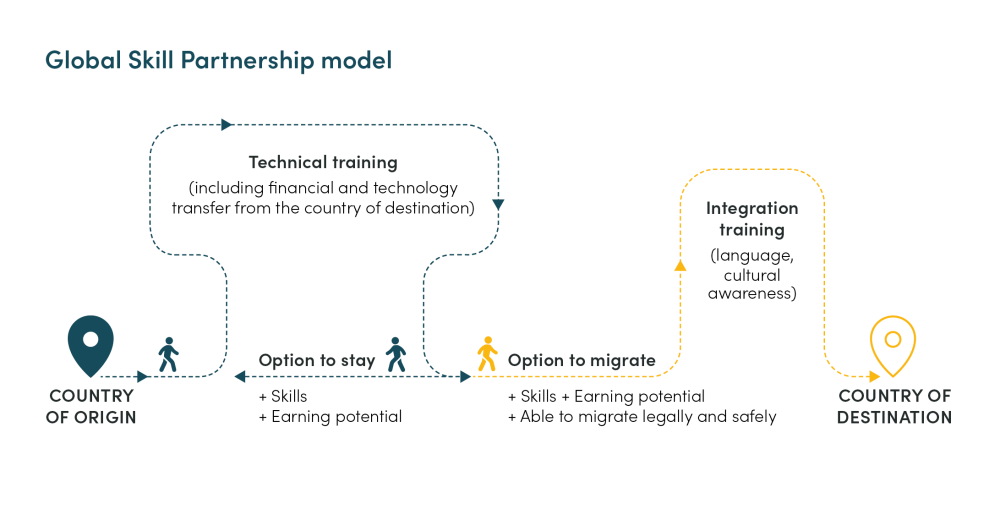
In migrant origin countries facing inadequate job creation, another option exists: connecting trained workers with labor markets abroad with sustained demand. The Global Skill Partnership model, under which destination countries and benefitting employers co-finance training in origin countries for skills demanded in both labor markets, operationalizes this idea. Some graduates migrate legally ("away track"), leveraging credential recognition frameworks or industry certifications; others remain and contribute to the domestic economy ("home track") (Figure 2).
Figure 2. The Global Skill Partnership model
This is a genuine partnership model. Some Central Asian countries have large, young, growing workforces that their domestic labor markets may not be able to fully absorb; European countries face acute skills shortages in precisely the sectors where the Global Gateway is investing. For example, alongside Uzbekistan’s broader planned investment in transport and logistics, cargo volumes in the Trans-Caspian Corridor are projected to grow three- to four-fold over the decade. This is generating strong demand for logistics professionals, customs specialists, and multimodal transport operators, all skills simultaneously in short supply across EU Member States.
Bringing together RBF-linked TVET contracts, an internationally recognized logistics certification, and a Global Skill Partnership would supply workers to three markets: employers engaged in the Corridor itself; employers in European destination countries; and—through circular migration—employers in Central Asia more broadly, who would benefit from the on-the-job experience of return migrants.
Uzbekistan demonstrates that the foundations are already in place. The government has created pre-departure training centers, a Skills Passport aligned with WorldSkills standards, and are investing in TVET more broadly. A 2025 bilateral agreement with Germany is facilitating labor mobility in construction, logistics, and healthcare (for example, they are one of the partners under the “Future International Talents for German Climate Businesses” project). This is a template that can be refined, adapted to the Kyrgyz Republic and Tajikistan, and scaled as institutional readiness develops.
The impacts of the Global Gateway, on both infrastructure and development metrics, could be maximized if employers can obtain enough skilled labor. By improving TVET through RBF mechanisms, and using Global Skills Partnerships to create sustainable demand for certified skilled workers, the Global Gateway could result in that elusive triple win.
[i] These statistics come from the forthcoming World Bank, IFC, and ADB report, “Jobs and the Green Economic Transformation of Central Asia.”
Topics
DISCLAIMER & PERMISSIONS
CGD's publications reflect the views of the authors, drawing on prior research and experience in their areas of expertise. CGD is a nonpartisan, independent organization and does not take institutional positions. You may use and disseminate CGD's publications under these conditions.
Thumbnail image by: ME Image/ Adobe Stock