Recommended
CGD NOTE
Zero LICs by 2040: A Call for G20 Action

Blog Post
The US G20 Should Deliver on Energy Transparency
This note considers how the G20 could support more rapid growth in low-income countries (LICs)—countries with a GNI per capita below $1,145 (1.5 percent of the US level, or 9 percent of China’s). G20 countries have considerable self-interested as well as humanitarian reasons to focus their attention on lifting LICs out of national poverty and toward self-sustaining growth. They also collectively dominate most of the international flows and institutions that could help speed LIC progress to middle-income status from trade through migration, aid, and finance as well as technology development, global regulation and standards setting.
This note lays out a range of policies to support LIC development prospects in those areas. It builds on an earlier note, Zero LICs by 2040: A Call for G20 Action. As argued there, these policies should apply to IDA-eligible countries by income (a $1,325 cutoff) in order to reduce the risk of sliding back into LIC status. IDA eligibility and UN least developed country (LDC) status considerably overlap.
Trade
Duty-free, quota-free (DFQF) access is associated with improved trade and development outcomes in LDCs. The EU's 2011 changes in rules of origin under the Everything But Arms initiative increased non-fuel EU imports from LDCs from $20.8 billion to $27.7 billion between 2010 and 2011. For some LDCs, full market access to large emerging markets alongside high-income countries would have additional significant benefits.
Note that coverage must be broad (spanning goods including agricultural products and textiles, for example) to have an impact: excluding as few as 3 percent of tariff lines reduces the benefits of DFQF to insignificance.
Table 1. Trade preferences for LDCs: Select countries
| Country | Duty-free tariff line coverage |
|---|---|
| Australia | 100% |
| Canada | 98.5% (excludes dairy and other animal products, meat, meat preparations, cereal products) |
| China* | 96.3% (excludes chemicals, transport vehicles, machinery and mechanical appliances, electrical machinery, paper) |
| European Union | 99.8% (excludes arms and ammunition) |
| India (2023) | 94.1% (excludes plastics, coffee and tea, alcoholic beverages, tobacco, food residues) |
| Japan | 97.9% (excludes fish and crustaceans, footwear, milling products, cereal products, sugar) |
| Republic of Korea | 89.3% (excludes fish and crustaceans, mineral fuels, oil seeds and oleaginous fruits, wood products, vegetables) |
| Türkiye (2023) | 78.1% (excludes iron and steel products, fish and crustaceans, food preparations, meat, oil seeds and oleaginous fruits) |
| United Kingdom | 99.8% (excludes some arms and ammunition) |
| United States** | 82.8% (excludes apparel and clothing, cotton, fibers, footwear, dairy and other animal products) |
* LDCs that have established diplomatic relations with China are eligible for preferential tariffs on 98% of tariff lines. **Refers to the United States' Generalized System of Preferences for least developed beneficiary countries. The United States also offers 96.9 percent DFQF to AGOA-eligible countries. Source: https://www.un.org/ldcportal/content/preferential-market-access-goods-2
In addition, preferences have greater impact with more generous rules of origin that avoid exclusions and restrictions. LDCs face the most restrictive product-specific rules of origin in sectors where they have a revealed comparative advantage. G20 countries could commit to adopting a simple change of tariff classification model for rules of origin, alongside a generous tolerance allowance for inputs that do not fulfil the requirements.
G20 countries could also commit to addressing the impact of other regulatory rules, including technical barriers to trade, such as sanitary and phytosanitary regulations, often considered a greater trade barrier than tariffs. In particular, members should examine the potential to cross-certify imports from IDA countries on technical standards (so that certification of an import’s regulatory compliance in one G20 jurisdiction satisfies certification requirements in whole or in part in other jurisdictions). The same exercise might also cover international rulemaking, including the Basel Convention on Hazardous Waste, International Maritime Organization regulations, and the Codex Alimentarius.
More broadly, a G20 panel might examine the potential chilling effects on LIC growth prospects from universal standards—including the International Conference on Harmonisation Pharmaceutical Guidelines, the International Union for the Protection of New Varieties of Plants, the International Civil Aviation Organization Universal Safety Oversight Audit Programme, and the International Labour Organization Core Conventions—and suggest potential remedies that ensure the vital global public good elements of these agreements while potentially easing application for the world’s poorest countries.
Debt finance and support for the private sector
Debt service to revenues for the median low-income country government reached about 15 percent by the end of 2023, up from 5 percent in 2012. Guinea-Bissau, Mozambique, Niger, Malawi, Rwanda, Sierra Leone, Togo, the Gambia, and Uganda all see interest payments (alone) above 10 percent. Private bondholders are a growing part of the debt burden. Malawi is making limited progress on negotiations with commercial creditors; other countries with significant private creditor share include Guinea-Bissau and Mozambique.
The G20 Common Framework is not delivering debt relief rapidly enough: it is slow, provides insufficient relief, and lacks creditor participation. The G20 should consider reforms such as incentives that encourage creditor participation and multicountry approaches. The G20 could also make better use of the Poverty Reduction and Growth Trust and MDB “market rate” financing (including IBRD) as part of restructuring. The work of developing actionable proposals could build on the Africa Expert Panel Report Commissioned by South Africa as G20 head, which called for a new G20 debt refinancing initiative for low-income and vulnerable countries. A first step might be a G20 Commission on the Debt of the Poorest Countries to propose solutions that the G20 could adopt or encourage.
Table 2. Low-income country debt risk category September 2025
| Country | Risk of External Debt Distress | Latest DSA Publication |
|---|---|---|
| Malawi | In debt distress | Nov 22, 2023 |
| Sudan | In debt distress | Jul 1, 2021 |
| Afghanistan | High | Jun 28, 2021 |
| Burundi | High | Jul 25, 2023 |
| Central African Republic | High | Jun 28, 2024 |
| Chad | High | Dec 12, 2024 |
| Gambia, The | High | Jan 14, 2025 |
| Guinea-Bissau | High | Dec 19, 2024 |
| Mozambique | High | Jul 12, 2024 |
| Niger | High | Jan 28, 2025 |
| Sierra Leone | High | Nov 22, 2024 |
| South Sudan | High | Jun 10, 2024 |
| Yemen, Rep. | Moderate | Sep 24, 2014 |
| Burkina Faso | Moderate | Jul 29, 2024 |
| Congo, Dem. Rep. | Moderate | Jan 27, 2025 |
| Liberia | Moderate | Oct 11, 2024 |
| Madagascar | Moderate | Mar 21, 2025 |
| Mali | Moderate | Jun 14, 2023 |
| Rwanda | Moderate | Dec 16, 2024 |
| Somalia | Moderate | Dec 17, 2024 |
| Togo | Moderate | Jan 16, 2025 |
| Uganda | Moderate | Sep 11, 2024 |
| Eritrea | - | No DSA published |
| Korea, Dem. People's Rep. | - | Not on DSA list |
| Syrian Arab Republic | - | Not yet prepared |
Note: Three countries have no current debt sustainability assessment available. Source: https://www.imf.org/external/pubs/ft/dsa/dsalist.pdf
The G20 should also work to ensure all sovereign financing to IDA countries, including financing that creates contingent liabilities for governments (such as public-private partnership agreements), is fully transparent in a global public registry. G20 countries could pass legislation declaring that non-reported debt is non-enforceable in their jurisdictions. In 2021, 20 percent of G20 members suggested they still do not share information on their own sovereign lending. All G20 countries should move to loan-by-loan reporting on public and private debt to IDA countries, including state-owned enterprises and local government. They should ensure future multilateral and bilateral lending to LICs include debt-pause clauses, enabling countries to manage post-shock liquidity shortages by deferring payments on existing debt obligations.
Development finance institutions are not working to foster development in LICs where they are most needed. Despite the use of IDA grant resources to subsidize work in IDA countries, for example, the World Bank Group’s private sector arm invested just $92 million in LICs in FY2024, or about 0.5 percent of the International Finance Corporation’s (IFC's) commitments that year, a share that has been shrinking.
The G20 should convene a working group to create reform proposals for major multinational development finance institutions (DFIs) to increase their role and impact in IDA countries. This would build on G20 initiatives including the Initiative on Supporting Industrialisation in Africa and Least Developed Countries, and the High-Level Principles on Sustainable Industrial Policy for Inclusive Economic Growth, Industrialisation, Jobs and Equality. The working group would build proposals for a DFI model in IDA countries based on proactive support for national industrial strategies with countries as primary clients, expanding from an investment focus in mining and mobile telephony to one backing tradeable manufacturing, services, agriculture and agro-processing, alongside infrastructure and services prioritized on their contribution to trade competitiveness and global value chain integration.
Tax and banking regulation
Base erosion and profit shifting alone might cost the average non-OECD country around 1 percent of GDP in lost tax revenues annually. On international taxation, the G20 established the Inclusive Framework in 2016 that helped to equip governments with instruments to address tax avoidance. That said, available evidence suggests tax revenue losses due to profit shifting have increased since the Framework was put in place. More of the rules involved in the framework should be simplified and mandatory rather than optional in order to reduce implementation burdens and increase efficacy. Recent proposals for G20 engagement on international tax issues include bridging gaps between North and South on the UN Framework Convention on Tax. G20 countries might also mandate that their beneficial ownership registries have automatic information exchange with IDA countries wherever possible.
The Financial Action Task Force’s grey list of jurisdictions includes those “actively working with the FATF to address strategic deficiencies in their regimes to counter money laundering, terrorist financing, and proliferation financing.” The grey list is skewed toward LICs.[1] Being added to the grey list has significant consequences. Capital inflows decline on average by 7.6 percent of GDP following grey listing, with particularly severe declines for LICs dependent on foreign investment.
The cost of grey listing creates incentives to put in place onerous know-your-customer and other regulations. Lower-income countries in particular are less likely to use FATF's flexibility measures (like simplified customer due diligence) due to the fear of negative ratings in the evaluation process. The related penalties to banks lead them to “gold plate” their own systems for bank anti-money laundering and counter terrorist financing measures.
Beyond the cost to banks, grey-listed countries, and firms and individuals excluded from financial services, the US Treasury notes that excessive derisking can lead to increased use of unregulated financial channels (including the use of physical cash), correspondent bank consolidation and resulting higher costs, delays in payments, and disruption to essential humanitarian support.
G20 members should ensure they do not use grey listing of IDA countries as an automatic trigger for greater regulatory demands on their own banks. In addition, they should work with FATF to ensure that both national and FATF guidance and training give countries the tools and confidence to identify lower risks where controls should be simplified, and move further toward risk-based approaches to grey listing that focus on larger banking systems.
As noted by the G20 Africa Expert Panel, other international regulatory frameworks, including Basel III and Solvency II, can have the side effect of reducing private flows to the poorest countries in particular. A G20 expert panel on this topic might provide actionable proposals for specific reforms that would preserve the effectiveness of such regulations while easing the pathway for investment in the world’s poorest countries.
The movement of people
Low-income countries benefit considerably from the movement of people. Remittances to LICs are worth approximately 4 percent of GNI. In the Gambia, Somalia, Yemen, and Liberia, they are worth more than 10 percent. They provide a vital source of income for many extremely poor families and foreign exchange for national economies. Low-income countries are also highly reliant on overseas institutions to provide quality tertiary education, in particular. Twenty-nine percent of students from Chad receiving tertiary education do so abroad, for example. And travel is necessary to build trade, investment, and other business links.
But people from the poorest countries pay about five times as much on average for visas as those from the richest countries. Average tourist visa costs for Europeans travelling abroad are below $20, compared to above $50 for sub-Saharan Africa, Central Asia, Northern Africa, and Southern Asia. Expressed in the number of days the average person would have to work to afford a visa, that is 22 days in sub-Saharan Africa compared to a fifth of a day for Northern America.
Costs for business and work visas are even higher. This is to say nothing of additional barriers: proof of funds requirements, documentation regarding bank accounts, travel insurance, invitation letters, and travel costs to embassies for interviews. And because of lower approval rates, all of these costs frequently end in visa rejection. Rejection rates are considerably higher for LICs than the average.
Table 3. US B-Visa and Schengen Short Term Visa rejection rates for low-income countries 2024
| Country | FY24 US B-Visa Rejection Rate | 2024 Schengen Short-Stay Visa Rejection Rate |
|---|---|---|
| Afghanistan | 48.89% | |
| Burkina Faso | 58.03% | 22% |
| Burundi | 65.52% | 40% |
| Central African Republic | 48.46% | 32% |
| Chad | 58.60% | 36% |
| Congo, Democratic Republic of | 46.77% | 30% |
| Eritrea | 49.94% | 29% |
| Ethiopia | 51.17% | 36% |
| Gambia, The | 66.03% | |
| Guinea-Bissau | 76.59% | 47% |
| Korea, North | NA | |
| Liberia | 79.38% | 1% |
| Madagascar | 13.12% | 31% |
| Malawi | 47.78% | |
| Mali | 60.90% | 43% |
| Mozambique | 34.75% | 7% |
| Niger | 38.18% | 17% |
| Rwanda | 55.76% | 33% |
| Sierra Leone | 69.36% | |
| Somalia | 77.02% | |
| South Sudan | 60.35% | |
| Sudan | 54.59% | |
| Syria (Syrian Arab Republic) | 45.84% | 27% |
| Togo | 66.60% | 37% |
| Uganda | 47.29% | 36% |
| Yemen | 58.07% |
Sources: U.S. Department of State, Bureau of Consular Affairs, Fiscal Year 2024 Adjusted Refusal Rates for B-Visas European Union Short-stay visas issued by Schengen countries
The G20 could ease travel restrictions to mutual benefit. Not least, the G20’s high-income countries and China combined will have more than 200 million fewer people of working age in 2050 than in 2020. They will need closer migration (and trade) links with countries where workers remain abundant. In particular, G20 countries could target existing programs designed to attract lower-skilled and temporary migration into sectors such as agriculture toward IDA country residents—previous such efforts have demonstrated the potential for significant impact on poverty in sending countries.
Global skills partnerships between G20 countries with shrinking workforces and LICs where working-age populations continue to grow could also be of considerable benefit to sending and receiving countries alike. Skills partnerships combine training in source countries supported by receiving countries with employment opportunities in receiving countries. They provide needed employees to firms and institutions in G20 economies while providing a source of remittances, training, skills development and trade and investment links to sending countries. Skills partnerships might focus on care, manufacturing, and (again) agriculture, where labor shortages are already acute in a number of G20 countries, and where skills requirements are comparatively limited. They could involve temporary or medium-term migration.
Middle-income members of the G20 might play a particularly important role in transferring skills and experience in basic manufacturing sectors where they are losing comparative advantage as domestic labor costs rise and they move up the manufacturing value chain. Specific programs that combine skills development and investment promotion might be particularly powerful. Bangladeshi migrants who gained experience in the South Korean textiles industry in the 1980s and 1990s were an important spur to the development of Bangladesh’s own textiles industry, for example, supported by South Korean FDI.
G20 countries could also support local and global human capital development as their domestic enrolments decline by providing low- or no-fee access to low-income country enrollees in their universities. Germany already provides no-fee access to all students regardless of nationality at public universities, but a policy focused solely on low-income country enrollees would have considerably lower costs. There are fewer than 3,000 students from African low-income countries enrolled in UK universities, for example, out of 732,000 foreign students. They make up about 0.1 percent of the UK student population.
Table 4. Tertiary enrollment in UK universities from African LICs
| Burkina Faso | 15 |
| Burundi | 30 |
| Central African Republic | 5 |
| Chad | 5 |
| Congo (Democratic Republic) {formerly Zaire} | 110 |
| Eritrea | 25 |
| Ethiopia | 200 |
| Gambia, The | 175 |
| Guinea-Bissau | 0 |
| Liberia | 30 |
| Madagascar | 50 |
| Malawi | 340 |
| Mali | 15 |
| Mozambique | 140 |
| Niger | 20 |
| Rwanda | 180 |
| Sierra Leone | 155 |
| Somalia | 90 |
| South Sudan | 35 |
| Sudan | 305 |
| Togo | 35 |
| Uganda | 1035 |
Source: https://www.hesa.ac.uk/data-and-analysis/students/where-from#non-uk
G20 countries might also work to reduce the costs and complexity of the visa application process for IDA countries, including expanding visa-free access, lower-cost application procedures, (at least partial) reimbursement for rejected applications, and abandoning in-person interviews (or at least allowing those interviews to be online). They should also recommit to the G20 targets to reduce remittance costs, and remove any taxes on remittances to IDA countries in particular.
Global public health
The G20 might lead a global fight against major diseases that disproportionately affect LICs. This might include a commitment to end malaria and HIV as significant health threats through a combination of elimination, vaccination, and other prophylactics and improved treatment options.
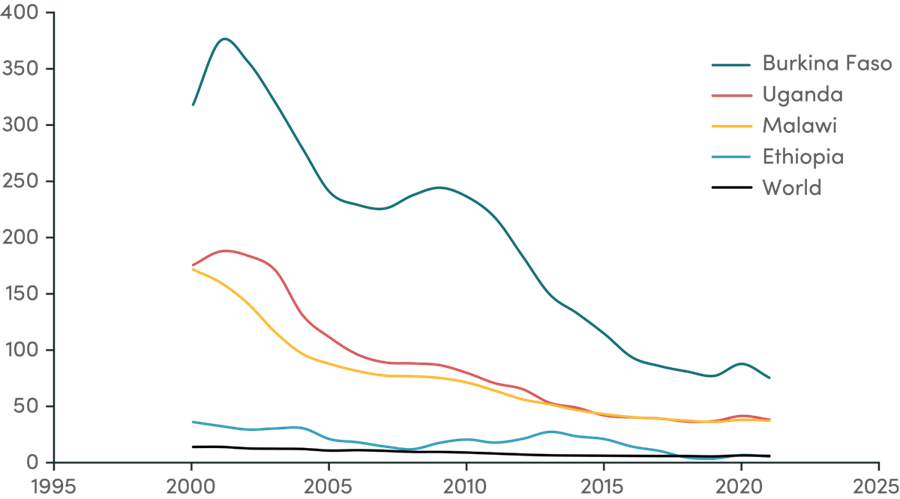
Since 1962, 48 previously malaria-endemic countries have eliminated malaria. El Salvador, China, Azerbaijan, Tajikistan, Belize, Cabo Verde, Egypt, Georgia, Suriname, and Timor-Leste have been certified malaria-free just since 2020. The remaining malaria burden is significantly concentrated in IDA countries in Africa (the region accounts for 95 percent of deaths).
As recently as 2008, malaria eradication was considered impossible with existing technologies, but in 2015, the heads of state from both Asia and Africa agreed targets to eliminate the disease in their regions, and the WHO declared a goal of a world free of malaria. Next-generation insecticide-treated nets are arriving as resistance to traditional treated nets is growing, vaccines are being rolled out in endemic countries, and new anti-malarials are in the pipeline along with gene drive technology that might reduce the number of mosquitoes or the risk they pass on malaria.
Successful elimination programs have seen dramatic and rapid progress: halving the number of cases each year and achieving zero cases within 12 years. In addition, the fight against malaria has the advantage that even if a global eradication goal is not met, elimination can certainly still be achieved in many more countries.
The economic benefits of elimination are estimated to be many multiples of the costs involved. A dated estimate is that the cost of an eradication effort might be $120 billion over 25 years. This investment might save an estimated 11 million lives over that period and provide approximately $2 trillion in benefits through productivity gains and health savings. Annual costs might be $9 billion by 2030.
Figure 1. Death rate from malaria per 100,000 people
Source: Our World in Data
While not as concentrated in IDA countries as malaria, HIV is still significantly over-represented in IDA countries in Africa (the region accounts for about two-thirds of the global burden). The G20 could support a global goal to end AIDS as a public health threat by 2030: a 90 percent reduction in HIV incidence and mortality by 2030 compared to 2010 levels. It might cost a total of $14 billion a year for low-income and lower-middle income countries, of which about half of spending would be in low-income countries. This would require reversing recent funding cuts but also focusing funding where it is needed most.
A G20 commitment toward more rapid progress against HIV and malaria should involve increased commitments to the Global Fund (which combats HIV, TB, and malaria) alongside bilateral support for combating the diseases. It should also involve greater global cooperation on technological advances toward vaccines, prophylactics, and affordable treatments. A G20 working group might propose more specific measures.
Technology
Low-income countries account for 0.4 percent of the global (market) economy. Such a small, poor market is not attractive to innovators and researchers, and LICs cannot afford to support significant research of their own. That combination means that technological challenges specific to poor countries are considerably under-researched, and solutions under-developed. Examples include diseases of poor countries like malaria, but also crops largely grown in poorer countries, off-grid technologies for energy, water, and sanitation, low-cost technologies to improve low-volume rural road quality, SMS-based service delivery, and capital-saving production technologies.
The G20 should support directed open access technology research into these issues and potentially back a new global institution dedicated to research, development, and rollout of such technologies. This could involve a permanent commission made up of representatives of developing countries, development organizations, and scientific experts to identify potential innovations for challenges that are neglected, tractable, and high impact, in that they would (i) ameliorate or help solve significant development challenges specific to or considerably concentrated in IDA countries where incentives to research solutions are limited, and (ii) would require comparatively small additional research and development steps to bring to market. The commission would be supported by a new global research institution that would design and finance research initiatives, pilots, trials, patent buyouts, prizes, and advance market commitments in the areas selected. It could work in part through supporting existing sector-specific initiatives, including the Drugs for Neglected Diseases Initiative and CGIAR.
Security
The G20 has been notably silent on security issues in the past, but low incomes and civil conflict are mutually reinforcing. The incidence of civil war approximately halves between the poorest countries and countries at the 20th percentile of the global distribution of GDP per capita. As well as the G20’s direct interest in reducing the global security threats presented by fragile and conflict-affected states, reducing the prevalence of civil conflict is a vital part of any mission to lift all countries out of low-income status. G20 countries, which include nearly all of the world’s major arms exporters, could agree to limit weapons transfers to LICs—this might include specific categories of weapons or ammunition, or (building on the Arms Trade Treaty) mechanisms to move to a general prohibition under UN Security Council guidance. In addition, the G20 could commit to prioritizing full funding and participation in UN Peacekeeping operations in the poorest countries.
Aid
In the area of grant and concessional assistance, the G20 could agree to better coordination and transparency, potentially building off measures such as Financing for International Development to create a comparable measure of the grant equivalent of real flows to developing countries that might replace the ODA measure.
The G20 could also agree to target assistance to low-income countries. The practical and ethical case for focusing aid on the poorest countries where it can make the most difference is strong, even if the question of how to use that assistance will vary considerably by country—not least the choice between working with governments and working around them.
The Doha Programme of Action agreed in 2022 to target greater assistance to LDCs. The G20 could lead by committing support to international institutions that target IDA countries, including IDA itself and Gavi. Using the coefficients on IDA aid effectiveness from World Bank research, the Zero LICs by 2040 agenda, which suggests targeting a 3.5 percent growth rate across LICs as a whole (up from 0.1 percent today), would naively imply raising the ODA/GNI ratio by 10 percent, or about a 40 percent increase from the 2020 level of ODA to LICs.
This refocusing could be part of a broader G20 assistance effectiveness agenda that prioritizes multilateral channels and country-programmable assistance rather than transactions-heavy small bilateral country programs supporting off-budget projects.
In order to expand resources for debt relief and development in LICs, the G20 could back sales of a part of the IMF’s 90.5 million ounces of gold, valued on its books at a few percentage points of its current value. It could currently generate $10 billion through sales of less than 7 percent of its holdings. The G20 could also relieve pressure on grant and concessional resources for LICs by greater use of debt finance for richer countries and global public goods—potentially through MDB capital increases, bilateral lending programs, and reforms toward greater use of loans by international organizations including the Global Fund.
The G20 could also follow up on the successful sponsorship of capital adequacy work at the MDBs with a commission on simplifying access to and use of MDB financing to reduce loan processing times and associated burdens.
[1] It currently includes: Algeria, Angola, Bolivia, Bulgaria, Cameroon, Côte d'Ivoire, Democratic Republic of Congo, Haiti, Kenya, Laos, Lebanon, Monaco, Namibia, Nepal, South Sudan, Syria, Venezuela, Vietnam, Virgin Islands (UK) and Yemen.
Topics
CITATION
Kenny, Charles. 2026. G20 Policies to Improve Development Prospects in Low-Income Countries. Center for Global Development.DISCLAIMER & PERMISSIONS
CGD's publications reflect the views of the authors, drawing on prior research and experience in their areas of expertise. CGD is a nonpartisan, independent organization and does not take institutional positions. You may use and disseminate CGD's publications under these conditions.
Thumbnail image by: Natasha Elkington/CIFOR