

Lead poisoning affects one in three children globally but receives much less attention and funding than comparable health threats. CGD is working to change this by bringing together researchers, policymakers, and funders to identify research gaps, propose solutions, and ensure that evidence is turned into action. The result has been a significant increase in international funding to mitigate the burden of lead poisoning and greater efforts at the country level to measure and reduce children’s exposure to lead.
The challenge
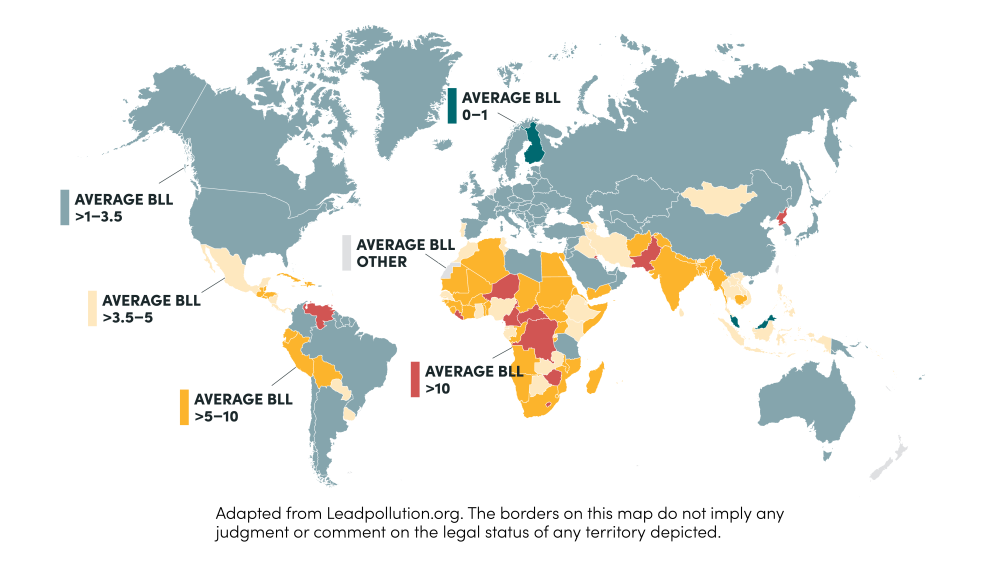
One in three children worldwide has unsafe blood lead levels (BLL), nearly all in low- and middle-income countries. Despite its prevalence, lead poisoning remains one of the most neglected threats to children's health and learning. Lead permanently damages children's brains, affects behavior and educational attainment, and raises the risk of heart disease in adulthood, with economic costs running into the trillions of dollars. Yet until recently, philanthropic funding for lead poisoning was just $10 million to $15 million a year, a fraction of what is directed to comparable threats like malaria and tuberculosis. Closing this gap requires translating evidence on lead poisoning into recommendations that funders and policymakers will act on.
What we did
In 2022, CGD convened a working group of experts to better understand and mitigate the global burden of lead poisoning and its impact on development. From June 2022 to October 2023, the working group brought together leading environmental health experts and representatives of major implementing organizations, alongside newcomers to the field, including the World Bank, the Asian Development Bank, and Bloomberg Philanthropies. The group focused on three priorities: synthesizing the evidence on the scale and cost of lead exposure; putting that evidence in front of the philanthropists and agencies able to fund a response; and identifying the highest-value research gaps where new evidence could shape funding and policy decisions. In its final statement, the working group found that childhood lead poisoning is a major but neglected global development challenge, estimating that just $350 million in development assistance through 2030, or $50 million a year, could mobilize scaled action in low- and middle-income countries.
Building on the working group’s findings, CGD experts have continued to convene a broad coalition of multidisciplinary experts to connect researchers and funders around a shared evidence base. Monthly meetings bring together up to 150 researchers and practitioners from 40 countries, helping those working in the field to compare methods and spot common bottlenecks. In one recent meeting, a World Bank presentation on Indonesia’s national blood lead survey examined the tradeoff between measurement precision and sample representativeness when choosing blood lead testing tools.
What we helped achieve
By 2025, the field looked quite different—due in part to the ongoing research and outreach of CGD experts. The Lead Exposure Action Fund brought $100 million from 13 philanthropists to the issue, and 14 institutions represented in the CGD working group joined the newly established Partnership for a Lead-Free Future, which was supporting 30 countries at different stages of their lead surveillance, source identification, and mitigation. In June 2025, CGD hosted the First Annual Conference on Global Lead Exposure in Washington, DC, bringing together more than 100 researchers, policymakers, funders, and people doing the work on the ground.
Momentum continued to build through 2025 and into 2026, with several organizations represented in the CGD working group committing to tackling lead exposure. On the global stage, the World Health Assembly passed a resolution calling for a Global Action Plan on Lead Mitigation to be presented in 2027, intended as a common framework for countries to address lead. The WHO also used CGD’s Second Annual Conference on Global Lead Exposure in 2026 to gather feedback on its forthcoming technical package. And at a high-level event during the UN General Assembly, evidence from CGD experts featured in discussions about where the growing international effort should focus next. CGD researchers also helped carry the issue into wider public and development media, including The Guardian, Devex, and NPR.
On the funding side, Bloomberg Philanthropies committed $250 million to preventing childhood lead exposure. Its announcement drew on CGD’s research on the huge scale of lead exposure's impacts on children’s learning. Progress was also made at the regional level: the Asian Development Bank published its first operational approach to achieving a lead-free future in Asia and the Pacific, setting out how it will address lead through its safeguards, hazardous-waste work, and health programs.
The most encouraging signs of progress are happening on the ground in affected countries. By late 2025, 20 national blood lead surveys were planned or underway, compared with just seven completed over the previous decade. CGD researchers have directed funding towards new field studies testing different solutions in Bangladesh, Botswana, Cameroon, Ethiopia, Ghana, India, and Mexico. CGD researchers are currently testing alongside Pure Earth in Ghana whether replacing household products containing lead, like cookware and eyeliners, with lead-free alternatives can reduce blood lead levels (BLLs). Surveys are not an outcome in themselves. But countries cannot remove their biggest sources of lead if they do not know how many children are exposed or where the exposure is coming from.
The progress made in 2025 belongs to a much wider community, including Coefficient Giving, Pure Earth, LEEP, Vital Strategies, Stanford University, WHO, UNICEF, the World Bank, and many others. CGD experts helped make the evidence legible, identify unanswered questions, and create spaces where researchers, funders, and implementers could work through them together.
What’s next
Funding commitments only matter if they translate into less lead in children's blood. CGD researchers are now focusing on converting new funding and momentum into the evidence needed to drive country-level action. They continue to convene the field through an annual lead conference and, in 2025 and 2026, advised directly on research funding decisions with Coefficient Giving through two rounds of grantmaking. These grants aim to generate new evidence on the questions that matter to policymakers: which exposure sources matter most, and which interventions work at what cost. Continued and expanded support for the Lead Exposure Action Fund, and for translating its findings into national policy, is where further philanthropic investment would go furthest.
Related Work
Support More Work Like This.
Your contribution makes it possible for the Center’s researchers to devise practical, evidence-based solutions for today’s most pressing development challenges.