

Non-communicable diseases could account for three-quarters of all deaths worldwide by 2030, with most in low- and middle-income countries. To address this challenge, CGD served as the secretariat of the Task Force on Fiscal Policy for Health, helping strengthen the evidence base for taxes on tobacco, alcohol, and sugary drinks, which contribute to these diseases. With major global conferences on the calendar and aid cuts creating an urgent need for countries to raise domestic resources, 2025 was a key year for health taxes. CGD capitalized on this moment through a year-long effort with its task force partners, helping secure health tax language in three major global declarations.
The challenge
By 2030, non-communicable diseases (NCDs) such as cancer, heart disease, and diabetes are expected to account for three out of every four deaths worldwide, with most occurring in low- and middle-income countries. Unhealthy products like tobacco, alcohol, and sugary drinks fuel this crisis. Taxes on these goods (“health taxes”) reduce consumption, thereby improving health and saving lives, while also raising much-needed revenue for countries. But despite these benefits, health taxes have been underused as a policy tool.
What we did
In 2024, a group of influential leaders including Michael Bloomberg and Mia Amor Mottley reconvened the Task Force on Fiscal Policy for Health to address the global burden of NCDs. First convened in 2019 with CGD support, the task force set out to review the evidence and encourage countries to significantly raise health taxes. As the task force’s secretariat, CGD helped shape its 2024 high-level report, strengthening the evidence base for health taxes.
A window for action on health taxes opened in 2025. Several key global conferences and declarations took place that year, including the fourth International Conference on Financing for Development (FfD), held only once every five years, and the fourth UN General Assembly (UNGA) High-Level Meeting on NCDs, convened after a seven-year gap. At the same time, countries were experiencing health financing shocks following cuts to international aid and were urgently seeking new sources of domestic revenue. Health taxes could be positioned as one such source—a quick and effective way to raise revenue without harming economic growth.
Capitalizing on this moment, CGD experts launched a year-long effort to bring the task force’s findings to national governments and international organizations. The first part of this strategy focused on raising public awareness of the health and economic benefits of health taxes. CGD experts worked with select task force members to produce op-eds presenting the evidence for health taxes as a tool to quickly raise revenue. To reach audiences in Latin America, Mauricio Cardenas and Andres Velasco, former finance ministers in South America, wrote for El Pais (in Spanish and English). To reach the international financial institutions, Minouche Shafik and Masood Ahmed, task force members with previous IMF leadership experience, made the case in the IMF’s Finance & Development magazine. And to reach audiences in low- and middle-income countries across the globe, Gordon Brown, former UK prime minister and World Health Organization Ambassador for Global Health Financing, wrote for Project Syndicate.
Beyond the public domain, CGD experts held private briefings with policymakers and civil servants on the evidence for health taxes as a means of boosting revenue and improving health. They worked with delegates at global convenings to develop and propose health tax language to add to influential global declarations. To widen the scope of this outreach, they partnered with multilateral organizations such as the World Health Organization (WHO), the United Nations Development Programme, and the World Bank, and with civil society organizations such as Vital Strategies, Economics for Health, and the Campaign for Tobacco Free Kids. They collaborated on research; coordinated outreach to policymakers, including briefing the Mexican parliament as part of a local NGO’s effort to support new health tax legislation; and worked with partners to disseminate findings. This collaboration was formalized through CGD experts’ engagement in the Inter-Agency Working Group on Health Taxes.
What we helped achieve
Through these public and private efforts, CGD experts helped ensure that language supporting health taxes was included in three major global declarations in 2025: the World Health Assembly’s resolution on strengthening health financing, the FfD outcome document, and the political declaration of the UNGA High-Level Meeting on NCDs. This language cements health taxes as a policy option for countries looking to improve health and raise revenue and provides a strong foundation for health tax advocates in the future.
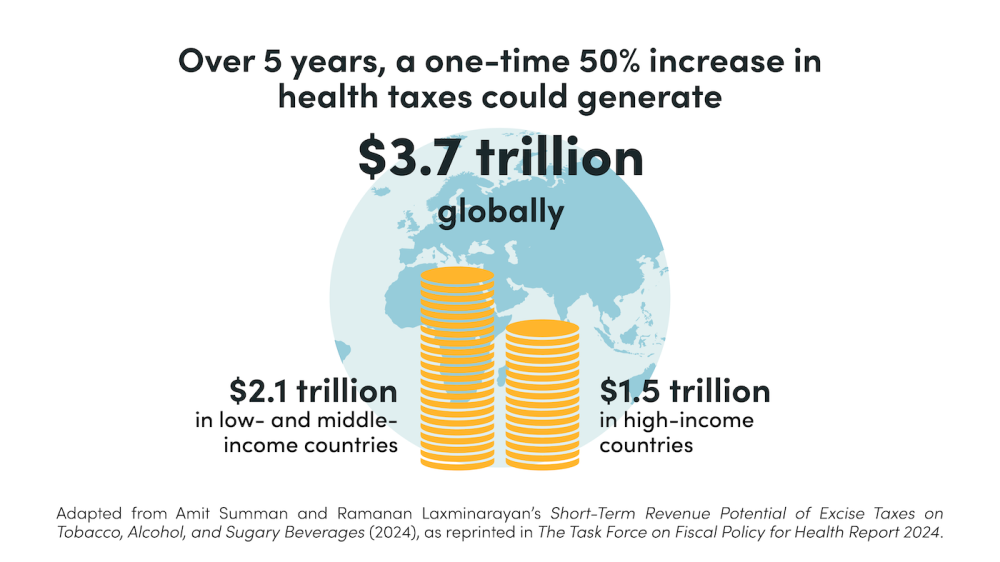
At the country level, CGD experts helped translate the global momentum on health taxes into increased local attention. Policymakers in Barbados referenced the task force report when introducing new health taxes in their 2025 Budgetary Proposals and Financial Statement. CGD experts also supported the development of the WHO-led 3 by 35 Initiative, which seeks to help countries increase taxes on tobacco, alcohol, and sugary beverages by 2035. CGD experts collaborated with the WHO to launch the initiative through a public CGD webinar featuring task force member N. K. Singh, CGD board member Mary-Ann Etiebet, and representatives from WHO and the government of Ethiopia. The initiative launch was widely covered in local media in many low- and middle-income countries, and advocates continue to rely on it to press their governments to act.
CGD’s work with the task force helped to ensure that 2025 was a pivotal year for raising global recognition of the economic benefits of health taxes, particularly in the wake of aid cuts. This momentum is reflected in the number of countries that increased health taxes in 2025. In Africa alone, 12 countries, with a combined population of 385 million (roughly a quarter of the continent’s population), introduced higher health taxes in 2025.
What’s next
Moving forward, CGD experts will focus on encouraging multilateral institutions to build and strengthen their health tax programs so they can better support countries in improving policy. CGD experts are working with the Africa Centres for Disease Control and Prevention, the IMF, and the Asian Development Bank to identify strategies for supporting countries seeking to save lives and raise revenue through health taxes.
Support More Work Like This.
Your contribution makes it possible for the Center’s researchers to devise practical, evidence-based solutions for today’s most pressing development challenges.